Event submissions
Published
This submission belongs to the session S3. Inorganic Crystalline Materials of the event The 4th International Online Conference on Crystals
Published date
18 Sep, 2024
Academic Editor
'%3e%3cpath%20d='M12.6657%2010.9104C12.4185%2010.325%2012.0599%209.79327%2011.6097%209.34482C11.1609%208.89508%2010.6293%208.5365%2010.0442%208.28888C10.0389%208.28626%2010.0337%208.28495%2010.0285%208.28233C10.8446%207.69279%2011.3752%206.73249%2011.3752%205.64904C11.3752%203.8542%209.92103%202.39999%208.1262%202.39999C6.33136%202.39999%204.87715%203.8542%204.87715%205.64904C4.87715%206.73249%205.40774%207.69279%206.22393%208.28364C6.21869%208.28626%206.21345%208.28757%206.20821%208.29019C5.62129%208.5378%205.09463%208.89284%204.64265%209.34613C4.1929%209.79493%203.83432%2010.3266%203.58671%2010.9117C3.34345%2011.4845%203.21226%2012.0987%203.20023%2012.7209C3.19988%2012.7349%203.20233%2012.7488%203.20744%2012.7619C3.21255%2012.7749%203.22022%2012.7867%203.22998%2012.7968C3.23975%2012.8068%203.25142%2012.8147%203.26431%2012.8202C3.2772%2012.8256%203.29105%2012.8284%203.30504%2012.8284H4.09109C4.14874%2012.8284%204.19459%2012.7825%204.1959%2012.7262C4.2221%2011.7148%204.62823%2010.7676%205.34617%2010.0497C6.08899%209.30683%207.0755%208.89808%208.1262%208.89808C9.17689%208.89808%2010.1634%209.30683%2010.9062%2010.0497C11.6242%2010.7676%2012.0303%2011.7148%2012.0565%2012.7262C12.0578%2012.7838%2012.1037%2012.8284%2012.1613%2012.8284H12.9474C12.9613%2012.8284%2012.9752%2012.8256%2012.9881%2012.8202C13.001%2012.8147%2013.0126%2012.8068%2013.0224%2012.7968C13.0322%2012.7867%2013.0398%2012.7749%2013.0449%2012.7619C13.0501%2012.7488%2013.0525%2012.7349%2013.0522%2012.7209C13.0391%2012.0947%2012.9094%2011.4855%2012.6657%2010.9104ZM8.1262%207.9024C7.52486%207.9024%206.9589%207.6679%206.53312%207.24211C6.10733%206.81633%205.87283%206.25037%205.87283%205.64904C5.87283%205.0477%206.10733%204.48174%206.53312%204.05596C6.9589%203.63018%207.52486%203.39567%208.1262%203.39567C8.72753%203.39567%209.29349%203.63018%209.71927%204.05596C10.1451%204.48174%2010.3796%205.0477%2010.3796%205.64904C10.3796%206.25037%2010.1451%206.81633%209.71927%207.24211C9.29349%207.6679%208.72753%207.9024%208.1262%207.9024Z'%20fill='%235D1EE1'/%3e%3c/g%3e%3c/svg%3e) Vladimir Fedin
Vladimir FedinCitation
Vasilios Raptis, Chemical Equitable Partitions of Inorganic Lattices, in Proceedings of The 4th International Online Conference on Crystals, 18 September–20 September 2024, MDPI: Basel, Switzerland
Share
Email
Facebook
Twitter
LinkedIn
Chemical Equitable Partitions of Inorganic Lattices

Vasilios Raptis 1
1. Department of Computer Science and Engineering, School of Sciences, European University Cyprus, 6 Diogenes str., Nicosia 2404, Cyprus
Abstract
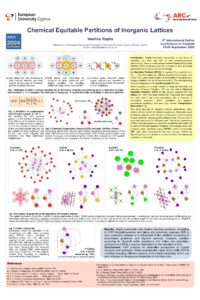
Introduction. Graph-theoretical approaches in the study of materials can shed new light on their structure--property relationships. Here, a novel concept termed Chemical Equitable Partition (CEP) [1,2] was used as a means to look at crystal symmetries and classify atoms accordingly.
Methods. The study focused on inorganic perovskites and oxides, without partial or mixed occupancies. Atom pairs were marked as adjacent when the sum of the atoms’ radii exceeded the pair distance, respecting unit-cell periodicity. Atom radii proposed by Alvarez [3] were used (occasionally rescaled to reproduce coordination numbers). The atoms’ connectivity profiles were processed as described by Michos and Raptis [1] to derive Chemical Equitable Partitions. Electrostatic lattice site potentials were calculated using VESTA’s [4] built-in functionality. CEP cells were compared to the atom groups defined by Wyckoff positions, on the one hand, and site potentials, on the other.
Results. Highly symmetric cells featured identical partitions, according to CEP, Wyckoff positions, and Madelung potentials, whereas CEP in systems with lower symmetry was a refinement of the partitions with respect to electrostatic potentials and Wyckoff positions.
Conclusions. CEP provides an alternative perspective on crystal structure and symmetry. Forthcoming research will specify how CEP seamlessly incorporates organic moieties, as found in hybrid organic/inorganic crystals, within a unifying framework.
References
1. I. Michos, V. Raptis. Graph Partitions in Chemistry. Entropy 2023, 25 (11), 1504.
2. V. Raptis, A. Kaltzoglou. Graph Theoretical Analysis as an Aid in the Elucidation of Structure-Property Relations of Perovskite Materials. AIP Conf Proc 2024, 3030 (1), 110005.
3. S. Alvarez. A cartography of the van der Waals territories. Dalton Trans 2013, 42, 8617–8635.
4. K. Momma, F. Izumi. VESTA 3 for three-dimensional visualization of crystal, volumetric and morphology data. J Appl Crystallogr 2011, 44, 1272-1276.
Keywords
Equitable partitions
inorganic crystals
Wyckoff positions
Madelung potentials
crystal symmetry
Poster
Raptis-poster-IOCC2024-v.2.pdf
Crystal structure determination and Hirshfeld surface analysis of C17H11N3O azo compound.
Exploring the Impact of Edge and Surface Sites on Functionalized Graphene-based Membrane in H2S Adsorption: A Computational Study