Event submissions
Published
This submission belongs to the session S3. Inorganic Crystalline Materials of the event The 4th International Online Conference on Crystals
Published date
18 Sep, 2024
Academic Editor
'%3e%3cpath%20d='M12.6657%2010.9104C12.4185%2010.325%2012.0599%209.79327%2011.6097%209.34482C11.1609%208.89508%2010.6293%208.5365%2010.0442%208.28888C10.0389%208.28626%2010.0337%208.28495%2010.0285%208.28233C10.8446%207.69279%2011.3752%206.73249%2011.3752%205.64904C11.3752%203.8542%209.92103%202.39999%208.1262%202.39999C6.33136%202.39999%204.87715%203.8542%204.87715%205.64904C4.87715%206.73249%205.40774%207.69279%206.22393%208.28364C6.21869%208.28626%206.21345%208.28757%206.20821%208.29019C5.62129%208.5378%205.09463%208.89284%204.64265%209.34613C4.1929%209.79493%203.83432%2010.3266%203.58671%2010.9117C3.34345%2011.4845%203.21226%2012.0987%203.20023%2012.7209C3.19988%2012.7349%203.20233%2012.7488%203.20744%2012.7619C3.21255%2012.7749%203.22022%2012.7867%203.22998%2012.7968C3.23975%2012.8068%203.25142%2012.8147%203.26431%2012.8202C3.2772%2012.8256%203.29105%2012.8284%203.30504%2012.8284H4.09109C4.14874%2012.8284%204.19459%2012.7825%204.1959%2012.7262C4.2221%2011.7148%204.62823%2010.7676%205.34617%2010.0497C6.08899%209.30683%207.0755%208.89808%208.1262%208.89808C9.17689%208.89808%2010.1634%209.30683%2010.9062%2010.0497C11.6242%2010.7676%2012.0303%2011.7148%2012.0565%2012.7262C12.0578%2012.7838%2012.1037%2012.8284%2012.1613%2012.8284H12.9474C12.9613%2012.8284%2012.9752%2012.8256%2012.9881%2012.8202C13.001%2012.8147%2013.0126%2012.8068%2013.0224%2012.7968C13.0322%2012.7867%2013.0398%2012.7749%2013.0449%2012.7619C13.0501%2012.7488%2013.0525%2012.7349%2013.0522%2012.7209C13.0391%2012.0947%2012.9094%2011.4855%2012.6657%2010.9104ZM8.1262%207.9024C7.52486%207.9024%206.9589%207.6679%206.53312%207.24211C6.10733%206.81633%205.87283%206.25037%205.87283%205.64904C5.87283%205.0477%206.10733%204.48174%206.53312%204.05596C6.9589%203.63018%207.52486%203.39567%208.1262%203.39567C8.72753%203.39567%209.29349%203.63018%209.71927%204.05596C10.1451%204.48174%2010.3796%205.0477%2010.3796%205.64904C10.3796%206.25037%2010.1451%206.81633%209.71927%207.24211C9.29349%207.6679%208.72753%207.9024%208.1262%207.9024Z'%20fill='%235D1EE1'/%3e%3c/g%3e%3c/svg%3e) Alessandra Toncelli
Alessandra ToncelliCitation
Alessandra Fantasia, Valentina Mameli, Marco Sanna Angotzi, Francesca Perra, Fausto Secci, Stefano Enzo, Carla Cannas, As V AND AsIII REMOVAL FROM WATER BY DIFFERENT IRON OXYHYDROXIDES NANOSORBENTS, in Proceedings of The 4th International Online Conference on Crystals, 18 September–20 September 2024, MDPI: Basel, Switzerland
Share
Email
Facebook
Twitter
LinkedIn
As V AND AsIII REMOVAL FROM WATER BY DIFFERENT IRON OXYHYDROXIDES NANOSORBENTS
'%3e%3cpath%20d='M12.6647%2010.9104C12.4176%2010.325%2012.0589%209.7933%2011.6088%209.34485C11.16%208.89511%2010.6283%208.53653%2010.0432%208.28891C10.038%208.28629%2010.0327%208.28498%2010.0275%208.28236C10.8437%207.69282%2011.3743%206.73252%2011.3743%205.64907C11.3743%203.85423%209.92005%202.40002%208.12522%202.40002C6.33038%202.40002%204.87618%203.85423%204.87618%205.64907C4.87618%206.73252%205.40677%207.69282%206.22296%208.28367C6.21772%208.28629%206.21248%208.2876%206.20724%208.29022C5.62031%208.53783%205.09365%208.89287%204.64167%209.34616C4.19192%209.79496%203.83334%2010.3266%203.58573%2010.9117C3.34247%2011.4846%203.21128%2012.0987%203.19925%2012.721C3.1989%2012.735%203.20135%2012.7489%203.20646%2012.7619C3.21157%2012.7749%203.21924%2012.7868%203.22901%2012.7968C3.23877%2012.8068%203.25045%2012.8148%203.26334%2012.8202C3.27623%2012.8256%203.29007%2012.8284%203.30406%2012.8284H4.09012C4.14776%2012.8284%204.19362%2012.7825%204.19493%2012.7262C4.22113%2011.7148%204.62726%2010.7676%205.34519%2010.0497C6.08802%209.30686%207.07452%208.89811%208.12522%208.89811C9.17592%208.89811%2010.1624%209.30686%2010.9052%2010.0497C11.6232%2010.7676%2012.0293%2011.7148%2012.0555%2012.7262C12.0568%2012.7839%2012.1027%2012.8284%2012.1603%2012.8284H12.9464C12.9604%2012.8284%2012.9742%2012.8256%2012.9871%2012.8202C13%2012.8148%2013.0117%2012.8068%2013.0214%2012.7968C13.0312%2012.7868%2013.0389%2012.7749%2013.044%2012.7619C13.0491%2012.7489%2013.0515%2012.735%2013.0512%2012.721C13.0381%2012.0947%2012.9084%2011.4856%2012.6647%2010.9104ZM8.12522%207.90243C7.52388%207.90243%206.95792%207.66793%206.53214%207.24215C6.10636%206.81636%205.87185%206.2504%205.87185%205.64907C5.87185%205.04773%206.10636%204.48177%206.53214%204.05599C6.95792%203.63021%207.52388%203.3957%208.12522%203.3957C8.72655%203.3957%209.29252%203.63021%209.7183%204.05599C10.1441%204.48177%2010.3786%205.04773%2010.3786%205.64907C10.3786%206.2504%2010.1441%206.81636%209.7183%207.24215C9.29252%207.66793%208.72655%207.90243%208.12522%207.90243Z'%20fill='%235D1EE1'/%3e%3c/g%3e%3c/svg%3e)
Alessandra Fantasia 1
Valentina Mameli 1
Marco Sanna Angotzi 1
Francesca Perra 1
Fausto Secci 1
Stefano Enzo 2
Carla Cannas 1
1. Department of Chemical and Geological Sciences, University of Cagliari, Cagliari, Italy
2. Department of Chemistry and Pharmacy, University of Sassari, Via Vienna 2, 07100 Sassari, Italy
Abstract
Introduction
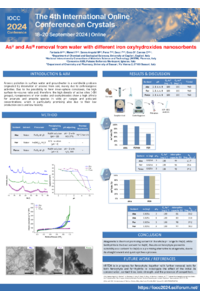
Arsenic pollution in surface water and groundwater is a worldwide problem originated by dissolution of arsenic from soil, mainly due to anthropogenic activities. Due to the possibility to form inner-sphere complexes, the high surface-to-volume ratio and, therefore, the high density of active sites (-OH groups), nanopowders of iron oxides and oxyhydroxides show a high affinity for arsenate and arsenite species in wide pH ranges and pollutant concentrations.
Methods
Akaganeite (β-FeOOH), ferrihydrite (Fe5HO8·4H2O), and feroxyhyte (δ-FeOOH) were synthesized by simple precipitation methods and tested for the removal of arsenic from water by changing different parameters (initial concentration, contact time, ionic strength, presence of competing ions and solid to liquid ratio). The same experimental conditions for the batch tests allowed a direct comparison between the adsorbents. All sorbents were characterized by XRD, TEM and HRTEM, N2-physisorption, ELS, TGA,ATR-FTIR.
Results
Thanks to its high and positive surface charge, akaganeite is found to be the most promising sorbent in the whole pH range for As(V) (adsorption capacity equal to 99% for CAs = 100 mg/L); it also shows good adsorption capacity for As(III) (81% and 83% for pH 3 and pH 8 respectively at 100 mg/L,). The best sorbent for As(III) is, however, ferrihydrite (98% at 100 mg/L for both pH 3 and pH 8), due to its high surface area. Preliminary results on feroxyhyte prove its suitability as a sorbent for As(V) (92% at 100 mg/L for pH 3).
Conclusions
Akaganeite is the most promising sorbent in the whole pH range for As(V), while ferrihydrite is the best sorbent for As(III). Results on feroxyhyte proved its suitability as a sorbent for As(V) as a promising alternative to akageneite, due to its straightforward and quick synthesis process.
Keywords
Arsenic pollution
iron oxyhydroxides
nanosorbents
Poster
IOCC2024_Fantasia.pdf
Exploring the Impact of Edge and Surface Sites on Functionalized Graphene-based Membrane in H2S Adsorption: A Computational Study
Data-led analysis and feature-based modelling of critical phases in the dissimilar welding of duplex stainless steel