Event submissions
Published
This submission belongs to the session S3. Inorganic Crystalline Materials of the event The 4th International Online Conference on Crystals
Published date
18 Sep, 2024
Academic Editor
'%3e%3cpath%20d='M12.6657%2010.9104C12.4185%2010.325%2012.0599%209.79327%2011.6097%209.34482C11.1609%208.89508%2010.6293%208.5365%2010.0442%208.28888C10.0389%208.28626%2010.0337%208.28495%2010.0285%208.28233C10.8446%207.69279%2011.3752%206.73249%2011.3752%205.64904C11.3752%203.8542%209.92103%202.39999%208.1262%202.39999C6.33136%202.39999%204.87715%203.8542%204.87715%205.64904C4.87715%206.73249%205.40774%207.69279%206.22393%208.28364C6.21869%208.28626%206.21345%208.28757%206.20821%208.29019C5.62129%208.5378%205.09463%208.89284%204.64265%209.34613C4.1929%209.79493%203.83432%2010.3266%203.58671%2010.9117C3.34345%2011.4845%203.21226%2012.0987%203.20023%2012.7209C3.19988%2012.7349%203.20233%2012.7488%203.20744%2012.7619C3.21255%2012.7749%203.22022%2012.7867%203.22998%2012.7968C3.23975%2012.8068%203.25142%2012.8147%203.26431%2012.8202C3.2772%2012.8256%203.29105%2012.8284%203.30504%2012.8284H4.09109C4.14874%2012.8284%204.19459%2012.7825%204.1959%2012.7262C4.2221%2011.7148%204.62823%2010.7676%205.34617%2010.0497C6.08899%209.30683%207.0755%208.89808%208.1262%208.89808C9.17689%208.89808%2010.1634%209.30683%2010.9062%2010.0497C11.6242%2010.7676%2012.0303%2011.7148%2012.0565%2012.7262C12.0578%2012.7838%2012.1037%2012.8284%2012.1613%2012.8284H12.9474C12.9613%2012.8284%2012.9752%2012.8256%2012.9881%2012.8202C13.001%2012.8147%2013.0126%2012.8068%2013.0224%2012.7968C13.0322%2012.7867%2013.0398%2012.7749%2013.0449%2012.7619C13.0501%2012.7488%2013.0525%2012.7349%2013.0522%2012.7209C13.0391%2012.0947%2012.9094%2011.4855%2012.6657%2010.9104ZM8.1262%207.9024C7.52486%207.9024%206.9589%207.6679%206.53312%207.24211C6.10733%206.81633%205.87283%206.25037%205.87283%205.64904C5.87283%205.0477%206.10733%204.48174%206.53312%204.05596C6.9589%203.63018%207.52486%203.39567%208.1262%203.39567C8.72753%203.39567%209.29349%203.63018%209.71927%204.05596C10.1451%204.48174%2010.3796%205.0477%2010.3796%205.64904C10.3796%206.25037%2010.1451%206.81633%209.71927%207.24211C9.29349%207.6679%208.72753%207.9024%208.1262%207.9024Z'%20fill='%235D1EE1'/%3e%3c/g%3e%3c/svg%3e) Alessandra Toncelli
Alessandra ToncelliCitation
Rosalía González-Brito, Pablo Montenegro, Alicia Méndez, Ramtin E. Shabgahi, Alberto Pasquarelli, Ricardo Borges, Use of boron-doped nanocrystalline diamond microelectrodes for amperometric determination of serotonin release in human platelets, in Proceedings of The 4th International Online Conference on Crystals, 18 September–20 September 2024, MDPI: Basel, Switzerland
Share
Email
Facebook
Twitter
LinkedIn
Use of boron-doped nanocrystalline diamond microelectrodes for amperometric determination of serotonin release in human platelets
'%3e%3cpath%20d='M12.6647%2010.9104C12.4176%2010.325%2012.0589%209.7933%2011.6088%209.34485C11.16%208.89511%2010.6283%208.53653%2010.0432%208.28891C10.038%208.28629%2010.0327%208.28498%2010.0275%208.28236C10.8437%207.69282%2011.3743%206.73252%2011.3743%205.64907C11.3743%203.85423%209.92005%202.40002%208.12522%202.40002C6.33038%202.40002%204.87618%203.85423%204.87618%205.64907C4.87618%206.73252%205.40677%207.69282%206.22296%208.28367C6.21772%208.28629%206.21248%208.2876%206.20724%208.29022C5.62031%208.53783%205.09365%208.89287%204.64167%209.34616C4.19192%209.79496%203.83334%2010.3266%203.58573%2010.9117C3.34247%2011.4846%203.21128%2012.0987%203.19925%2012.721C3.1989%2012.735%203.20135%2012.7489%203.20646%2012.7619C3.21157%2012.7749%203.21924%2012.7868%203.22901%2012.7968C3.23877%2012.8068%203.25045%2012.8148%203.26334%2012.8202C3.27623%2012.8256%203.29007%2012.8284%203.30406%2012.8284H4.09012C4.14776%2012.8284%204.19362%2012.7825%204.19493%2012.7262C4.22113%2011.7148%204.62726%2010.7676%205.34519%2010.0497C6.08802%209.30686%207.07452%208.89811%208.12522%208.89811C9.17592%208.89811%2010.1624%209.30686%2010.9052%2010.0497C11.6232%2010.7676%2012.0293%2011.7148%2012.0555%2012.7262C12.0568%2012.7839%2012.1027%2012.8284%2012.1603%2012.8284H12.9464C12.9604%2012.8284%2012.9742%2012.8256%2012.9871%2012.8202C13%2012.8148%2013.0117%2012.8068%2013.0214%2012.7968C13.0312%2012.7868%2013.0389%2012.7749%2013.044%2012.7619C13.0491%2012.7489%2013.0515%2012.735%2013.0512%2012.721C13.0381%2012.0947%2012.9084%2011.4856%2012.6647%2010.9104ZM8.12522%207.90243C7.52388%207.90243%206.95792%207.66793%206.53214%207.24215C6.10636%206.81636%205.87185%206.2504%205.87185%205.64907C5.87185%205.04773%206.10636%204.48177%206.53214%204.05599C6.95792%203.63021%207.52388%203.3957%208.12522%203.3957C8.72655%203.3957%209.29252%203.63021%209.7183%204.05599C10.1441%204.48177%2010.3786%205.04773%2010.3786%205.64907C10.3786%206.2504%2010.1441%206.81636%209.7183%207.24215C9.29252%207.66793%208.72655%207.90243%208.12522%207.90243Z'%20fill='%235D1EE1'/%3e%3c/g%3e%3c/svg%3e)
Rosalía González-Brito 1,2,3
Pablo Montenegro 1,2

Alicia Méndez 1,2
Ramtin E. Shabgahi 4
Alberto Pasquarelli 4

Ricardo Borges 1,2
1. Pharmacology Unit, Medical School, Universidad de La Laguna. Spain
2. Instituto Fundación Teófilo Hernando, Madrid, Spain
3. Organic Chemistry Department, Universidad de La Laguna, Spain
4. Institute of Electron Devices and Circuits, Ulm University, Germany
Abstract
Introduction
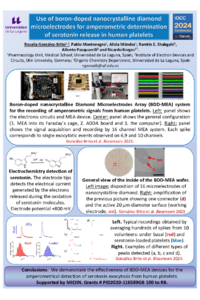
Boron-doped nanocrystalline diamond (BDD) is an outstanding structure, and one of the best materials for high-sensitivity amperometric measurements. Nanocrystalline diamond structures show a high concentration of electrical charge carriers.
Amperometry is a widely used technique for studying the exocytosis of biological amines (dopamine, serotonin, noradrenaline, adrenaline, and histamine), and multielectrode array (MEA) systems have increased the efficiency and speed of amperometric studies.
In human, platelets are the most accessible cells to study the exocytosis of serotonin.
Methods
BDD-MEA fabrication utilizes several processes typical of microelectronics, here including chemical vapor deposition (CVD), optical lithography, metal evaporation, and reactive ion etching (RIE).
We detected amperometric recordings from the quantum release of serotonin from human platelets with boron-doped nanocrystalline diamond on MEA systems (BDD-MEA) of 16 microelectrodes. Our studies were carried out with devices on silicone matrices (BDD-on-silicon MEA)1 and quartz substrates (BDD-on-quartz MEA)2.
Results
Typical amperometric signals were obtained from the release and subsequent oxidation of serotonin molecules stored in platelet vesicles. We carried out and compared the release measurements both under basal conditions and after loading the platelets with 10 µM serotonin for 2 h. In this communication, we show different types of peaks registered in these studies and we present kinetics parameters obtained with both types of MEA systems (maximum oxidation current, spike width at half maximum, spike net charge, and ascending slope of spike).1,2
Conclusions
BDD MEA devices have proven to be effective and biologically compatible in amperometric studies with live platelets. Here, we demonstrate their usefulness in studies of serotonin exocytosis from human platelets.
References.
1 González Brito, R; Montenegro, P; Méndez, A; Carabelli, V; Tomagra, G; Shabgahi, R.E.; Pasquarelli, A.; Borges, R. Biosensors2023, 13, 86.
2 González Brito, R; Montenegro, P; Méndez, A; Shabgahi, R.E.; Pasquarelli, A.; Borges, R. Biosensors2024, 14, 75.
Keywords
Nanocrystalline diamond
Amperometry
Exocytosis: Serotonin
MEA devices
Poster
Poster_ID_096581_Rosalia_Gonzalez_Brito_IOCC2024.pdf
Using Cutting-Edge Architectural Technologies and Creative Materials To Support Smart Building Design Paradigm
ELUCIDATING THE ROLE OF THE O-METHOXY GROUP AT THE LOWER RIM-APPENDED SALICYLIDENEAMINE SUBSTITUENTS OF CALIX[4]ARENE LIGANDS ON THE MOLECULAR AND ELECTRONIC STRUCTURE OF DINUCLEAR Fe(III)-BASED “DIAMOND CORE” COMPLEXES