Event submissions
Published
This submission belongs to the session S5. Hybrid and Composite Crystalline Materials of the event The 4th International Online Conference on Crystals
Published date
18 Sep, 2024
Academic Editor
'%3e%3cpath%20d='M12.6657%2010.9104C12.4185%2010.325%2012.0599%209.79327%2011.6097%209.34482C11.1609%208.89508%2010.6293%208.5365%2010.0442%208.28888C10.0389%208.28626%2010.0337%208.28495%2010.0285%208.28233C10.8446%207.69279%2011.3752%206.73249%2011.3752%205.64904C11.3752%203.8542%209.92103%202.39999%208.1262%202.39999C6.33136%202.39999%204.87715%203.8542%204.87715%205.64904C4.87715%206.73249%205.40774%207.69279%206.22393%208.28364C6.21869%208.28626%206.21345%208.28757%206.20821%208.29019C5.62129%208.5378%205.09463%208.89284%204.64265%209.34613C4.1929%209.79493%203.83432%2010.3266%203.58671%2010.9117C3.34345%2011.4845%203.21226%2012.0987%203.20023%2012.7209C3.19988%2012.7349%203.20233%2012.7488%203.20744%2012.7619C3.21255%2012.7749%203.22022%2012.7867%203.22998%2012.7968C3.23975%2012.8068%203.25142%2012.8147%203.26431%2012.8202C3.2772%2012.8256%203.29105%2012.8284%203.30504%2012.8284H4.09109C4.14874%2012.8284%204.19459%2012.7825%204.1959%2012.7262C4.2221%2011.7148%204.62823%2010.7676%205.34617%2010.0497C6.08899%209.30683%207.0755%208.89808%208.1262%208.89808C9.17689%208.89808%2010.1634%209.30683%2010.9062%2010.0497C11.6242%2010.7676%2012.0303%2011.7148%2012.0565%2012.7262C12.0578%2012.7838%2012.1037%2012.8284%2012.1613%2012.8284H12.9474C12.9613%2012.8284%2012.9752%2012.8256%2012.9881%2012.8202C13.001%2012.8147%2013.0126%2012.8068%2013.0224%2012.7968C13.0322%2012.7867%2013.0398%2012.7749%2013.0449%2012.7619C13.0501%2012.7488%2013.0525%2012.7349%2013.0522%2012.7209C13.0391%2012.0947%2012.9094%2011.4855%2012.6657%2010.9104ZM8.1262%207.9024C7.52486%207.9024%206.9589%207.6679%206.53312%207.24211C6.10733%206.81633%205.87283%206.25037%205.87283%205.64904C5.87283%205.0477%206.10733%204.48174%206.53312%204.05596C6.9589%203.63018%207.52486%203.39567%208.1262%203.39567C8.72753%203.39567%209.29349%203.63018%209.71927%204.05596C10.1451%204.48174%2010.3796%205.0477%2010.3796%205.64904C10.3796%206.25037%2010.1451%206.81633%209.71927%207.24211C9.29349%207.6679%208.72753%207.9024%208.1262%207.9024Z'%20fill='%235D1EE1'/%3e%3c/g%3e%3c/svg%3e) Alessandra Toncelli
Alessandra ToncelliCitation
Angelina Iova, Iuliia Strelnikova, Alexander Ovsyannikov, Igor Litvinov, Andrew Pyataev, Islamov Daut, Svetlana Solovieva, Igor Antipin, ELUCIDATING THE ROLE OF THE O-METHOXY GROUP AT THE LOWER RIM-APPENDED SALICYLIDENEAMINE SUBSTITUENTS OF CALIX[4]ARENE LIGANDS ON THE MOLECULAR AND ELECTRONIC STRUCTURE OF DINUCLEAR Fe(III)-BASED “DIAMOND CORE” COMPLEXES, in Proceedings of The 4th International Online Conference on Crystals, 18 September–20 September 2024, MDPI: Basel, Switzerland
Share
Email
Facebook
Twitter
LinkedIn
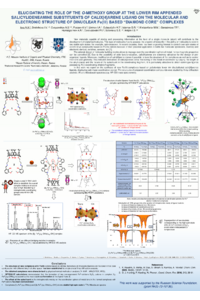
ELUCIDATING THE ROLE OF THE O-METHOXY GROUP AT THE LOWER RIM-APPENDED SALICYLIDENEAMINE SUBSTITUENTS OF CALIX[4]ARENE LIGANDS ON THE MOLECULAR AND ELECTRONIC STRUCTURE OF DINUCLEAR Fe(III)-BASED “DIAMOND CORE” COMPLEXES
'%3e%3cpath%20d='M12.6647%2010.9104C12.4176%2010.325%2012.0589%209.7933%2011.6088%209.34485C11.16%208.89511%2010.6283%208.53653%2010.0432%208.28891C10.038%208.28629%2010.0327%208.28498%2010.0275%208.28236C10.8437%207.69282%2011.3743%206.73252%2011.3743%205.64907C11.3743%203.85423%209.92005%202.40002%208.12522%202.40002C6.33038%202.40002%204.87618%203.85423%204.87618%205.64907C4.87618%206.73252%205.40677%207.69282%206.22296%208.28367C6.21772%208.28629%206.21248%208.2876%206.20724%208.29022C5.62031%208.53783%205.09365%208.89287%204.64167%209.34616C4.19192%209.79496%203.83334%2010.3266%203.58573%2010.9117C3.34247%2011.4846%203.21128%2012.0987%203.19925%2012.721C3.1989%2012.735%203.20135%2012.7489%203.20646%2012.7619C3.21157%2012.7749%203.21924%2012.7868%203.22901%2012.7968C3.23877%2012.8068%203.25045%2012.8148%203.26334%2012.8202C3.27623%2012.8256%203.29007%2012.8284%203.30406%2012.8284H4.09012C4.14776%2012.8284%204.19362%2012.7825%204.19493%2012.7262C4.22113%2011.7148%204.62726%2010.7676%205.34519%2010.0497C6.08802%209.30686%207.07452%208.89811%208.12522%208.89811C9.17592%208.89811%2010.1624%209.30686%2010.9052%2010.0497C11.6232%2010.7676%2012.0293%2011.7148%2012.0555%2012.7262C12.0568%2012.7839%2012.1027%2012.8284%2012.1603%2012.8284H12.9464C12.9604%2012.8284%2012.9742%2012.8256%2012.9871%2012.8202C13%2012.8148%2013.0117%2012.8068%2013.0214%2012.7968C13.0312%2012.7868%2013.0389%2012.7749%2013.044%2012.7619C13.0491%2012.7489%2013.0515%2012.735%2013.0512%2012.721C13.0381%2012.0947%2012.9084%2011.4856%2012.6647%2010.9104ZM8.12522%207.90243C7.52388%207.90243%206.95792%207.66793%206.53214%207.24215C6.10636%206.81636%205.87185%206.2504%205.87185%205.64907C5.87185%205.04773%206.10636%204.48177%206.53214%204.05599C6.95792%203.63021%207.52388%203.3957%208.12522%203.3957C8.72655%203.3957%209.29252%203.63021%209.7183%204.05599C10.1441%204.48177%2010.3786%205.04773%2010.3786%205.64907C10.3786%206.2504%2010.1441%206.81636%209.7183%207.24215C9.29252%207.66793%208.72655%207.90243%208.12522%207.90243Z'%20fill='%235D1EE1'/%3e%3c/g%3e%3c/svg%3e)
Angelina Iova 1
Iuliia Strelnikova 1,2
Alexander Ovsyannikov 2
Igor Litvinov 2
Andrew Pyataev 1
Islamov Daut 1
Svetlana Solovieva 1,2
Igor Antipin 1,2
1. Kazan Federal University, Kazan, Russian Federation
2. Arbuzov Institute of Organic and Physical Chemistry, FRC KSC, RAS, Kazan, Russian Federation
Abstract
New materials capable of storing and processing information at the level of a single molecule (atom) will contribute to the development of digital technologies. This type of molecules has to possess the property of bistability—the ability of molecules to exist in two stable spin states, for example, spin-crossover. In recent decades, there has been a growing interest in control over spin states of coordinative compounds based on Fe(III) cations because of their potential application in fields like molecular spintronics, memory and electronic devices, switches, and sensors [1].
The rational design of molecular building blocks allows researchers to manage the coordination sphere of the metal, and hence magnetic properties can be controlled [2]. Due to the possibility of wide functionalization, calix[4]arenes are extremely attractive for the design of pre-organized ligands. Moreover, the modification of calix[4]arene makes it possible to tune the structure of the complexes as well as to control their size and geometry. Disubstituted derivatives of calix[4]arenes allow the fine-tuning of the metal environment by varying the length of the alkyl spacer and the nature of the substituent in the coordinating fragment. It is particularly attractive to obtain salen-type ligands possessing N,O-coordinating chelate fragments.
In this work, we report on the synthesis of new Fe(III)-complexes based on polydentate lower rim disubstituted calix[4]arenes ligands, displaying a salen-type coordination pocket. The structures of prepared coordination compounds were studied by means of X-ray diffraction analysis, IR and 57Fe Mössbauer spectroscopy, and HR-ESI mass spectrometry. The structure–property correlation is also discussed.
- Kaushik, S. Mehta, M. Das, S. Ghosh, S. Kamilya, A. Mondal. Chem. Com. 2023. 59(88), 13107-13124.
- J. Harding, P. Harding, W. Phonsri. Coord. Chem. Rev. 2016, 313, 38-61.
Keywords
disubstituted calix[4]arene
iron (III) complexes
57Fe Mössbauer spectroscopy
spin properties
salen-type ligands.
Poster
1poster.pdf
Use of boron-doped nanocrystalline diamond microelectrodes for amperometric determination of serotonin release in human platelets
O-H...O AND O-H...N HYDROGEN BONDS AS SUPRAMOLECULAR SYNTONS IN THE FORMATION OF CHIRAL ARCHITECTURES ON THIAZOLO[3,2-a]PYRIMIDINE 2-ARILMETHYLIDENE DERIVATIVE FRAMEWORKS IN THE CRYSTALLINE PHASE