Event submissions
Published
This submission belongs to the session S6. Materials for Energy Applications of the event The 4th International Online Conference on Crystals
Published date
18 Sep, 2024
Academic Editor
'%3e%3cpath%20d='M12.6657%2010.9104C12.4185%2010.325%2012.0599%209.79327%2011.6097%209.34482C11.1609%208.89508%2010.6293%208.5365%2010.0442%208.28888C10.0389%208.28626%2010.0337%208.28495%2010.0285%208.28233C10.8446%207.69279%2011.3752%206.73249%2011.3752%205.64904C11.3752%203.8542%209.92103%202.39999%208.1262%202.39999C6.33136%202.39999%204.87715%203.8542%204.87715%205.64904C4.87715%206.73249%205.40774%207.69279%206.22393%208.28364C6.21869%208.28626%206.21345%208.28757%206.20821%208.29019C5.62129%208.5378%205.09463%208.89284%204.64265%209.34613C4.1929%209.79493%203.83432%2010.3266%203.58671%2010.9117C3.34345%2011.4845%203.21226%2012.0987%203.20023%2012.7209C3.19988%2012.7349%203.20233%2012.7488%203.20744%2012.7619C3.21255%2012.7749%203.22022%2012.7867%203.22998%2012.7968C3.23975%2012.8068%203.25142%2012.8147%203.26431%2012.8202C3.2772%2012.8256%203.29105%2012.8284%203.30504%2012.8284H4.09109C4.14874%2012.8284%204.19459%2012.7825%204.1959%2012.7262C4.2221%2011.7148%204.62823%2010.7676%205.34617%2010.0497C6.08899%209.30683%207.0755%208.89808%208.1262%208.89808C9.17689%208.89808%2010.1634%209.30683%2010.9062%2010.0497C11.6242%2010.7676%2012.0303%2011.7148%2012.0565%2012.7262C12.0578%2012.7838%2012.1037%2012.8284%2012.1613%2012.8284H12.9474C12.9613%2012.8284%2012.9752%2012.8256%2012.9881%2012.8202C13.001%2012.8147%2013.0126%2012.8068%2013.0224%2012.7968C13.0322%2012.7867%2013.0398%2012.7749%2013.0449%2012.7619C13.0501%2012.7488%2013.0525%2012.7349%2013.0522%2012.7209C13.0391%2012.0947%2012.9094%2011.4855%2012.6657%2010.9104ZM8.1262%207.9024C7.52486%207.9024%206.9589%207.6679%206.53312%207.24211C6.10733%206.81633%205.87283%206.25037%205.87283%205.64904C5.87283%205.0477%206.10733%204.48174%206.53312%204.05596C6.9589%203.63018%207.52486%203.39567%208.1262%203.39567C8.72753%203.39567%209.29349%203.63018%209.71927%204.05596C10.1451%204.48174%2010.3796%205.0477%2010.3796%205.64904C10.3796%206.25037%2010.1451%206.81633%209.71927%207.24211C9.29349%207.6679%208.72753%207.9024%208.1262%207.9024Z'%20fill='%235D1EE1'/%3e%3c/g%3e%3c/svg%3e) Ioannis Spanopoulos
Ioannis SpanopoulosCitation
Mariangela Oggianu, Guiotto Virginia, Fabio Manna, Mameli Valentina, Carla Cannas, Valentina Crocellà, Norberto Masciocchi, Maria Laura Mercuri, A structural comparison between CoII and CuII anilato-based ultramicroporous 3DMOFs, in Proceedings of The 4th International Online Conference on Crystals, 18 September–20 September 2024, MDPI: Basel, Switzerland
Share
Email
Facebook
Twitter
LinkedIn
A structural comparison between CoII and CuII anilato-based ultramicroporous 3DMOFs
'%3e%3cpath%20d='M12.6647%2010.9104C12.4176%2010.325%2012.0589%209.7933%2011.6088%209.34485C11.16%208.89511%2010.6283%208.53653%2010.0432%208.28891C10.038%208.28629%2010.0327%208.28498%2010.0275%208.28236C10.8437%207.69282%2011.3743%206.73252%2011.3743%205.64907C11.3743%203.85423%209.92005%202.40002%208.12522%202.40002C6.33038%202.40002%204.87618%203.85423%204.87618%205.64907C4.87618%206.73252%205.40677%207.69282%206.22296%208.28367C6.21772%208.28629%206.21248%208.2876%206.20724%208.29022C5.62031%208.53783%205.09365%208.89287%204.64167%209.34616C4.19192%209.79496%203.83334%2010.3266%203.58573%2010.9117C3.34247%2011.4846%203.21128%2012.0987%203.19925%2012.721C3.1989%2012.735%203.20135%2012.7489%203.20646%2012.7619C3.21157%2012.7749%203.21924%2012.7868%203.22901%2012.7968C3.23877%2012.8068%203.25045%2012.8148%203.26334%2012.8202C3.27623%2012.8256%203.29007%2012.8284%203.30406%2012.8284H4.09012C4.14776%2012.8284%204.19362%2012.7825%204.19493%2012.7262C4.22113%2011.7148%204.62726%2010.7676%205.34519%2010.0497C6.08802%209.30686%207.07452%208.89811%208.12522%208.89811C9.17592%208.89811%2010.1624%209.30686%2010.9052%2010.0497C11.6232%2010.7676%2012.0293%2011.7148%2012.0555%2012.7262C12.0568%2012.7839%2012.1027%2012.8284%2012.1603%2012.8284H12.9464C12.9604%2012.8284%2012.9742%2012.8256%2012.9871%2012.8202C13%2012.8148%2013.0117%2012.8068%2013.0214%2012.7968C13.0312%2012.7868%2013.0389%2012.7749%2013.044%2012.7619C13.0491%2012.7489%2013.0515%2012.735%2013.0512%2012.721C13.0381%2012.0947%2012.9084%2011.4856%2012.6647%2010.9104ZM8.12522%207.90243C7.52388%207.90243%206.95792%207.66793%206.53214%207.24215C6.10636%206.81636%205.87185%206.2504%205.87185%205.64907C5.87185%205.04773%206.10636%204.48177%206.53214%204.05599C6.95792%203.63021%207.52388%203.3957%208.12522%203.3957C8.72655%203.3957%209.29252%203.63021%209.7183%204.05599C10.1441%204.48177%2010.3786%205.04773%2010.3786%205.64907C10.3786%206.2504%2010.1441%206.81636%209.7183%207.24215C9.29252%207.66793%208.72655%207.90243%208.12522%207.90243Z'%20fill='%235D1EE1'/%3e%3c/g%3e%3c/svg%3e)
Mariangela Oggianu 1
Guiotto Virginia 2
Fabio Manna 3

Mameli Valentina 4

Carla Cannas 4

Valentina Crocellà 2
Norberto Masciocchi 5

Maria Laura Mercuri 4
1. University of Cagliari, Via Università 40, 09124 Cagliari, Italy
2. Department of Chemistry, Torino, Italy
3. 1Department of Chemical and Geological Science, Cagliari, Italy
4. Department of Chemical and Geological Science, Cagliari, Italy
5. Department of Science and High Technology, Como, Italy
Abstract
Introduction
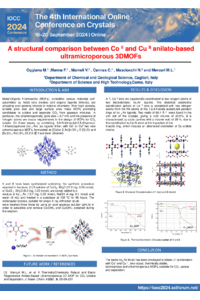
Metal–Organic Frameworks (MOFs), porous materials self-assembled by metal ions and organic ligands, are attracting ever-growing interest in material chemistry. Their high porosity, tunable pore size and large surface area make MOFs promising candidates to separate CO2. Ultramicroporosity (pore size < 0,7 nm) and the presence of nitrogen atoms are crucial requirements in the design of MOFs for CO2 uptake.. Based on this, by combining 3 6-N-ditriazolyl-2,5-dihydroxy-1,4-benzoquinone (trz2An), as the organic linker, with CoII or CuII, two new ultramicroporous MOFs, formulated as [Co(trz2An)]n·3H2O (1) and[Cu(trz2An)]·(H2O)2.5(2), have been obtained.
Material and Methods
MOFs 1 and 2 were synthesized by optimizing the synthetic procedure reported in literature. A solution of CoCl2·6H2O or CuCl2·2H2O was slowly added to a mixture of trz2An, NaOH and water and heated in autoclave at 130 °C for 48 hours. The rectangular crystals, suitable for a single X-ray diffraction study, were washed three times using an acid aqueous solution in order to solubilize and remove the Co(OH)2 and Cu(OH)2 obtained during the reaction.
Results
In 1, CoII ions are equatorially coordinated to four oxygen atoms of two bis(bidentate) trz2An ligands. The distorted octahedral coordination sphere of CoII ions is completed with two nitrogen atoms from the N4 atoms of the 1,2,4-triazole substituted pendant rings of trz2An ligands. Two voids of 90.4 Å3 were found in the unit cell of the crystals, giving a void volume of 23.5%. MOF 2 is characterized by cubic cavities with a volume void of 28 % due to the coordination to the N atom at the 4-position of the triazole ring, which induces an alternate orientation of Cu-anilate chains.
Conclusions
The same trz2An linker has been employed to obtain, in combination with CoII and CuII, two robust, isomorphous and ultramicroporous MOFs, suitable for CO2uptake and separation.
Keywords
MOFs
CO2 Separation
SC-Xray Diffraction
Poster
Poster IOCC_oggianu .pdf
New Quantitative Visible (VIS) Spectrophotometric Analysis of pure Oxacillin in a Pharmaceutical: A Statistical Study of Linear Regression
Investigation of the phases and the nature of the corresponding phase transition of a chiral ferroelectric liquid crystalline compound