Event submissions
Published
This submission belongs to the session S1. Liquid Crystals of the event The 4th International Online Conference on Crystals
Published date
18 Sep, 2024
Academic Editor
'%3e%3cpath%20d='M12.6657%2010.9104C12.4185%2010.325%2012.0599%209.79327%2011.6097%209.34482C11.1609%208.89508%2010.6293%208.5365%2010.0442%208.28888C10.0389%208.28626%2010.0337%208.28495%2010.0285%208.28233C10.8446%207.69279%2011.3752%206.73249%2011.3752%205.64904C11.3752%203.8542%209.92103%202.39999%208.1262%202.39999C6.33136%202.39999%204.87715%203.8542%204.87715%205.64904C4.87715%206.73249%205.40774%207.69279%206.22393%208.28364C6.21869%208.28626%206.21345%208.28757%206.20821%208.29019C5.62129%208.5378%205.09463%208.89284%204.64265%209.34613C4.1929%209.79493%203.83432%2010.3266%203.58671%2010.9117C3.34345%2011.4845%203.21226%2012.0987%203.20023%2012.7209C3.19988%2012.7349%203.20233%2012.7488%203.20744%2012.7619C3.21255%2012.7749%203.22022%2012.7867%203.22998%2012.7968C3.23975%2012.8068%203.25142%2012.8147%203.26431%2012.8202C3.2772%2012.8256%203.29105%2012.8284%203.30504%2012.8284H4.09109C4.14874%2012.8284%204.19459%2012.7825%204.1959%2012.7262C4.2221%2011.7148%204.62823%2010.7676%205.34617%2010.0497C6.08899%209.30683%207.0755%208.89808%208.1262%208.89808C9.17689%208.89808%2010.1634%209.30683%2010.9062%2010.0497C11.6242%2010.7676%2012.0303%2011.7148%2012.0565%2012.7262C12.0578%2012.7838%2012.1037%2012.8284%2012.1613%2012.8284H12.9474C12.9613%2012.8284%2012.9752%2012.8256%2012.9881%2012.8202C13.001%2012.8147%2013.0126%2012.8068%2013.0224%2012.7968C13.0322%2012.7867%2013.0398%2012.7749%2013.0449%2012.7619C13.0501%2012.7488%2013.0525%2012.7349%2013.0522%2012.7209C13.0391%2012.0947%2012.9094%2011.4855%2012.6657%2010.9104ZM8.1262%207.9024C7.52486%207.9024%206.9589%207.6679%206.53312%207.24211C6.10733%206.81633%205.87283%206.25037%205.87283%205.64904C5.87283%205.0477%206.10733%204.48174%206.53312%204.05596C6.9589%203.63018%207.52486%203.39567%208.1262%203.39567C8.72753%203.39567%209.29349%203.63018%209.71927%204.05596C10.1451%204.48174%2010.3796%205.0477%2010.3796%205.64904C10.3796%206.25037%2010.1451%206.81633%209.71927%207.24211C9.29349%207.6679%208.72753%207.9024%208.1262%207.9024Z'%20fill='%235D1EE1'/%3e%3c/g%3e%3c/svg%3e) Alessandra Toncelli
Alessandra ToncelliCitation
BARNALI BARMAN, Investigation of the phases and the nature of the corresponding phase transition of a chiral ferroelectric liquid crystalline compound, in Proceedings of The 4th International Online Conference on Crystals, 18 September–20 September 2024, MDPI: Basel, Switzerland
Share
Email
Facebook
Twitter
LinkedIn
Investigation of the phases and the nature of the corresponding phase transition of a chiral ferroelectric liquid crystalline compound
'%3e%3cpath%20d='M12.6647%2010.9104C12.4176%2010.325%2012.0589%209.7933%2011.6088%209.34485C11.16%208.89511%2010.6283%208.53653%2010.0432%208.28891C10.038%208.28629%2010.0327%208.28498%2010.0275%208.28236C10.8437%207.69282%2011.3743%206.73252%2011.3743%205.64907C11.3743%203.85423%209.92005%202.40002%208.12522%202.40002C6.33038%202.40002%204.87618%203.85423%204.87618%205.64907C4.87618%206.73252%205.40677%207.69282%206.22296%208.28367C6.21772%208.28629%206.21248%208.2876%206.20724%208.29022C5.62031%208.53783%205.09365%208.89287%204.64167%209.34616C4.19192%209.79496%203.83334%2010.3266%203.58573%2010.9117C3.34247%2011.4846%203.21128%2012.0987%203.19925%2012.721C3.1989%2012.735%203.20135%2012.7489%203.20646%2012.7619C3.21157%2012.7749%203.21924%2012.7868%203.22901%2012.7968C3.23877%2012.8068%203.25045%2012.8148%203.26334%2012.8202C3.27623%2012.8256%203.29007%2012.8284%203.30406%2012.8284H4.09012C4.14776%2012.8284%204.19362%2012.7825%204.19493%2012.7262C4.22113%2011.7148%204.62726%2010.7676%205.34519%2010.0497C6.08802%209.30686%207.07452%208.89811%208.12522%208.89811C9.17592%208.89811%2010.1624%209.30686%2010.9052%2010.0497C11.6232%2010.7676%2012.0293%2011.7148%2012.0555%2012.7262C12.0568%2012.7839%2012.1027%2012.8284%2012.1603%2012.8284H12.9464C12.9604%2012.8284%2012.9742%2012.8256%2012.9871%2012.8202C13%2012.8148%2013.0117%2012.8068%2013.0214%2012.7968C13.0312%2012.7868%2013.0389%2012.7749%2013.044%2012.7619C13.0491%2012.7489%2013.0515%2012.735%2013.0512%2012.721C13.0381%2012.0947%2012.9084%2011.4856%2012.6647%2010.9104ZM8.12522%207.90243C7.52388%207.90243%206.95792%207.66793%206.53214%207.24215C6.10636%206.81636%205.87185%206.2504%205.87185%205.64907C5.87185%205.04773%206.10636%204.48177%206.53214%204.05599C6.95792%203.63021%207.52388%203.3957%208.12522%203.3957C8.72655%203.3957%209.29252%203.63021%209.7183%204.05599C10.1441%204.48177%2010.3786%205.04773%2010.3786%205.64907C10.3786%206.2504%2010.1441%206.81636%209.7183%207.24215C9.29252%207.66793%208.72655%207.90243%208.12522%207.90243Z'%20fill='%235D1EE1'/%3e%3c/g%3e%3c/svg%3e)
BARNALI BARMAN 1
1. Department of Physics, Seva Bharati Mahavidyalaya, Jhargram, West Bengal, India, 721507.
Abstract
Investigation of the phases and the nature of the corresponding phase transition of a chiral ferroelectric liquid crystalline compound
Barnali Barman
Department of Physics, Seva Bharati Mahavidyalaya, Jhargram, West Bengal, India, 721507
Abstract
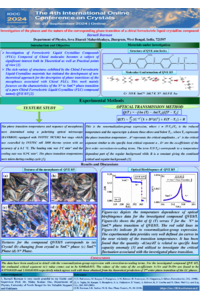
Liquid crystals offer an excellent platform for studying the nature of phase transitions by providing a rich variety of mesophase orderings [1]. In many cases, they occur in narrow temperature ranges, and the phase transitions between different mesophases can be either continuous or weakly first-order. The most commonly studied mesophases are nematic (N), smectic-A (SmA), smectic-C (SmC), and their chiral analogue,s such as N*, SmA*, and SmC* phases. This work mainly focuses on the characteristics of the N* to SmC* phase transition of a pure ferroelectric liquid crystalline (FLC) compound, namely QVE 8/5 [2, 3]. The textures are characteristics of the different phases. For the studied compound, the characteristic textures corresponding to the N* and SmC* phases have been detected. The optical transmission method [ 4, 5] has been used in order to investigate the N* to SmC* phase transition. The temperature variation of the transmitted intensity for the compounds QVE 8/5 have been measured for both planar and homeotropic alignments of the molecules. The critical behaviour of the N* to SmC* phase transition has also been investigated. The extracted critical exponent (α') of the investigated compound was found to be less than 0.5, which implies the second-order nature of the N*-SmC* phase transition corresponding to the studied FLC compound.
References
- A. Clark, S. T. Lagerwall; Ferroelectrics Appl. Phys, 59, 25 (1984).
- Pakhomov, M. Kaspar, V. Hamplova, A.M. Bubnov, H. Sverenyak, M. Glogarova, I. Stibor; Ferroelectrics, 212, 341 (1998).
- Vajda, M. Kaspar, V. Hamplova, S. A. Pakhomov, P. Vanek, A. Bubnov, K. Fodor-Csorba and Nandor Eber; Mol Cry. and Liq. Cry., 365, 569 (2001).
- Prasad and M. K. Das; J. Phys. Condens. Matter., 22, 195106 (2010).
- Barman, S.K. Sarkar, M. K. Das; Phase Transit., 91, 58 (2018).
Keywords
Ferroelectric Liquid Crystal (FLC)
Phase Transition
Poster
Poster-IOCC-2024-Barnali Barman.pdf
A structural comparison between CoII and CuII anilato-based ultramicroporous 3DMOFs
Exploring Optical Properties of Nematic Liquid Crystals dispersed with Perovskite Quantum Dots