Event submissions
Published
This submission belongs to the session S6. Materials for Energy Applications of the event The 4th International Online Conference on Crystals
Published date
18 Sep, 2024
Academic Editor
'%3e%3cpath%20d='M12.6657%2010.9104C12.4185%2010.325%2012.0599%209.79327%2011.6097%209.34482C11.1609%208.89508%2010.6293%208.5365%2010.0442%208.28888C10.0389%208.28626%2010.0337%208.28495%2010.0285%208.28233C10.8446%207.69279%2011.3752%206.73249%2011.3752%205.64904C11.3752%203.8542%209.92103%202.39999%208.1262%202.39999C6.33136%202.39999%204.87715%203.8542%204.87715%205.64904C4.87715%206.73249%205.40774%207.69279%206.22393%208.28364C6.21869%208.28626%206.21345%208.28757%206.20821%208.29019C5.62129%208.5378%205.09463%208.89284%204.64265%209.34613C4.1929%209.79493%203.83432%2010.3266%203.58671%2010.9117C3.34345%2011.4845%203.21226%2012.0987%203.20023%2012.7209C3.19988%2012.7349%203.20233%2012.7488%203.20744%2012.7619C3.21255%2012.7749%203.22022%2012.7867%203.22998%2012.7968C3.23975%2012.8068%203.25142%2012.8147%203.26431%2012.8202C3.2772%2012.8256%203.29105%2012.8284%203.30504%2012.8284H4.09109C4.14874%2012.8284%204.19459%2012.7825%204.1959%2012.7262C4.2221%2011.7148%204.62823%2010.7676%205.34617%2010.0497C6.08899%209.30683%207.0755%208.89808%208.1262%208.89808C9.17689%208.89808%2010.1634%209.30683%2010.9062%2010.0497C11.6242%2010.7676%2012.0303%2011.7148%2012.0565%2012.7262C12.0578%2012.7838%2012.1037%2012.8284%2012.1613%2012.8284H12.9474C12.9613%2012.8284%2012.9752%2012.8256%2012.9881%2012.8202C13.001%2012.8147%2013.0126%2012.8068%2013.0224%2012.7968C13.0322%2012.7867%2013.0398%2012.7749%2013.0449%2012.7619C13.0501%2012.7488%2013.0525%2012.7349%2013.0522%2012.7209C13.0391%2012.0947%2012.9094%2011.4855%2012.6657%2010.9104ZM8.1262%207.9024C7.52486%207.9024%206.9589%207.6679%206.53312%207.24211C6.10733%206.81633%205.87283%206.25037%205.87283%205.64904C5.87283%205.0477%206.10733%204.48174%206.53312%204.05596C6.9589%203.63018%207.52486%203.39567%208.1262%203.39567C8.72753%203.39567%209.29349%203.63018%209.71927%204.05596C10.1451%204.48174%2010.3796%205.0477%2010.3796%205.64904C10.3796%206.25037%2010.1451%206.81633%209.71927%207.24211C9.29349%207.6679%208.72753%207.9024%208.1262%207.9024Z'%20fill='%235D1EE1'/%3e%3c/g%3e%3c/svg%3e) Ioannis Spanopoulos
Ioannis SpanopoulosCitation
Roman Mukhachev, Sergey Platonov, Anatoly Kuchin, Aleksey Volegov, Vasilii Gaviko, Mari Yakovleva, Alexey Lukoyanov, Magnetocaloric GdMn₁₋xRuxSi compounds with x = 0 - 1 for gas liquefaction, in Proceedings of The 4th International Online Conference on Crystals, 18 September–20 September 2024, MDPI: Basel, Switzerland
Share
Email
Facebook
Twitter
LinkedIn
Magnetocaloric GdMn1-xRuxSi compounds with x = 0 - 1 for gas liquefaction

Roman Mukhachev 1
'%3e%3cpath%20d='M12.6647%2010.9104C12.4176%2010.325%2012.0589%209.7933%2011.6088%209.34485C11.16%208.89511%2010.6283%208.53653%2010.0432%208.28891C10.038%208.28629%2010.0327%208.28498%2010.0275%208.28236C10.8437%207.69282%2011.3743%206.73252%2011.3743%205.64907C11.3743%203.85423%209.92005%202.40002%208.12522%202.40002C6.33038%202.40002%204.87618%203.85423%204.87618%205.64907C4.87618%206.73252%205.40677%207.69282%206.22296%208.28367C6.21772%208.28629%206.21248%208.2876%206.20724%208.29022C5.62031%208.53783%205.09365%208.89287%204.64167%209.34616C4.19192%209.79496%203.83334%2010.3266%203.58573%2010.9117C3.34247%2011.4846%203.21128%2012.0987%203.19925%2012.721C3.1989%2012.735%203.20135%2012.7489%203.20646%2012.7619C3.21157%2012.7749%203.21924%2012.7868%203.22901%2012.7968C3.23877%2012.8068%203.25045%2012.8148%203.26334%2012.8202C3.27623%2012.8256%203.29007%2012.8284%203.30406%2012.8284H4.09012C4.14776%2012.8284%204.19362%2012.7825%204.19493%2012.7262C4.22113%2011.7148%204.62726%2010.7676%205.34519%2010.0497C6.08802%209.30686%207.07452%208.89811%208.12522%208.89811C9.17592%208.89811%2010.1624%209.30686%2010.9052%2010.0497C11.6232%2010.7676%2012.0293%2011.7148%2012.0555%2012.7262C12.0568%2012.7839%2012.1027%2012.8284%2012.1603%2012.8284H12.9464C12.9604%2012.8284%2012.9742%2012.8256%2012.9871%2012.8202C13%2012.8148%2013.0117%2012.8068%2013.0214%2012.7968C13.0312%2012.7868%2013.0389%2012.7749%2013.044%2012.7619C13.0491%2012.7489%2013.0515%2012.735%2013.0512%2012.721C13.0381%2012.0947%2012.9084%2011.4856%2012.6647%2010.9104ZM8.12522%207.90243C7.52388%207.90243%206.95792%207.66793%206.53214%207.24215C6.10636%206.81636%205.87185%206.2504%205.87185%205.64907C5.87185%205.04773%206.10636%204.48177%206.53214%204.05599C6.95792%203.63021%207.52388%203.3957%208.12522%203.3957C8.72655%203.3957%209.29252%203.63021%209.7183%204.05599C10.1441%204.48177%2010.3786%205.04773%2010.3786%205.64907C10.3786%206.2504%2010.1441%206.81636%209.7183%207.24215C9.29252%207.66793%208.72655%207.90243%208.12522%207.90243Z'%20fill='%235D1EE1'/%3e%3c/g%3e%3c/svg%3e)
Sergey Platonov 1
Anatoly Kuchin 1

Aleksey Volegov 1,2
Vasilii Gaviko 1,2
Mari Yakovleva 1

Alexey Lukoyanov 1,2
1. M.N. Mikheev Institute of Metal Physics of Ural Branch of Russian Academy of Sciences, 620108 Yekaterinburg, Russia
2. Ural Federal University named after the first President of Russia B.N. Yeltsin, 620002 Yekaterinburg, Russia
Abstract
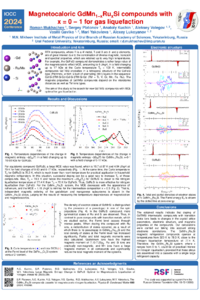
Ternary intermetallic compounds based on rare-earth metals are characterized by high values of the magnetocaloric effect (MCE) and magnetoresistance, making them suitable materials for a variety of innovative, environmentally friendly and efficient applications. Magnetic refrigeration, for example, is a potential candidate for environmentally friendly gas liquefaction and for preventing gas from evaporating during storage. As an example, liquid nitrogen is often used as a final refrigerant for liquefied natural gas at 111 K. Novel intermetallics GdMn1−xRuxSi with a tetragonal CeFeSi-type structure (P4/nmm), were synthesized, with x = 0, 0.2, 0.5, 0.8 and 1 [1]. Their Curie temperature TC changes from 78.3 to 320 K with a change in manganese content. The electronic structure and magnetic moments of GdMn1-xRuxSi intermetallic compounds were calculated using the theoretical DFT+U method. The calculated total magnetic moments of GdMn1-xRuxSi also show reduced values for intermediate Ru concentrations. In the GdMn1-xRuxSi system, MCE occurs during a second-order phase transition and in a wide temperature range from 78.3 (which is near the boiling point of liquid nitrogen at 77.4 K) to 320 K. The GdMn1-xRuxSi system, with x = 0 - 1, is of practical interest for the liquefaction of gases, including nitrogen. A cassette can be made from compounds within this range with slightly varying chemical compositions. Due to their properties, the intermetallic GdMn1-xRuxSi compounds are novel, more efficient magnetocaloric materials suitable for the liquefaction of nitrogen and other gases.
1. Platonov, S.P.; Kuchin, A.G.; Volegov, A.S.; Gaviko, V.S.; Mukhachev, R.D.; Lukoyanov, A.V.; Yakovleva, M.Yu. The GdMn1-xRuxSi Compounds Cassette for Magnetocaloric Nitrogen Liquefaction. Physica B: Condensed Matter 2024, 685, 416060. https://doi.org/10.1016/j.physb.2024.416060
Keywords
magnetocaloric effect
energy material
crystal structure
gas liquefaction
Poster
Crrystals2024_poster.pdf
Optical and pressure-induced investigations of double perovskite Ba2TiMnO6 from the first principles
Electronic structures of Cs3GdCl6 and Cs3NdCl6 double perovskite crystals using first-principles calculations