Event submissions
Published
This submission belongs to the session S4. Organic Crystalline Materials of the event The 4th International Online Conference on Crystals
Published date
18 Sep, 2024
Academic Editor
'%3e%3cpath%20d='M12.6657%2010.9104C12.4185%2010.325%2012.0599%209.79327%2011.6097%209.34482C11.1609%208.89508%2010.6293%208.5365%2010.0442%208.28888C10.0389%208.28626%2010.0337%208.28495%2010.0285%208.28233C10.8446%207.69279%2011.3752%206.73249%2011.3752%205.64904C11.3752%203.8542%209.92103%202.39999%208.1262%202.39999C6.33136%202.39999%204.87715%203.8542%204.87715%205.64904C4.87715%206.73249%205.40774%207.69279%206.22393%208.28364C6.21869%208.28626%206.21345%208.28757%206.20821%208.29019C5.62129%208.5378%205.09463%208.89284%204.64265%209.34613C4.1929%209.79493%203.83432%2010.3266%203.58671%2010.9117C3.34345%2011.4845%203.21226%2012.0987%203.20023%2012.7209C3.19988%2012.7349%203.20233%2012.7488%203.20744%2012.7619C3.21255%2012.7749%203.22022%2012.7867%203.22998%2012.7968C3.23975%2012.8068%203.25142%2012.8147%203.26431%2012.8202C3.2772%2012.8256%203.29105%2012.8284%203.30504%2012.8284H4.09109C4.14874%2012.8284%204.19459%2012.7825%204.1959%2012.7262C4.2221%2011.7148%204.62823%2010.7676%205.34617%2010.0497C6.08899%209.30683%207.0755%208.89808%208.1262%208.89808C9.17689%208.89808%2010.1634%209.30683%2010.9062%2010.0497C11.6242%2010.7676%2012.0303%2011.7148%2012.0565%2012.7262C12.0578%2012.7838%2012.1037%2012.8284%2012.1613%2012.8284H12.9474C12.9613%2012.8284%2012.9752%2012.8256%2012.9881%2012.8202C13.001%2012.8147%2013.0126%2012.8068%2013.0224%2012.7968C13.0322%2012.7867%2013.0398%2012.7749%2013.0449%2012.7619C13.0501%2012.7488%2013.0525%2012.7349%2013.0522%2012.7209C13.0391%2012.0947%2012.9094%2011.4855%2012.6657%2010.9104ZM8.1262%207.9024C7.52486%207.9024%206.9589%207.6679%206.53312%207.24211C6.10733%206.81633%205.87283%206.25037%205.87283%205.64904C5.87283%205.0477%206.10733%204.48174%206.53312%204.05596C6.9589%203.63018%207.52486%203.39567%208.1262%203.39567C8.72753%203.39567%209.29349%203.63018%209.71927%204.05596C10.1451%204.48174%2010.3796%205.0477%2010.3796%205.64904C10.3796%206.25037%2010.1451%206.81633%209.71927%207.24211C9.29349%207.6679%208.72753%207.9024%208.1262%207.9024Z'%20fill='%235D1EE1'/%3e%3c/g%3e%3c/svg%3e) Rodolfo Reda
Rodolfo RedaCitation
Nadia El hasnaoui nadiaelhasnaouu94@gmail.com, Youness Benjalal y.benjalal@usms.ma, Arrays of Lander molecules stabilized by multiple interactions on surfaces, in Proceedings of The 4th International Online Conference on Crystals, 18 September–20 September 2024, MDPI: Basel, Switzerland
Share
Email
Facebook
Twitter
LinkedIn
Arrays of Lander molecules stabilized by multiple interactions on surfaces
'%3e%3cpath%20d='M12.6647%2010.9104C12.4176%2010.325%2012.0589%209.7933%2011.6088%209.34485C11.16%208.89511%2010.6283%208.53653%2010.0432%208.28891C10.038%208.28629%2010.0327%208.28498%2010.0275%208.28236C10.8437%207.69282%2011.3743%206.73252%2011.3743%205.64907C11.3743%203.85423%209.92005%202.40002%208.12522%202.40002C6.33038%202.40002%204.87618%203.85423%204.87618%205.64907C4.87618%206.73252%205.40677%207.69282%206.22296%208.28367C6.21772%208.28629%206.21248%208.2876%206.20724%208.29022C5.62031%208.53783%205.09365%208.89287%204.64167%209.34616C4.19192%209.79496%203.83334%2010.3266%203.58573%2010.9117C3.34247%2011.4846%203.21128%2012.0987%203.19925%2012.721C3.1989%2012.735%203.20135%2012.7489%203.20646%2012.7619C3.21157%2012.7749%203.21924%2012.7868%203.22901%2012.7968C3.23877%2012.8068%203.25045%2012.8148%203.26334%2012.8202C3.27623%2012.8256%203.29007%2012.8284%203.30406%2012.8284H4.09012C4.14776%2012.8284%204.19362%2012.7825%204.19493%2012.7262C4.22113%2011.7148%204.62726%2010.7676%205.34519%2010.0497C6.08802%209.30686%207.07452%208.89811%208.12522%208.89811C9.17592%208.89811%2010.1624%209.30686%2010.9052%2010.0497C11.6232%2010.7676%2012.0293%2011.7148%2012.0555%2012.7262C12.0568%2012.7839%2012.1027%2012.8284%2012.1603%2012.8284H12.9464C12.9604%2012.8284%2012.9742%2012.8256%2012.9871%2012.8202C13%2012.8148%2013.0117%2012.8068%2013.0214%2012.7968C13.0312%2012.7868%2013.0389%2012.7749%2013.044%2012.7619C13.0491%2012.7489%2013.0515%2012.735%2013.0512%2012.721C13.0381%2012.0947%2012.9084%2011.4856%2012.6647%2010.9104ZM8.12522%207.90243C7.52388%207.90243%206.95792%207.66793%206.53214%207.24215C6.10636%206.81636%205.87185%206.2504%205.87185%205.64907C5.87185%205.04773%206.10636%204.48177%206.53214%204.05599C6.95792%203.63021%207.52388%203.3957%208.12522%203.3957C8.72655%203.3957%209.29252%203.63021%209.7183%204.05599C10.1441%204.48177%2010.3786%205.04773%2010.3786%205.64907C10.3786%206.2504%2010.1441%206.81636%209.7183%207.24215C9.29252%207.66793%208.72655%207.90243%208.12522%207.90243Z'%20fill='%235D1EE1'/%3e%3c/g%3e%3c/svg%3e)
Nadia El hasnaoui nadiaelhasnaouu94@gmail.com 1

Youness Benjalal y.benjalal@usms.ma 1
1. Université Sultan Moulay Slimane, Faculté polydisciplinaire, Département de chimie, ERSIC, Béni Mellal, Morocco
Abstract
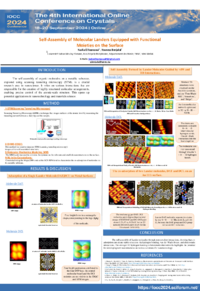
Molecular assemblies driven by non-covalent interactions have sparked enormous interest in the last decade, due to their high versatility, flexibility, and recoverability. To figure out the interplay of the non-covalent interactions, such as hydrogen bonding (HB), electrostatic interaction, stacking, metal–organic coordination, van der Waals (vdW) forces, etc., intensive attention has been focused on the sophisticated systems composed of multiple components that are balanced by multiple non-covalent interactions.
Theoretical investigations have been carried out with an extended semiempirical atom superposition and electron delocalization (ASED+, Atom Superposition, and Electron Delocalization), based on the extended Hückel molecular orbital theory. Calculated STM images were obtained within the EHMO-ESQC method (Extended Hückel Molecular Orbital–Elastic-Scattering Quantum Chemistry), which describes the electronic scattering between the substrate and the tip by modeling the chemical structure of the tunnel gap (substrate, molecule, tip apex, and tip substrate).
Molecular Landers are a distinctive family of molecules, with bulky functional groups acting as the legs to lift up the aromatic molecular board. When the compounds are adsorbed on surfaces, only the legs are in contact with the surface, while the molecular board is decoupled from the substrate. To align these Landers into extended and well-ordered arrangements, different routes have been employed. In our previous work, we have demonstrated that one-dimensional (1D) and two-dimensional (2D) well-ordered assemblies of Landers can be observed not only between the same compounds, but also between hetero-Landers. However, all these interactions occurred when the molecular boards have an identical or comparable height, while the possibility of bonding between Landers and legless molecules remains unknown. Moreover, besides the two routes mentioned above, guest–host chemistry has been recognized as another fascinating way to align molecules on surfaces.
Keywords
Molecular Landers
Hydrogen Bonding (HB)
Electrostatic Interaction
Van der Waals (vdW)
ASED+
Calculated STM
EHMO-ESQC Method
one-dimensional (1-D) and two-dimensional (2-D)
Poster
poster.pdf
Effect of extract concentration and temperature on microstructural properties of biological ZnO nanoparticles
8CB-based plasmonic nanomaterials