Event submissions
Published
This submission belongs to the session S5. Hybrid and Composite Crystalline Materials of the event The 4th International Online Conference on Crystals
Published date
18 Sep, 2024
Academic Editor
'%3e%3cpath%20d='M12.6657%2010.9104C12.4185%2010.325%2012.0599%209.79327%2011.6097%209.34482C11.1609%208.89508%2010.6293%208.5365%2010.0442%208.28888C10.0389%208.28626%2010.0337%208.28495%2010.0285%208.28233C10.8446%207.69279%2011.3752%206.73249%2011.3752%205.64904C11.3752%203.8542%209.92103%202.39999%208.1262%202.39999C6.33136%202.39999%204.87715%203.8542%204.87715%205.64904C4.87715%206.73249%205.40774%207.69279%206.22393%208.28364C6.21869%208.28626%206.21345%208.28757%206.20821%208.29019C5.62129%208.5378%205.09463%208.89284%204.64265%209.34613C4.1929%209.79493%203.83432%2010.3266%203.58671%2010.9117C3.34345%2011.4845%203.21226%2012.0987%203.20023%2012.7209C3.19988%2012.7349%203.20233%2012.7488%203.20744%2012.7619C3.21255%2012.7749%203.22022%2012.7867%203.22998%2012.7968C3.23975%2012.8068%203.25142%2012.8147%203.26431%2012.8202C3.2772%2012.8256%203.29105%2012.8284%203.30504%2012.8284H4.09109C4.14874%2012.8284%204.19459%2012.7825%204.1959%2012.7262C4.2221%2011.7148%204.62823%2010.7676%205.34617%2010.0497C6.08899%209.30683%207.0755%208.89808%208.1262%208.89808C9.17689%208.89808%2010.1634%209.30683%2010.9062%2010.0497C11.6242%2010.7676%2012.0303%2011.7148%2012.0565%2012.7262C12.0578%2012.7838%2012.1037%2012.8284%2012.1613%2012.8284H12.9474C12.9613%2012.8284%2012.9752%2012.8256%2012.9881%2012.8202C13.001%2012.8147%2013.0126%2012.8068%2013.0224%2012.7968C13.0322%2012.7867%2013.0398%2012.7749%2013.0449%2012.7619C13.0501%2012.7488%2013.0525%2012.7349%2013.0522%2012.7209C13.0391%2012.0947%2012.9094%2011.4855%2012.6657%2010.9104ZM8.1262%207.9024C7.52486%207.9024%206.9589%207.6679%206.53312%207.24211C6.10733%206.81633%205.87283%206.25037%205.87283%205.64904C5.87283%205.0477%206.10733%204.48174%206.53312%204.05596C6.9589%203.63018%207.52486%203.39567%208.1262%203.39567C8.72753%203.39567%209.29349%203.63018%209.71927%204.05596C10.1451%204.48174%2010.3796%205.0477%2010.3796%205.64904C10.3796%206.25037%2010.1451%206.81633%209.71927%207.24211C9.29349%207.6679%208.72753%207.9024%208.1262%207.9024Z'%20fill='%235D1EE1'/%3e%3c/g%3e%3c/svg%3e) Ferdinando Costantino
Ferdinando CostantinoCitation
Natalia Igorevna Cherkashina, Vyacheslav Ivanovich Pavlenko, Semen Nikolayevich Domarev, Dar’ya Aleksandrovna Ryzhikh, Study of structure and filler crystallinity index of polymer composite with silica nanofibrous filler, in Proceedings of The 4th International Online Conference on Crystals, 18 September–20 September 2024, MDPI: Basel, Switzerland
Share
Email
Facebook
Twitter
LinkedIn
Study of structure and filler crystallinity index of polymer composite with silica nanofibrous filler
'%3e%3cpath%20d='M12.6647%2010.9104C12.4176%2010.325%2012.0589%209.7933%2011.6088%209.34485C11.16%208.89511%2010.6283%208.53653%2010.0432%208.28891C10.038%208.28629%2010.0327%208.28498%2010.0275%208.28236C10.8437%207.69282%2011.3743%206.73252%2011.3743%205.64907C11.3743%203.85423%209.92005%202.40002%208.12522%202.40002C6.33038%202.40002%204.87618%203.85423%204.87618%205.64907C4.87618%206.73252%205.40677%207.69282%206.22296%208.28367C6.21772%208.28629%206.21248%208.2876%206.20724%208.29022C5.62031%208.53783%205.09365%208.89287%204.64167%209.34616C4.19192%209.79496%203.83334%2010.3266%203.58573%2010.9117C3.34247%2011.4846%203.21128%2012.0987%203.19925%2012.721C3.1989%2012.735%203.20135%2012.7489%203.20646%2012.7619C3.21157%2012.7749%203.21924%2012.7868%203.22901%2012.7968C3.23877%2012.8068%203.25045%2012.8148%203.26334%2012.8202C3.27623%2012.8256%203.29007%2012.8284%203.30406%2012.8284H4.09012C4.14776%2012.8284%204.19362%2012.7825%204.19493%2012.7262C4.22113%2011.7148%204.62726%2010.7676%205.34519%2010.0497C6.08802%209.30686%207.07452%208.89811%208.12522%208.89811C9.17592%208.89811%2010.1624%209.30686%2010.9052%2010.0497C11.6232%2010.7676%2012.0293%2011.7148%2012.0555%2012.7262C12.0568%2012.7839%2012.1027%2012.8284%2012.1603%2012.8284H12.9464C12.9604%2012.8284%2012.9742%2012.8256%2012.9871%2012.8202C13%2012.8148%2013.0117%2012.8068%2013.0214%2012.7968C13.0312%2012.7868%2013.0389%2012.7749%2013.044%2012.7619C13.0491%2012.7489%2013.0515%2012.735%2013.0512%2012.721C13.0381%2012.0947%2012.9084%2011.4856%2012.6647%2010.9104ZM8.12522%207.90243C7.52388%207.90243%206.95792%207.66793%206.53214%207.24215C6.10636%206.81636%205.87185%206.2504%205.87185%205.64907C5.87185%205.04773%206.10636%204.48177%206.53214%204.05599C6.95792%203.63021%207.52388%203.3957%208.12522%203.3957C8.72655%203.3957%209.29252%203.63021%209.7183%204.05599C10.1441%204.48177%2010.3786%205.04773%2010.3786%205.64907C10.3786%206.2504%2010.1441%206.81636%209.7183%207.24215C9.29252%207.66793%208.72655%207.90243%208.12522%207.90243Z'%20fill='%235D1EE1'/%3e%3c/g%3e%3c/svg%3e)
Natalia Igorevna Cherkashina 1
Vyacheslav Ivanovich Pavlenko 1

Semen Nikolayevich Domarev 1
Dar’ya Aleksandrovna Ryzhikh 1
1. Department of Theoretical and Applied Chemistry, Belgorod State Technological University Named after V.G. Shukhov, 308012 Belgorod, Russia
Abstract
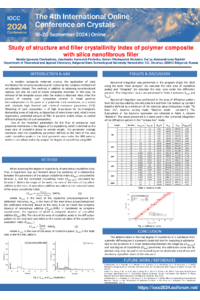
Introduction: In this study the technique of obtaining a composite material based on polyimide track membranes prepared by the deposition of TEOS (tetraethoxysilane) hydrolysis products in medium with acidic catalyst will be considered further. The obtained material sample microstructure and effect of the presence of crystalline forms of silicon dioxide on the overall crystallinity index (CI) of the silica filler will be studied.
Methods: The microstructure of the composite material surface was studied using scanning electron microscopy (SEM TESCAN MIRA 3). The effect of the presence of crystalline forms of silicon dioxide on the overall CI of the silica filler was studied using XRD (ARL X'TRA). For the purpose of this study, the CI was defined as the ratio of the area of the peaks of the crystalline phase in the diffraction pattern to the total area under it. A series of experiments were carried out with a model samples with different wt. % contents of crystalline silica powder and a correlation curve of the crystallinity of the sample and the crystallinity from the diffraction pattern was plotted.
Results: From the surface examination of the samples, it was found that the silica filler deposited in the pores of the polyimide track membrane has a nanofibrous structure. When crystalline powders were added in the amount of 30% wt. of the planned reaction yield, the CI did not exceed ≈32%, which indicates the absence of the formation of a new crystalline phase in the reaction volume.
Conclusion: According to the conducted study advantages of using an acidic catalyst of TEOS, the hydrolysis reaction can be regarded as the most successful, since its use leads to the formation of nanofibrous structures in the pores of the polyimide track membrane. The addition of crystalline forms of silicon oxide studied in this paper did not result in a significant change in the CI of silica filler.
Keywords
nanomaterials
crystallinity index
nanofibers
track etched membranes
self-assembly
Poster
Domarev Poster for IOCC.pdf
Design method of a variable-focus-length lens employing a liquid-crystal-loaded metasurface
Liquid lecithin crystals as carriers of biologically active substances and nanoparticles