Event submissions
Published
This submission belongs to the session S3. Inorganic Crystalline Materials of the event The 4th International Online Conference on Crystals
Published date
18 Sep, 2024
Academic Editor
'%3e%3cpath%20d='M12.6657%2010.9104C12.4185%2010.325%2012.0599%209.79327%2011.6097%209.34482C11.1609%208.89508%2010.6293%208.5365%2010.0442%208.28888C10.0389%208.28626%2010.0337%208.28495%2010.0285%208.28233C10.8446%207.69279%2011.3752%206.73249%2011.3752%205.64904C11.3752%203.8542%209.92103%202.39999%208.1262%202.39999C6.33136%202.39999%204.87715%203.8542%204.87715%205.64904C4.87715%206.73249%205.40774%207.69279%206.22393%208.28364C6.21869%208.28626%206.21345%208.28757%206.20821%208.29019C5.62129%208.5378%205.09463%208.89284%204.64265%209.34613C4.1929%209.79493%203.83432%2010.3266%203.58671%2010.9117C3.34345%2011.4845%203.21226%2012.0987%203.20023%2012.7209C3.19988%2012.7349%203.20233%2012.7488%203.20744%2012.7619C3.21255%2012.7749%203.22022%2012.7867%203.22998%2012.7968C3.23975%2012.8068%203.25142%2012.8147%203.26431%2012.8202C3.2772%2012.8256%203.29105%2012.8284%203.30504%2012.8284H4.09109C4.14874%2012.8284%204.19459%2012.7825%204.1959%2012.7262C4.2221%2011.7148%204.62823%2010.7676%205.34617%2010.0497C6.08899%209.30683%207.0755%208.89808%208.1262%208.89808C9.17689%208.89808%2010.1634%209.30683%2010.9062%2010.0497C11.6242%2010.7676%2012.0303%2011.7148%2012.0565%2012.7262C12.0578%2012.7838%2012.1037%2012.8284%2012.1613%2012.8284H12.9474C12.9613%2012.8284%2012.9752%2012.8256%2012.9881%2012.8202C13.001%2012.8147%2013.0126%2012.8068%2013.0224%2012.7968C13.0322%2012.7867%2013.0398%2012.7749%2013.0449%2012.7619C13.0501%2012.7488%2013.0525%2012.7349%2013.0522%2012.7209C13.0391%2012.0947%2012.9094%2011.4855%2012.6657%2010.9104ZM8.1262%207.9024C7.52486%207.9024%206.9589%207.6679%206.53312%207.24211C6.10733%206.81633%205.87283%206.25037%205.87283%205.64904C5.87283%205.0477%206.10733%204.48174%206.53312%204.05596C6.9589%203.63018%207.52486%203.39567%208.1262%203.39567C8.72753%203.39567%209.29349%203.63018%209.71927%204.05596C10.1451%204.48174%2010.3796%205.0477%2010.3796%205.64904C10.3796%206.25037%2010.1451%206.81633%209.71927%207.24211C9.29349%207.6679%208.72753%207.9024%208.1262%207.9024Z'%20fill='%235D1EE1'/%3e%3c/g%3e%3c/svg%3e) Alessandra Toncelli
Alessandra ToncelliCitation
Irina A. Kaurova, Galina M. Kuz'micheva, Levko A. Arbanas, Vera L. Manomenova, The influence of an ultra-small amount of heterovalent Y³⁺ activator ions in aqueous solution on the defect formation of different growth sectors of α-Ni²⁺SO₄·6H₂O crystals, in Proceedings of The 4th International Online Conference on Crystals, 18 September–20 September 2024, MDPI: Basel, Switzerland
Share
Email
Facebook
Twitter
LinkedIn
The influence of an ultra-small amount of heterovalent Y3+ activator ions in aqueous solution on the defect formation of different growth sectors of α-Ni2+SO4·6H2O crystals

Irina A. Kaurova 1

Galina M. Kuz'micheva 1

Levko A. Arbanas 1
'%3e%3cpath%20d='M12.6647%2010.9104C12.4176%2010.325%2012.0589%209.7933%2011.6088%209.34485C11.16%208.89511%2010.6283%208.53653%2010.0432%208.28891C10.038%208.28629%2010.0327%208.28498%2010.0275%208.28236C10.8437%207.69282%2011.3743%206.73252%2011.3743%205.64907C11.3743%203.85423%209.92005%202.40002%208.12522%202.40002C6.33038%202.40002%204.87618%203.85423%204.87618%205.64907C4.87618%206.73252%205.40677%207.69282%206.22296%208.28367C6.21772%208.28629%206.21248%208.2876%206.20724%208.29022C5.62031%208.53783%205.09365%208.89287%204.64167%209.34616C4.19192%209.79496%203.83334%2010.3266%203.58573%2010.9117C3.34247%2011.4846%203.21128%2012.0987%203.19925%2012.721C3.1989%2012.735%203.20135%2012.7489%203.20646%2012.7619C3.21157%2012.7749%203.21924%2012.7868%203.22901%2012.7968C3.23877%2012.8068%203.25045%2012.8148%203.26334%2012.8202C3.27623%2012.8256%203.29007%2012.8284%203.30406%2012.8284H4.09012C4.14776%2012.8284%204.19362%2012.7825%204.19493%2012.7262C4.22113%2011.7148%204.62726%2010.7676%205.34519%2010.0497C6.08802%209.30686%207.07452%208.89811%208.12522%208.89811C9.17592%208.89811%2010.1624%209.30686%2010.9052%2010.0497C11.6232%2010.7676%2012.0293%2011.7148%2012.0555%2012.7262C12.0568%2012.7839%2012.1027%2012.8284%2012.1603%2012.8284H12.9464C12.9604%2012.8284%2012.9742%2012.8256%2012.9871%2012.8202C13%2012.8148%2013.0117%2012.8068%2013.0214%2012.7968C13.0312%2012.7868%2013.0389%2012.7749%2013.044%2012.7619C13.0491%2012.7489%2013.0515%2012.735%2013.0512%2012.721C13.0381%2012.0947%2012.9084%2011.4856%2012.6647%2010.9104ZM8.12522%207.90243C7.52388%207.90243%206.95792%207.66793%206.53214%207.24215C6.10636%206.81636%205.87185%206.2504%205.87185%205.64907C5.87185%205.04773%206.10636%204.48177%206.53214%204.05599C6.95792%203.63021%207.52388%203.3957%208.12522%203.3957C8.72655%203.3957%209.29252%203.63021%209.7183%204.05599C10.1441%204.48177%2010.3786%205.04773%2010.3786%205.64907C10.3786%206.2504%2010.1441%206.81636%209.7183%207.24215C9.29252%207.66793%208.72655%207.90243%208.12522%207.90243Z'%20fill='%235D1EE1'/%3e%3c/g%3e%3c/svg%3e)
Vera L. Manomenova 2
1. MIREA - Russian Technological University, Vernadsky pr., 78, Moscow, 119454, Russian Federation
2. Federal Research Centre «Crystallography and Photonics», Russian Academy of Sciences, Leninsky pr., 59, Moscow, 119333, Russian Federation
Abstract
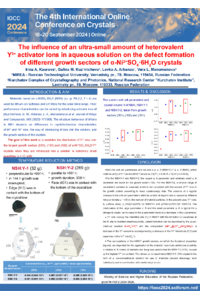
Materials based on α-NiSO4·6H2O (NSH) (sp. gr. P41212, Z = 4) are used for lithium-ion batteries and UV filters for the solar-blind range. Their performance characteristics can be varied by introducing activator ions М. The behaviour of M in NSH depends on differences in crystallochemical characteristics of Mn+ and Ni2+ ions, the way of introducing M ions into the solution, and the growth sectors of the crystals. The goal of this work is to establish the distribution of Y3+ ions over the growth sectors of NSH:Y crystals when they are introduced into a solution in extremely small quantities (c = 10 mM).
Two crystals were grown on NSH (001) plates: NSH:Y-1—perpendicular to <001> (32 g; growth duration 144 h); NSH:Y-2—parallel to <001> (269 g; growth duration 336 h). The habit (mmm) was found for NSH:Y-1, faceted by {001}, {101}, {011}, {012}, and {110} with face areas (Sface{hkl}) {101}>{011}>{012}>{001}>{110}. In the habit (mm2) of NSH:Y-2 crystals, new faces ((102), (1 2), and (1 )) with Sface(hkl) (101)>(012)>(102)>(011)>(001)>(1 2)>(1 )>(110) also appeared. The NSH:Y-2 crystal, by its (00) face, was at the bottom of the crystallizer during growth (uneven supply of the solution).
The c, Å tetragonal crystal parameter (X-ray diffraction of powdered crystals) decreased with the decrease in Y3+ content (см, ppm—mass spectrometry), c{101}>c{102}>c{001}, consistent with crystal morphology. Defect formation can be described by the quasi-chemical reaction 0 VNin’+Yim· and the composition (Ni2+1-x[])(Y3+i(x))SO4]. In the {101}-{102}-{001} series, a decrease in Y3+ content is accompanied by a decrease in the Y3+ interstitials (Yim·) and vacancies in the Ni2+ site (VNin’).
The compositions of the NSH:Y growth sectors, on which the functional properties depend, are important for the application of the material in the form of plates.
Funding: Ministry of Science and Higher Education of the Russian Federation, grant No. FSFZ-2024-0026.
Keywords
optical materials
crystal growth
structure
composition
X-ray diffraction
Poster
Kaurova MDPI.pdf
Nano-enhanced phase change materials doped with carbon allotropes for thermal energy storage: a patent landscape analysis
Nucleation, nuclei stability, and crystal growth in supercooled organic melts of benzocaine and tolbutamide