Event submissions
Published
This submission belongs to the session S2. Crystal Engineering of the event The 4th International Online Conference on Crystals
Published date
18 Sep, 2024
Academic Editor
'%3e%3cpath%20d='M12.6657%2010.9104C12.4185%2010.325%2012.0599%209.79327%2011.6097%209.34482C11.1609%208.89508%2010.6293%208.5365%2010.0442%208.28888C10.0389%208.28626%2010.0337%208.28495%2010.0285%208.28233C10.8446%207.69279%2011.3752%206.73249%2011.3752%205.64904C11.3752%203.8542%209.92103%202.39999%208.1262%202.39999C6.33136%202.39999%204.87715%203.8542%204.87715%205.64904C4.87715%206.73249%205.40774%207.69279%206.22393%208.28364C6.21869%208.28626%206.21345%208.28757%206.20821%208.29019C5.62129%208.5378%205.09463%208.89284%204.64265%209.34613C4.1929%209.79493%203.83432%2010.3266%203.58671%2010.9117C3.34345%2011.4845%203.21226%2012.0987%203.20023%2012.7209C3.19988%2012.7349%203.20233%2012.7488%203.20744%2012.7619C3.21255%2012.7749%203.22022%2012.7867%203.22998%2012.7968C3.23975%2012.8068%203.25142%2012.8147%203.26431%2012.8202C3.2772%2012.8256%203.29105%2012.8284%203.30504%2012.8284H4.09109C4.14874%2012.8284%204.19459%2012.7825%204.1959%2012.7262C4.2221%2011.7148%204.62823%2010.7676%205.34617%2010.0497C6.08899%209.30683%207.0755%208.89808%208.1262%208.89808C9.17689%208.89808%2010.1634%209.30683%2010.9062%2010.0497C11.6242%2010.7676%2012.0303%2011.7148%2012.0565%2012.7262C12.0578%2012.7838%2012.1037%2012.8284%2012.1613%2012.8284H12.9474C12.9613%2012.8284%2012.9752%2012.8256%2012.9881%2012.8202C13.001%2012.8147%2013.0126%2012.8068%2013.0224%2012.7968C13.0322%2012.7867%2013.0398%2012.7749%2013.0449%2012.7619C13.0501%2012.7488%2013.0525%2012.7349%2013.0522%2012.7209C13.0391%2012.0947%2012.9094%2011.4855%2012.6657%2010.9104ZM8.1262%207.9024C7.52486%207.9024%206.9589%207.6679%206.53312%207.24211C6.10733%206.81633%205.87283%206.25037%205.87283%205.64904C5.87283%205.0477%206.10733%204.48174%206.53312%204.05596C6.9589%203.63018%207.52486%203.39567%208.1262%203.39567C8.72753%203.39567%209.29349%203.63018%209.71927%204.05596C10.1451%204.48174%2010.3796%205.0477%2010.3796%205.64904C10.3796%206.25037%2010.1451%206.81633%209.71927%207.24211C9.29349%207.6679%208.72753%207.9024%208.1262%207.9024Z'%20fill='%235D1EE1'/%3e%3c/g%3e%3c/svg%3e) David Cordes
David CordesCitation
Artjoms Jermakovs, Aina Semjonova, Agris Bērziņš, Crystallization control possibilities of para-aminobenzoic acid using crystallization additives, in Proceedings of The 4th International Online Conference on Crystals, 18 September–20 September 2024, MDPI: Basel, Switzerland
Share
Email
Facebook
Twitter
LinkedIn
Crystallization control possibilities of para-aminobenzoic acid using crystallization additives
'%3e%3cpath%20d='M12.6647%2010.9104C12.4176%2010.325%2012.0589%209.7933%2011.6088%209.34485C11.16%208.89511%2010.6283%208.53653%2010.0432%208.28891C10.038%208.28629%2010.0327%208.28498%2010.0275%208.28236C10.8437%207.69282%2011.3743%206.73252%2011.3743%205.64907C11.3743%203.85423%209.92005%202.40002%208.12522%202.40002C6.33038%202.40002%204.87618%203.85423%204.87618%205.64907C4.87618%206.73252%205.40677%207.69282%206.22296%208.28367C6.21772%208.28629%206.21248%208.2876%206.20724%208.29022C5.62031%208.53783%205.09365%208.89287%204.64167%209.34616C4.19192%209.79496%203.83334%2010.3266%203.58573%2010.9117C3.34247%2011.4846%203.21128%2012.0987%203.19925%2012.721C3.1989%2012.735%203.20135%2012.7489%203.20646%2012.7619C3.21157%2012.7749%203.21924%2012.7868%203.22901%2012.7968C3.23877%2012.8068%203.25045%2012.8148%203.26334%2012.8202C3.27623%2012.8256%203.29007%2012.8284%203.30406%2012.8284H4.09012C4.14776%2012.8284%204.19362%2012.7825%204.19493%2012.7262C4.22113%2011.7148%204.62726%2010.7676%205.34519%2010.0497C6.08802%209.30686%207.07452%208.89811%208.12522%208.89811C9.17592%208.89811%2010.1624%209.30686%2010.9052%2010.0497C11.6232%2010.7676%2012.0293%2011.7148%2012.0555%2012.7262C12.0568%2012.7839%2012.1027%2012.8284%2012.1603%2012.8284H12.9464C12.9604%2012.8284%2012.9742%2012.8256%2012.9871%2012.8202C13%2012.8148%2013.0117%2012.8068%2013.0214%2012.7968C13.0312%2012.7868%2013.0389%2012.7749%2013.044%2012.7619C13.0491%2012.7489%2013.0515%2012.735%2013.0512%2012.721C13.0381%2012.0947%2012.9084%2011.4856%2012.6647%2010.9104ZM8.12522%207.90243C7.52388%207.90243%206.95792%207.66793%206.53214%207.24215C6.10636%206.81636%205.87185%206.2504%205.87185%205.64907C5.87185%205.04773%206.10636%204.48177%206.53214%204.05599C6.95792%203.63021%207.52388%203.3957%208.12522%203.3957C8.72655%203.3957%209.29252%203.63021%209.7183%204.05599C10.1441%204.48177%2010.3786%205.04773%2010.3786%205.64907C10.3786%206.2504%2010.1441%206.81636%209.7183%207.24215C9.29252%207.66793%208.72655%207.90243%208.12522%207.90243Z'%20fill='%235D1EE1'/%3e%3c/g%3e%3c/svg%3e)
Artjoms Jermakovs 1
Aina Semjonova 1
Agris Bērziņš 1
1. University of Latvia
Abstract
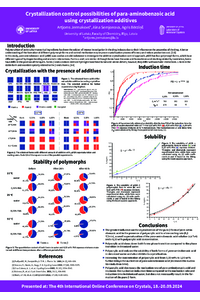
Polymorphism in active pharmaceutical ingredients has been the subject of intense investigation in the drug industry due to its influence on the properties of a drug. A better understanding of the formation of different polymorphic forms and control mechanisms may improve crystallization process efficiency and reduce production costs [1-2].
In this study, para-aminobenzoic acid (pABA) was used as a model substance to investigate the crystallization control approach using additives. pABA has four polymorphic forms, in which there are different types of hydrogen bonding and aromatic interactions [3].
The polymorphic outcome of crystallization of pABA was explored under different conditions by performing evaporation and cooling crystallization from different solvents and in the presence of different additives. For the cooling crystallization, different cooling rates were used. Solid products obtained in the crystallization were characterized by powder X-ray diffraction. The solubility of different pABA polymorphic forms was determined in water and the presence of selected additive. Additionally, induction time measurements were performed to determine the effect of the selected additive on the crystal nucleation rates.
In most cases, the crystallization results with an additive present were the same as those from the pure solvent. However, polyacrylic acid has shown the potential to form a metastable form by cooling crystallization. In the crystallization using the fastest cooling rate, α or β form or their mixture was obtained, but when using the slower cooling rate pure metastable β form was achieved. The solubility of pABA α and β forms in the presence of polyacrylic acid is lower than in water. Additionally, polyacrylic acid slows down the nucleation of pABA.
References:
[1] Pudipeddi, M.; et al. J. Pharm. Sci. 2005, 94 (5), 929–939.
[2] Simone, E.; et. al. CrystEngComm 2015, 17 (48), 9370–9379.
[3] Cruz-Cabeza, et al. CrystEngComm 2019, 21 (13), 2034–2042.
Keywords
PARA-AMINOBENZOIC ACID
POLYMORPHS
CRYSTALLIZATION
X - RAY POWDER DIFRACTION
CRYSTALLIZATION ADDITIVES
Poster
Crystallization control possibilities of para-aminobenzoic acid using crystallization additives by Artjoms Jermakovs Aina Semjonova and Agris Berzin.pdf
Nucleation, nuclei stability, and crystal growth in supercooled organic melts of benzocaine and tolbutamide
The Intricate Magnetic Properties of Co-Mn Ferrite Nanoparticles Studied by Neutron Scattering