Event submissions
Published
This submission belongs to the session S3. Inorganic Crystalline Materials of the event The 4th International Online Conference on Crystals
Published date
18 Sep, 2024
Academic Editor
'%3e%3cpath%20d='M12.6657%2010.9104C12.4185%2010.325%2012.0599%209.79327%2011.6097%209.34482C11.1609%208.89508%2010.6293%208.5365%2010.0442%208.28888C10.0389%208.28626%2010.0337%208.28495%2010.0285%208.28233C10.8446%207.69279%2011.3752%206.73249%2011.3752%205.64904C11.3752%203.8542%209.92103%202.39999%208.1262%202.39999C6.33136%202.39999%204.87715%203.8542%204.87715%205.64904C4.87715%206.73249%205.40774%207.69279%206.22393%208.28364C6.21869%208.28626%206.21345%208.28757%206.20821%208.29019C5.62129%208.5378%205.09463%208.89284%204.64265%209.34613C4.1929%209.79493%203.83432%2010.3266%203.58671%2010.9117C3.34345%2011.4845%203.21226%2012.0987%203.20023%2012.7209C3.19988%2012.7349%203.20233%2012.7488%203.20744%2012.7619C3.21255%2012.7749%203.22022%2012.7867%203.22998%2012.7968C3.23975%2012.8068%203.25142%2012.8147%203.26431%2012.8202C3.2772%2012.8256%203.29105%2012.8284%203.30504%2012.8284H4.09109C4.14874%2012.8284%204.19459%2012.7825%204.1959%2012.7262C4.2221%2011.7148%204.62823%2010.7676%205.34617%2010.0497C6.08899%209.30683%207.0755%208.89808%208.1262%208.89808C9.17689%208.89808%2010.1634%209.30683%2010.9062%2010.0497C11.6242%2010.7676%2012.0303%2011.7148%2012.0565%2012.7262C12.0578%2012.7838%2012.1037%2012.8284%2012.1613%2012.8284H12.9474C12.9613%2012.8284%2012.9752%2012.8256%2012.9881%2012.8202C13.001%2012.8147%2013.0126%2012.8068%2013.0224%2012.7968C13.0322%2012.7867%2013.0398%2012.7749%2013.0449%2012.7619C13.0501%2012.7488%2013.0525%2012.7349%2013.0522%2012.7209C13.0391%2012.0947%2012.9094%2011.4855%2012.6657%2010.9104ZM8.1262%207.9024C7.52486%207.9024%206.9589%207.6679%206.53312%207.24211C6.10733%206.81633%205.87283%206.25037%205.87283%205.64904C5.87283%205.0477%206.10733%204.48174%206.53312%204.05596C6.9589%203.63018%207.52486%203.39567%208.1262%203.39567C8.72753%203.39567%209.29349%203.63018%209.71927%204.05596C10.1451%204.48174%2010.3796%205.0477%2010.3796%205.64904C10.3796%206.25037%2010.1451%206.81633%209.71927%207.24211C9.29349%207.6679%208.72753%207.9024%208.1262%207.9024Z'%20fill='%235D1EE1'/%3e%3c/g%3e%3c/svg%3e) Vladimir Fedin
Vladimir FedinCitation
Vasileios Ntoupis, Christos Michail, Nektarios Kalyvas, George Fountos, Athanasios Bakas, Ioannis Kandarakis, Ioannis Valais, Effective luminescence efficiency and spectral matching of a cerium fluoride crystal scintillator with various optical sensors, in Proceedings of The 4th International Online Conference on Crystals, 18 September–20 September 2024, MDPI: Basel, Switzerland
Share
Email
Facebook
Twitter
LinkedIn
Effective luminescence efficiency and spectral matching of a cerium fluoride crystal scintillator with various optical sensors
'%3e%3cpath%20d='M12.6647%2010.9104C12.4176%2010.325%2012.0589%209.7933%2011.6088%209.34485C11.16%208.89511%2010.6283%208.53653%2010.0432%208.28891C10.038%208.28629%2010.0327%208.28498%2010.0275%208.28236C10.8437%207.69282%2011.3743%206.73252%2011.3743%205.64907C11.3743%203.85423%209.92005%202.40002%208.12522%202.40002C6.33038%202.40002%204.87618%203.85423%204.87618%205.64907C4.87618%206.73252%205.40677%207.69282%206.22296%208.28367C6.21772%208.28629%206.21248%208.2876%206.20724%208.29022C5.62031%208.53783%205.09365%208.89287%204.64167%209.34616C4.19192%209.79496%203.83334%2010.3266%203.58573%2010.9117C3.34247%2011.4846%203.21128%2012.0987%203.19925%2012.721C3.1989%2012.735%203.20135%2012.7489%203.20646%2012.7619C3.21157%2012.7749%203.21924%2012.7868%203.22901%2012.7968C3.23877%2012.8068%203.25045%2012.8148%203.26334%2012.8202C3.27623%2012.8256%203.29007%2012.8284%203.30406%2012.8284H4.09012C4.14776%2012.8284%204.19362%2012.7825%204.19493%2012.7262C4.22113%2011.7148%204.62726%2010.7676%205.34519%2010.0497C6.08802%209.30686%207.07452%208.89811%208.12522%208.89811C9.17592%208.89811%2010.1624%209.30686%2010.9052%2010.0497C11.6232%2010.7676%2012.0293%2011.7148%2012.0555%2012.7262C12.0568%2012.7839%2012.1027%2012.8284%2012.1603%2012.8284H12.9464C12.9604%2012.8284%2012.9742%2012.8256%2012.9871%2012.8202C13%2012.8148%2013.0117%2012.8068%2013.0214%2012.7968C13.0312%2012.7868%2013.0389%2012.7749%2013.044%2012.7619C13.0491%2012.7489%2013.0515%2012.735%2013.0512%2012.721C13.0381%2012.0947%2012.9084%2011.4856%2012.6647%2010.9104ZM8.12522%207.90243C7.52388%207.90243%206.95792%207.66793%206.53214%207.24215C6.10636%206.81636%205.87185%206.2504%205.87185%205.64907C5.87185%205.04773%206.10636%204.48177%206.53214%204.05599C6.95792%203.63021%207.52388%203.3957%208.12522%203.3957C8.72655%203.3957%209.29252%203.63021%209.7183%204.05599C10.1441%204.48177%2010.3786%205.04773%2010.3786%205.64907C10.3786%206.2504%2010.1441%206.81636%209.7183%207.24215C9.29252%207.66793%208.72655%207.90243%208.12522%207.90243Z'%20fill='%235D1EE1'/%3e%3c/g%3e%3c/svg%3e)
Vasileios Ntoupis 1

Christos Michail 1
Nektarios Kalyvas 1

George Fountos 1
Athanasios Bakas 2

Ioannis Kandarakis 1

Ioannis Valais 1
1. Department of Biomedical Engineering, Radiation Physics, Materials Technology and Biomedical Imaging Laborato-ry, University of West Attica, Athens, 12210, Greece
2. Department of Biomedical Sciences, University of West Attica, Athens, 12210, Greece
Abstract
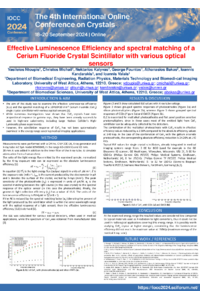
Introduction. The aim of this study was to examine the effective luminescence efficiency (ELE) and the spectral matching of a 10×10×10 mm3 cerium fluoride (CeF3) single-crystal scintillator with various optical sensors. Numerous investigations have shown that CeF3 crystals have a non-proportional response to gamma rays, and they have already been successfully used in high-rate calorimetry, including the Large Hadron Collider's high-luminosity phase experiments. However, the scintillation response of CeF3 has not been systematically examined in the energy range covering medical imaging applications.
Methods. Measurements were performed with a CPI Inc. CMP 200 DR X-ray generator and the X-ray tube IAE SpA model RTM90HS in the range of 60–150 kVp and 63 mAs. Twenty mm of Al was added in addition to the inner filter of the X-ray tube to simulate attenuation from a human chest. The effective luminescence efficiency (ELE) and the spectral matching (SMF) of the scintillator wwere examined with various optical sensors.
Results. The effective luminescence efficiency increases continuously in the examined energy range (60-150 kVp), with the maximum value (0.812 efficiency units (EU) is the S.I. equivalent μWm-2/(mGy/s)) at 150 kVp. With an emission maximum at 314 nm, the optimum effective efficiency was found for a multialkali photocathode (0.81 EU) and the flat-panel position-sensitive photomultiplier (PS-PMT) H8500D-03 (0.808). The corresponding spectral matching (SMF) values were equal to 0.97 for both the multialkali photocathode and the PS-PMT H8500D-03.
Conclusion. Within the examined energy range, the resulting values are considered low compared to those for typical materials used as X-ray radiation-t-light converters; thus, CeF3 could not be used in radiological applications covering this energy range. It is possibly worth studying CeF3 crystals at higher energies considering that the luminescence efficiency did not reach the maximum value at 150 kVp (the maximum energy of the medical X-ray tube).
Keywords
Single crystals
CeF3
effective luminescence efficiency
spectral matching
medical imaging
X-ray
Poster
sciforum-093657_Ntoupis IOCC_2024.pdf
CONE BEAM COMPUTED TOMOGRAPHY: Preliminary studies on novel detector schemes
The temperature-dependent luminescence efficiency of a hygroscopic cerium-doped lanthanum bromide (LaBr3:Ce) single-crystal scintillator