Event submissions
Published
This submission belongs to the session S3. Inorganic Crystalline Materials of the event The 4th International Online Conference on Crystals
Published date
18 Sep, 2024
Academic Editor
'%3e%3cpath%20d='M12.6657%2010.9104C12.4185%2010.325%2012.0599%209.79327%2011.6097%209.34482C11.1609%208.89508%2010.6293%208.5365%2010.0442%208.28888C10.0389%208.28626%2010.0337%208.28495%2010.0285%208.28233C10.8446%207.69279%2011.3752%206.73249%2011.3752%205.64904C11.3752%203.8542%209.92103%202.39999%208.1262%202.39999C6.33136%202.39999%204.87715%203.8542%204.87715%205.64904C4.87715%206.73249%205.40774%207.69279%206.22393%208.28364C6.21869%208.28626%206.21345%208.28757%206.20821%208.29019C5.62129%208.5378%205.09463%208.89284%204.64265%209.34613C4.1929%209.79493%203.83432%2010.3266%203.58671%2010.9117C3.34345%2011.4845%203.21226%2012.0987%203.20023%2012.7209C3.19988%2012.7349%203.20233%2012.7488%203.20744%2012.7619C3.21255%2012.7749%203.22022%2012.7867%203.22998%2012.7968C3.23975%2012.8068%203.25142%2012.8147%203.26431%2012.8202C3.2772%2012.8256%203.29105%2012.8284%203.30504%2012.8284H4.09109C4.14874%2012.8284%204.19459%2012.7825%204.1959%2012.7262C4.2221%2011.7148%204.62823%2010.7676%205.34617%2010.0497C6.08899%209.30683%207.0755%208.89808%208.1262%208.89808C9.17689%208.89808%2010.1634%209.30683%2010.9062%2010.0497C11.6242%2010.7676%2012.0303%2011.7148%2012.0565%2012.7262C12.0578%2012.7838%2012.1037%2012.8284%2012.1613%2012.8284H12.9474C12.9613%2012.8284%2012.9752%2012.8256%2012.9881%2012.8202C13.001%2012.8147%2013.0126%2012.8068%2013.0224%2012.7968C13.0322%2012.7867%2013.0398%2012.7749%2013.0449%2012.7619C13.0501%2012.7488%2013.0525%2012.7349%2013.0522%2012.7209C13.0391%2012.0947%2012.9094%2011.4855%2012.6657%2010.9104ZM8.1262%207.9024C7.52486%207.9024%206.9589%207.6679%206.53312%207.24211C6.10733%206.81633%205.87283%206.25037%205.87283%205.64904C5.87283%205.0477%206.10733%204.48174%206.53312%204.05596C6.9589%203.63018%207.52486%203.39567%208.1262%203.39567C8.72753%203.39567%209.29349%203.63018%209.71927%204.05596C10.1451%204.48174%2010.3796%205.0477%2010.3796%205.64904C10.3796%206.25037%2010.1451%206.81633%209.71927%207.24211C9.29349%207.6679%208.72753%207.9024%208.1262%207.9024Z'%20fill='%235D1EE1'/%3e%3c/g%3e%3c/svg%3e) Alessandra Toncelli
Alessandra ToncelliCitation
Angeliki Martzakli, Ioannis Valais, Stavros Tseremoglou, Nektarios Kalyvas, George Fountos, Athanasios Bakas, Konstantinos Ninos, Ioannis Kandarakis, Christos Michail, The temperature-dependent luminescence efficiency of a hygroscopic cerium-doped lanthanum bromide (LaBr₃:Ce) single-crystal scintillator, in Proceedings of The 4th International Online Conference on Crystals, 18 September–20 September 2024, MDPI: Basel, Switzerland
Share
Email
Facebook
Twitter
LinkedIn
The temperature-dependent luminescence efficiency of a hygroscopic cerium-doped lanthanum bromide (LaBr3:Ce) single-crystal scintillator
'%3e%3cpath%20d='M12.6647%2010.9104C12.4176%2010.325%2012.0589%209.7933%2011.6088%209.34485C11.16%208.89511%2010.6283%208.53653%2010.0432%208.28891C10.038%208.28629%2010.0327%208.28498%2010.0275%208.28236C10.8437%207.69282%2011.3743%206.73252%2011.3743%205.64907C11.3743%203.85423%209.92005%202.40002%208.12522%202.40002C6.33038%202.40002%204.87618%203.85423%204.87618%205.64907C4.87618%206.73252%205.40677%207.69282%206.22296%208.28367C6.21772%208.28629%206.21248%208.2876%206.20724%208.29022C5.62031%208.53783%205.09365%208.89287%204.64167%209.34616C4.19192%209.79496%203.83334%2010.3266%203.58573%2010.9117C3.34247%2011.4846%203.21128%2012.0987%203.19925%2012.721C3.1989%2012.735%203.20135%2012.7489%203.20646%2012.7619C3.21157%2012.7749%203.21924%2012.7868%203.22901%2012.7968C3.23877%2012.8068%203.25045%2012.8148%203.26334%2012.8202C3.27623%2012.8256%203.29007%2012.8284%203.30406%2012.8284H4.09012C4.14776%2012.8284%204.19362%2012.7825%204.19493%2012.7262C4.22113%2011.7148%204.62726%2010.7676%205.34519%2010.0497C6.08802%209.30686%207.07452%208.89811%208.12522%208.89811C9.17592%208.89811%2010.1624%209.30686%2010.9052%2010.0497C11.6232%2010.7676%2012.0293%2011.7148%2012.0555%2012.7262C12.0568%2012.7839%2012.1027%2012.8284%2012.1603%2012.8284H12.9464C12.9604%2012.8284%2012.9742%2012.8256%2012.9871%2012.8202C13%2012.8148%2013.0117%2012.8068%2013.0214%2012.7968C13.0312%2012.7868%2013.0389%2012.7749%2013.044%2012.7619C13.0491%2012.7489%2013.0515%2012.735%2013.0512%2012.721C13.0381%2012.0947%2012.9084%2011.4856%2012.6647%2010.9104ZM8.12522%207.90243C7.52388%207.90243%206.95792%207.66793%206.53214%207.24215C6.10636%206.81636%205.87185%206.2504%205.87185%205.64907C5.87185%205.04773%206.10636%204.48177%206.53214%204.05599C6.95792%203.63021%207.52388%203.3957%208.12522%203.3957C8.72655%203.3957%209.29252%203.63021%209.7183%204.05599C10.1441%204.48177%2010.3786%205.04773%2010.3786%205.64907C10.3786%206.2504%2010.1441%206.81636%209.7183%207.24215C9.29252%207.66793%208.72655%207.90243%208.12522%207.90243Z'%20fill='%235D1EE1'/%3e%3c/g%3e%3c/svg%3e)
Angeliki Martzakli 1

Ioannis Valais 2
Stavros Tseremoglou 1
Nektarios Kalyvas 1

George Fountos 1
Athanasios Bakas 3
Konstantinos Ninos 3

Ioannis Kandarakis 1

Christos Michail 2
1. Department of Biomedical Engineering, Radiation Physics, Materials Technology and Biomedical Imaging Laboratory, University of West Attica, Athens, 12210, Greece
2. Department of Biomedical Engineering, Radiation Physics, Materials Technology and Biomedical Imaging Laboratory, University of West Attica, Athens, 12210, Greece;
3. Department of Biomedical Sciences, University of West Attica, Athens, 12210, Greece
Abstract
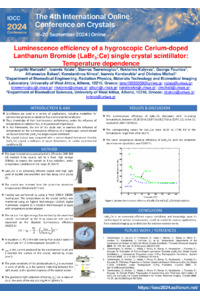
Background. Scintillators are used in a variety of applications, including modalities in environmental conditions of extreme temperature or radiation flux. Thus, knowledge of their luminescence performance under the influence of temperature or radiation flux is of paramount importance. In this framework, the aim of this study was to examine the influence of temperature on the luminescence efficiency of a hygroscopic cerium-doped lanthanum bromide (LaBr3:Ce) single-crystal scintillator. The crystal output was compared with a cerium-doped lanthanum chloride (LaCl3:Ce) crystal scintillator of equal dimensions, in similar experimental conditions.
Materials and Methods. The experimental setup comprised a CPI series CMP 200 DR medical X-ray source set to a fixed high voltage (90kVp) to expose the sample to X-ray radiation under temperature conditions in the range of 23–154 oC. LaBr3:Ce is an extremely efficient crystal, with a high light yield of 63,000 photons/MeV and a fast decay time (25ns). The crystal was removed from the protective aluminum encapsulation (thickness 0.7 mm). Heating was performed using a Perel 3700-9 2000W heating gun. The temperature on the crystal surface was monitored using an Agilent Technologies U1253A digital multimeter, coupled to a U1185A thermocouple (J-Type) with a temperature probe adapter.
Results. The luminescence efficiency of LaBr3:Ce decreases with increasing temperature, from 69.58 EU at 23.0oC to 18.27 EU at 154oC (EU is the S.I. equivalent μWm-2/(mGy/s). The corresponding values for LaCl3:Ce were 33.14 to 17.96 EU in the temperature range from 29 to 162 oC. The room-temperature absolute efficiency of LaBr3:Ce, with the protective aluminum encapsulation, was 50.02 EU.
Conclusion. LaBr3:Ce is an extremely efficient crystal scintillator and knowledge of its performance in various temperatures could be useful for various applications, from medical imaging to detectors for extreme environments.
Keywords
Single crystals
LaBr3:Ce
thermal behavior
extreme environments
medical imaging
Poster
Sciforum-093646_Martzakli IOCC_2024.pdf
Effective luminescence efficiency and spectral matching of a cerium fluoride crystal scintillator with various optical sensors
Disorder effects in magnetic properties and electronic structure of orthorhombic Mn2TiGe