Event submissions
Published
This submission belongs to the session S4. Organic Crystalline Materials of the event The 4th International Online Conference on Crystals
Published date
18 Sep, 2024
Academic Editor
'%3e%3cpath%20d='M12.6657%2010.9104C12.4185%2010.325%2012.0599%209.79327%2011.6097%209.34482C11.1609%208.89508%2010.6293%208.5365%2010.0442%208.28888C10.0389%208.28626%2010.0337%208.28495%2010.0285%208.28233C10.8446%207.69279%2011.3752%206.73249%2011.3752%205.64904C11.3752%203.8542%209.92103%202.39999%208.1262%202.39999C6.33136%202.39999%204.87715%203.8542%204.87715%205.64904C4.87715%206.73249%205.40774%207.69279%206.22393%208.28364C6.21869%208.28626%206.21345%208.28757%206.20821%208.29019C5.62129%208.5378%205.09463%208.89284%204.64265%209.34613C4.1929%209.79493%203.83432%2010.3266%203.58671%2010.9117C3.34345%2011.4845%203.21226%2012.0987%203.20023%2012.7209C3.19988%2012.7349%203.20233%2012.7488%203.20744%2012.7619C3.21255%2012.7749%203.22022%2012.7867%203.22998%2012.7968C3.23975%2012.8068%203.25142%2012.8147%203.26431%2012.8202C3.2772%2012.8256%203.29105%2012.8284%203.30504%2012.8284H4.09109C4.14874%2012.8284%204.19459%2012.7825%204.1959%2012.7262C4.2221%2011.7148%204.62823%2010.7676%205.34617%2010.0497C6.08899%209.30683%207.0755%208.89808%208.1262%208.89808C9.17689%208.89808%2010.1634%209.30683%2010.9062%2010.0497C11.6242%2010.7676%2012.0303%2011.7148%2012.0565%2012.7262C12.0578%2012.7838%2012.1037%2012.8284%2012.1613%2012.8284H12.9474C12.9613%2012.8284%2012.9752%2012.8256%2012.9881%2012.8202C13.001%2012.8147%2013.0126%2012.8068%2013.0224%2012.7968C13.0322%2012.7867%2013.0398%2012.7749%2013.0449%2012.7619C13.0501%2012.7488%2013.0525%2012.7349%2013.0522%2012.7209C13.0391%2012.0947%2012.9094%2011.4855%2012.6657%2010.9104ZM8.1262%207.9024C7.52486%207.9024%206.9589%207.6679%206.53312%207.24211C6.10733%206.81633%205.87283%206.25037%205.87283%205.64904C5.87283%205.0477%206.10733%204.48174%206.53312%204.05596C6.9589%203.63018%207.52486%203.39567%208.1262%203.39567C8.72753%203.39567%209.29349%203.63018%209.71927%204.05596C10.1451%204.48174%2010.3796%205.0477%2010.3796%205.64904C10.3796%206.25037%2010.1451%206.81633%209.71927%207.24211C9.29349%207.6679%208.72753%207.9024%208.1262%207.9024Z'%20fill='%235D1EE1'/%3e%3c/g%3e%3c/svg%3e) Rodolfo Reda
Rodolfo RedaCitation
Tomislav Balic, Maja Molnar, Dominik Cinčić, Mario Komar, Milenko Korica, Vinko Nemec, Structural and thermal properties of 3-substituted quinazoline Schiff base conjugates , in Proceedings of The 4th International Online Conference on Crystals, 18 September–20 September 2024, MDPI: Basel, Switzerland
Share
Email
Facebook
Twitter
LinkedIn
Structural and thermal properties of 3-substituted quinazoline Schiff base conjugates
'%3e%3cpath%20d='M12.6647%2010.9104C12.4176%2010.325%2012.0589%209.7933%2011.6088%209.34485C11.16%208.89511%2010.6283%208.53653%2010.0432%208.28891C10.038%208.28629%2010.0327%208.28498%2010.0275%208.28236C10.8437%207.69282%2011.3743%206.73252%2011.3743%205.64907C11.3743%203.85423%209.92005%202.40002%208.12522%202.40002C6.33038%202.40002%204.87618%203.85423%204.87618%205.64907C4.87618%206.73252%205.40677%207.69282%206.22296%208.28367C6.21772%208.28629%206.21248%208.2876%206.20724%208.29022C5.62031%208.53783%205.09365%208.89287%204.64167%209.34616C4.19192%209.79496%203.83334%2010.3266%203.58573%2010.9117C3.34247%2011.4846%203.21128%2012.0987%203.19925%2012.721C3.1989%2012.735%203.20135%2012.7489%203.20646%2012.7619C3.21157%2012.7749%203.21924%2012.7868%203.22901%2012.7968C3.23877%2012.8068%203.25045%2012.8148%203.26334%2012.8202C3.27623%2012.8256%203.29007%2012.8284%203.30406%2012.8284H4.09012C4.14776%2012.8284%204.19362%2012.7825%204.19493%2012.7262C4.22113%2011.7148%204.62726%2010.7676%205.34519%2010.0497C6.08802%209.30686%207.07452%208.89811%208.12522%208.89811C9.17592%208.89811%2010.1624%209.30686%2010.9052%2010.0497C11.6232%2010.7676%2012.0293%2011.7148%2012.0555%2012.7262C12.0568%2012.7839%2012.1027%2012.8284%2012.1603%2012.8284H12.9464C12.9604%2012.8284%2012.9742%2012.8256%2012.9871%2012.8202C13%2012.8148%2013.0117%2012.8068%2013.0214%2012.7968C13.0312%2012.7868%2013.0389%2012.7749%2013.044%2012.7619C13.0491%2012.7489%2013.0515%2012.735%2013.0512%2012.721C13.0381%2012.0947%2012.9084%2011.4856%2012.6647%2010.9104ZM8.12522%207.90243C7.52388%207.90243%206.95792%207.66793%206.53214%207.24215C6.10636%206.81636%205.87185%206.2504%205.87185%205.64907C5.87185%205.04773%206.10636%204.48177%206.53214%204.05599C6.95792%203.63021%207.52388%203.3957%208.12522%203.3957C8.72655%203.3957%209.29252%203.63021%209.7183%204.05599C10.1441%204.48177%2010.3786%205.04773%2010.3786%205.64907C10.3786%206.2504%2010.1441%206.81636%209.7183%207.24215C9.29252%207.66793%208.72655%207.90243%208.12522%207.90243Z'%20fill='%235D1EE1'/%3e%3c/g%3e%3c/svg%3e)
Tomislav Balic 1

Maja Molnar 2

Dominik Cinčić 3
Mario Komar 2
Milenko Korica 1
Vinko Nemec 3
1. Department of Chemistry, Josip Juraj Strossmayer University of Osijek, Cara Hadrijana 8/A, 31000 Osijek, Croatia
2. Faculty of Food Technology Osijek, Josip Juraj Strossmayer University of Osijek, Croatia
3. Department of Chemistry, Faculty of Science, University of Zagreb, Horvatovac 102a, HR-10000 Zagreb, Croatia
Abstract
Quinazoline Schiff base conjugates have recently attracted considerable attention from the scientific community due to their potential application as anti-cancer drugs and promising multidentate ligands. Unfortunately, reports dealing with the structural characterization of these compounds are incomprehensibly scarce. To contribute and explore the supramolecular features of these perspective compounds, we have prepared and crystalized four quinazoline Schiff base conjugates (SB1= 3-{(E)-[(2,4-dihydroxyphenyl)methylidene]amino}-2-methylquinazolin-4(3H)-one, SB4= 3-{(E)-[(2-chlorophenyl)methylidene]amino}-2-methylquinazolin-4(3H)-one, SB8= 3-{(E)-[(2,3-dihydroxyphenyl)methylidene]amino}-2-methylquinazolin-4(3H)-one, and SB21= 3-[(E)-benzylideneamino]-2-methylquinazolin-4(3H)-one). Single crystals were obtained by recrystallization of the crude products from different solvents, and crystal structures were determined by a single crystal X-ray diffraction. The prepared compounds can be described as Schiff bases composed of 2-methyl-quinazoline-4-one moiety and differently substituted benzene moieties connected by the imine bond. Considering their molecular structure, these compounds are similar, with the most pronounced differences being in the dihedral angle between aromatic systems. In the crystal, compounds with OH groups on the benzene ring (SB1 and SB8) are primarily connected by strong O-H∙∙∙N hydrogen bonds, and unsubstituted (SB21) and Cl-substituted (SB4) compounds via N-H∙∙∙O hydrogen bonds and π∙∙∙π interactions. Thermal analysis results have shown that the highest melting point compound is 2,4-OH-substituted SB1 (226 °C), followed by 2,3-OH-substituted SB8 (201 °C), unsubstituted SB21 (192 °C); the lowest melting was found with Cl-substituted SB4 (159 °C). Additional Hirshfeld surface analysis and intermolecular energy calculations indicate that the electrostatic interactions (hydrogen bonds) have the largest impact on thermal stability, and that the dispersive interactions are important for stability but can be sterically hindered by bulky substituents on aromatic systems.
Keywords
quinazoline
Schiff bases
single-crystal X-ray diffraction
thermal properties
intermolecular interactions
Poster
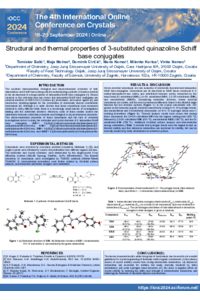
TBalic et_al_Structural and thermal properties of 3-substituted quinazoline Schiff base conjugates.pdf
Study of the percolation effect in the luminescent structure of ZnS:Cu,Br phosphors on improving their radioluminescence
Screening Conditions for the Synthesis of Crystalline Spherical Clusters using 5-Hydroxynicotinic Acid