Event submissions
Published
This submission belongs to the session S2. Crystal Engineering of the event The 4th International Online Conference on Crystals
Published date
18 Sep, 2024
Academic Editor
'%3e%3cpath%20d='M12.6657%2010.9104C12.4185%2010.325%2012.0599%209.79327%2011.6097%209.34482C11.1609%208.89508%2010.6293%208.5365%2010.0442%208.28888C10.0389%208.28626%2010.0337%208.28495%2010.0285%208.28233C10.8446%207.69279%2011.3752%206.73249%2011.3752%205.64904C11.3752%203.8542%209.92103%202.39999%208.1262%202.39999C6.33136%202.39999%204.87715%203.8542%204.87715%205.64904C4.87715%206.73249%205.40774%207.69279%206.22393%208.28364C6.21869%208.28626%206.21345%208.28757%206.20821%208.29019C5.62129%208.5378%205.09463%208.89284%204.64265%209.34613C4.1929%209.79493%203.83432%2010.3266%203.58671%2010.9117C3.34345%2011.4845%203.21226%2012.0987%203.20023%2012.7209C3.19988%2012.7349%203.20233%2012.7488%203.20744%2012.7619C3.21255%2012.7749%203.22022%2012.7867%203.22998%2012.7968C3.23975%2012.8068%203.25142%2012.8147%203.26431%2012.8202C3.2772%2012.8256%203.29105%2012.8284%203.30504%2012.8284H4.09109C4.14874%2012.8284%204.19459%2012.7825%204.1959%2012.7262C4.2221%2011.7148%204.62823%2010.7676%205.34617%2010.0497C6.08899%209.30683%207.0755%208.89808%208.1262%208.89808C9.17689%208.89808%2010.1634%209.30683%2010.9062%2010.0497C11.6242%2010.7676%2012.0303%2011.7148%2012.0565%2012.7262C12.0578%2012.7838%2012.1037%2012.8284%2012.1613%2012.8284H12.9474C12.9613%2012.8284%2012.9752%2012.8256%2012.9881%2012.8202C13.001%2012.8147%2013.0126%2012.8068%2013.0224%2012.7968C13.0322%2012.7867%2013.0398%2012.7749%2013.0449%2012.7619C13.0501%2012.7488%2013.0525%2012.7349%2013.0522%2012.7209C13.0391%2012.0947%2012.9094%2011.4855%2012.6657%2010.9104ZM8.1262%207.9024C7.52486%207.9024%206.9589%207.6679%206.53312%207.24211C6.10733%206.81633%205.87283%206.25037%205.87283%205.64904C5.87283%205.0477%206.10733%204.48174%206.53312%204.05596C6.9589%203.63018%207.52486%203.39567%208.1262%203.39567C8.72753%203.39567%209.29349%203.63018%209.71927%204.05596C10.1451%204.48174%2010.3796%205.0477%2010.3796%205.64904C10.3796%206.25037%2010.1451%206.81633%209.71927%207.24211C9.29349%207.6679%208.72753%207.9024%208.1262%207.9024Z'%20fill='%235D1EE1'/%3e%3c/g%3e%3c/svg%3e) David Cordes
David CordesCitation
Catarina Veríssimo Esteves, Screening Conditions for the Synthesis of Crystalline Spherical Clusters using 5-Hydroxynicotinic Acid, in Proceedings of The 4th International Online Conference on Crystals, 18 September–20 September 2024, MDPI: Basel, Switzerland
Share
Email
Facebook
Twitter
LinkedIn
Screening Conditions for the Synthesis of Crystalline Spherical Clusters using 5-Hydroxynicotinic Acid

Catarina Veríssimo Esteves 1,2,3
1. Centro de Química Estrutural, Institute of Molecular Sciences, Faculdade de Ciências, Universidade de Lisboa, 1749-016 Lisboa, Portugal
2. LAQV-REQUIMTE, Chemistry Department, NOVA School of Science and Technology, NOVA University of Lisbon, 2829-516 Caparica, Portugal
3. Departamento de Engenharia Química e Biológica, Escola Superior de Tecnologia do Barreiro, Instituto Politécnico de Setúbal
Abstract
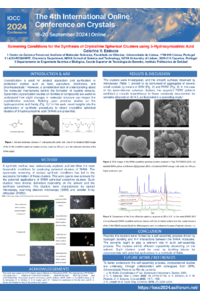
Crystallization is used for product separation and purification in production sectors such as food, agriculture, electronics, and pharmaceuticals.1 However, a considerable lack of understanding about the molecular mechanisms behind the formation of crystals remains. Systematic solubility and crystallization studies on families of compounds are useful to understand how slight changes in molecular structure can impact the crystallization outcome. Building upon previous studies on the hydroxynicotinic acid family,2 in this work, novel insights into the optimization of synthetic procedures to obtain crystalline spherical clusters of 5-hydroxynicotinic acid (5HNA) are presented. This work meticulously explores and identifies the most favourable conditions for producing spherical clusters of 5HNA. The systematic screening of various synthetic conditions has led to the successful formation of these clusters. This work opens up new avenues for the potential applications of 5HNA spherical crystalline clusters. Such clusters have diverse diameters depending on the solvent and the synthesis conditions. The clusters were characterized by means of optical microscopy, scanning electron microscopy (SEM), and powder X-ray diffraction (PXRD). The clusters were possibly formed through a self-assembly process driven by hydrogen bonding and π–π interactions between the 5HNA molecules. The solvents ought to play a relevant role in such a self-assembly process. The clusters exhibit different crystallinity depending on the solvent. Such clusters could be used as building blocks for nanomaterials with potential applications in a multitude of fields.
References
- J. W. Mullin Crystallization 4th ed., Butterworth-Heinemann, Boston, 2001.
- C. V. Esteves, New J. Chem. 2022, 46, 21124-21135; A. V. Johnson, M. F. M. Piedade, C. V. Esteves, Crystals 2023, 13(7), 1062.
Keywords
5-hydroxynicotinic acid
crystallization
spherical clusters
Poster
CVEsteves Poster using Template.pdf
Structural and thermal properties of 3-substituted quinazoline Schiff base conjugates
New antimicrobial systems based on zeolites with RE = La, Gd functional ions