Event submissions
Published
This submission belongs to the session S5. Hybrid and Composite Crystalline Materials of the event The 4th International Online Conference on Crystals
Published date
18 Sep, 2024
Academic Editor
'%3e%3cpath%20d='M12.6657%2010.9104C12.4185%2010.325%2012.0599%209.79327%2011.6097%209.34482C11.1609%208.89508%2010.6293%208.5365%2010.0442%208.28888C10.0389%208.28626%2010.0337%208.28495%2010.0285%208.28233C10.8446%207.69279%2011.3752%206.73249%2011.3752%205.64904C11.3752%203.8542%209.92103%202.39999%208.1262%202.39999C6.33136%202.39999%204.87715%203.8542%204.87715%205.64904C4.87715%206.73249%205.40774%207.69279%206.22393%208.28364C6.21869%208.28626%206.21345%208.28757%206.20821%208.29019C5.62129%208.5378%205.09463%208.89284%204.64265%209.34613C4.1929%209.79493%203.83432%2010.3266%203.58671%2010.9117C3.34345%2011.4845%203.21226%2012.0987%203.20023%2012.7209C3.19988%2012.7349%203.20233%2012.7488%203.20744%2012.7619C3.21255%2012.7749%203.22022%2012.7867%203.22998%2012.7968C3.23975%2012.8068%203.25142%2012.8147%203.26431%2012.8202C3.2772%2012.8256%203.29105%2012.8284%203.30504%2012.8284H4.09109C4.14874%2012.8284%204.19459%2012.7825%204.1959%2012.7262C4.2221%2011.7148%204.62823%2010.7676%205.34617%2010.0497C6.08899%209.30683%207.0755%208.89808%208.1262%208.89808C9.17689%208.89808%2010.1634%209.30683%2010.9062%2010.0497C11.6242%2010.7676%2012.0303%2011.7148%2012.0565%2012.7262C12.0578%2012.7838%2012.1037%2012.8284%2012.1613%2012.8284H12.9474C12.9613%2012.8284%2012.9752%2012.8256%2012.9881%2012.8202C13.001%2012.8147%2013.0126%2012.8068%2013.0224%2012.7968C13.0322%2012.7867%2013.0398%2012.7749%2013.0449%2012.7619C13.0501%2012.7488%2013.0525%2012.7349%2013.0522%2012.7209C13.0391%2012.0947%2012.9094%2011.4855%2012.6657%2010.9104ZM8.1262%207.9024C7.52486%207.9024%206.9589%207.6679%206.53312%207.24211C6.10733%206.81633%205.87283%206.25037%205.87283%205.64904C5.87283%205.0477%206.10733%204.48174%206.53312%204.05596C6.9589%203.63018%207.52486%203.39567%208.1262%203.39567C8.72753%203.39567%209.29349%203.63018%209.71927%204.05596C10.1451%204.48174%2010.3796%205.0477%2010.3796%205.64904C10.3796%206.25037%2010.1451%206.81633%209.71927%207.24211C9.29349%207.6679%208.72753%207.9024%208.1262%207.9024Z'%20fill='%235D1EE1'/%3e%3c/g%3e%3c/svg%3e) Ferdinando Costantino
Ferdinando CostantinoCitation
Elena N. Domoroshchina, Daria A Tarkhanova, Galina M Kuz'micheva, Raisa P Terekhova, New antimicrobial systems based on zeolites with RE = La, Gd functional ions, in Proceedings of The 4th International Online Conference on Crystals, 18 September–20 September 2024, MDPI: Basel, Switzerland
Share
Email
Facebook
Twitter
LinkedIn
New antimicrobial systems based on zeolites with RE = La, Gd functional ions
'%3e%3cpath%20d='M12.6647%2010.9104C12.4176%2010.325%2012.0589%209.7933%2011.6088%209.34485C11.16%208.89511%2010.6283%208.53653%2010.0432%208.28891C10.038%208.28629%2010.0327%208.28498%2010.0275%208.28236C10.8437%207.69282%2011.3743%206.73252%2011.3743%205.64907C11.3743%203.85423%209.92005%202.40002%208.12522%202.40002C6.33038%202.40002%204.87618%203.85423%204.87618%205.64907C4.87618%206.73252%205.40677%207.69282%206.22296%208.28367C6.21772%208.28629%206.21248%208.2876%206.20724%208.29022C5.62031%208.53783%205.09365%208.89287%204.64167%209.34616C4.19192%209.79496%203.83334%2010.3266%203.58573%2010.9117C3.34247%2011.4846%203.21128%2012.0987%203.19925%2012.721C3.1989%2012.735%203.20135%2012.7489%203.20646%2012.7619C3.21157%2012.7749%203.21924%2012.7868%203.22901%2012.7968C3.23877%2012.8068%203.25045%2012.8148%203.26334%2012.8202C3.27623%2012.8256%203.29007%2012.8284%203.30406%2012.8284H4.09012C4.14776%2012.8284%204.19362%2012.7825%204.19493%2012.7262C4.22113%2011.7148%204.62726%2010.7676%205.34519%2010.0497C6.08802%209.30686%207.07452%208.89811%208.12522%208.89811C9.17592%208.89811%2010.1624%209.30686%2010.9052%2010.0497C11.6232%2010.7676%2012.0293%2011.7148%2012.0555%2012.7262C12.0568%2012.7839%2012.1027%2012.8284%2012.1603%2012.8284H12.9464C12.9604%2012.8284%2012.9742%2012.8256%2012.9871%2012.8202C13%2012.8148%2013.0117%2012.8068%2013.0214%2012.7968C13.0312%2012.7868%2013.0389%2012.7749%2013.044%2012.7619C13.0491%2012.7489%2013.0515%2012.735%2013.0512%2012.721C13.0381%2012.0947%2012.9084%2011.4856%2012.6647%2010.9104ZM8.12522%207.90243C7.52388%207.90243%206.95792%207.66793%206.53214%207.24215C6.10636%206.81636%205.87185%206.2504%205.87185%205.64907C5.87185%205.04773%206.10636%204.48177%206.53214%204.05599C6.95792%203.63021%207.52388%203.3957%208.12522%203.3957C8.72655%203.3957%209.29252%203.63021%209.7183%204.05599C10.1441%204.48177%2010.3786%205.04773%2010.3786%205.64907C10.3786%206.2504%2010.1441%206.81636%209.7183%207.24215C9.29252%207.66793%208.72655%207.90243%208.12522%207.90243Z'%20fill='%235D1EE1'/%3e%3c/g%3e%3c/svg%3e)
Elena N. Domoroshchina 1
Daria A Tarkhanova 1

Galina M Kuz'micheva 1
Raisa P Terekhova 2
1. MIREA - Russian Technological University
2. Vishnevsky Institute of Surgery
Abstract
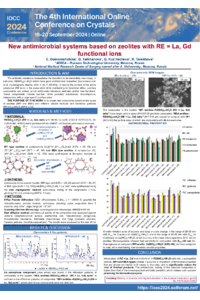
Antibiotic resistance necessitates the transition to fundamentally new drugs, in particular RE(NO3)3× xH2O salts [1]. To reduce the active substance (RE ion) content in drugs while maintaining their functionality, RE/MFI and RE/BEA systems based on MFI and BEA zeolites are offered.
Composites with MFI ((Hx)[(Fe3+xSi4+12-x)O24] with Si/Fe=25,68: MFI(Fe25), MFI(Fe68); [(Ti4+xSi4+12-x)O24] with Si/Ti=47,60: MFI(Ti47), (MFI(Ti60)); and BEA ((Hx)[(Al3+xSi4+12-x)O24] with Si/Al=12,150: BEA(Al12), BEA(Al150)) and RE(NO3)3×6H2O (RE=La,Gd) salts were obtained using the cold impregnation method, with solid-phase mixing of the components (1:1.2), grinding (~4 minutes), and annealing (250°C, 1 hour).
The compositions of RE/BEA include amorphous components. Moreover, the samples differ in their particle/associate sizes (N, µm), which are greater with MFI (N=12.5-35 µm) than with BEA (N=7.5-8 µm), except for RE/MFI(Ti60).
The growth inhibition zones (D,mm) of the bacteria S.aureus, E.coli, P.aeruginosa, A.baumannii, and K.Pneumonia and the fungi C.albicans, C.glabrata, and C.parapsilosis on the salts change from D=28 to D=50 mm with Dmax for S.aureus on Gd; from D=45 to D=56 mm with Dmax for C.albicans on La, which is a record for these microorganisms; and D=0 mm for zeolites. The microorganisms showed high sensitivity to the composites—A.baumannii and P.aeruginosa with Dmax=38 mm on Gd/MFI(Ti60) and Gd/MFI(Fe68); and C.parapsilosis with Dmax= 45 mm on Gd/MFI(Fe68)—but less compared to that seen for the salts, while maintaining their excellent biocidal properties. Аll the new systems demonstrated antimicrobial activity higher than that of the antibiotic penicillin, which makes them promising for biomedical purposes.
Funding: Funding was received from the Ministry of Science and Higher Education of the Russian Federation, grant number FSFZ-2024-0003.
[1] Kuz’micheva G.M. et all. Crystallography Reports. 2020. V. 65. P. 922-932.
Keywords
composites
MFI type zeolites
BEA type zeolites
lanthanum and gadolinium nitrates
antimicrobial activity
Poster
Poster_Domoroshchina (1).pdf
Screening Conditions for the Synthesis of Crystalline Spherical Clusters using 5-Hydroxynicotinic Acid
Lithium adsorption properties of two-dimensional chromium nitride