Event submissions
Published
This submission belongs to the session S2. Forest Biodiversity, Ecosystem Services, and Earth Observations of the event The 4th International Electronic Conference on Forests
Published date
19 Sep, 2024
Academic Editor
'%3e%3cpath%20d='M12.6657%2010.9104C12.4185%2010.325%2012.0599%209.79327%2011.6097%209.34482C11.1609%208.89508%2010.6293%208.5365%2010.0442%208.28888C10.0389%208.28626%2010.0337%208.28495%2010.0285%208.28233C10.8446%207.69279%2011.3752%206.73249%2011.3752%205.64904C11.3752%203.8542%209.92103%202.39999%208.1262%202.39999C6.33136%202.39999%204.87715%203.8542%204.87715%205.64904C4.87715%206.73249%205.40774%207.69279%206.22393%208.28364C6.21869%208.28626%206.21345%208.28757%206.20821%208.29019C5.62129%208.5378%205.09463%208.89284%204.64265%209.34613C4.1929%209.79493%203.83432%2010.3266%203.58671%2010.9117C3.34345%2011.4845%203.21226%2012.0987%203.20023%2012.7209C3.19988%2012.7349%203.20233%2012.7488%203.20744%2012.7619C3.21255%2012.7749%203.22022%2012.7867%203.22998%2012.7968C3.23975%2012.8068%203.25142%2012.8147%203.26431%2012.8202C3.2772%2012.8256%203.29105%2012.8284%203.30504%2012.8284H4.09109C4.14874%2012.8284%204.19459%2012.7825%204.1959%2012.7262C4.2221%2011.7148%204.62823%2010.7676%205.34617%2010.0497C6.08899%209.30683%207.0755%208.89808%208.1262%208.89808C9.17689%208.89808%2010.1634%209.30683%2010.9062%2010.0497C11.6242%2010.7676%2012.0303%2011.7148%2012.0565%2012.7262C12.0578%2012.7838%2012.1037%2012.8284%2012.1613%2012.8284H12.9474C12.9613%2012.8284%2012.9752%2012.8256%2012.9881%2012.8202C13.001%2012.8147%2013.0126%2012.8068%2013.0224%2012.7968C13.0322%2012.7867%2013.0398%2012.7749%2013.0449%2012.7619C13.0501%2012.7488%2013.0525%2012.7349%2013.0522%2012.7209C13.0391%2012.0947%2012.9094%2011.4855%2012.6657%2010.9104ZM8.1262%207.9024C7.52486%207.9024%206.9589%207.6679%206.53312%207.24211C6.10733%206.81633%205.87283%206.25037%205.87283%205.64904C5.87283%205.0477%206.10733%204.48174%206.53312%204.05596C6.9589%203.63018%207.52486%203.39567%208.1262%203.39567C8.72753%203.39567%209.29349%203.63018%209.71927%204.05596C10.1451%204.48174%2010.3796%205.0477%2010.3796%205.64904C10.3796%206.25037%2010.1451%206.81633%209.71927%207.24211C9.29349%207.6679%208.72753%207.9024%208.1262%207.9024Z'%20fill='%235D1EE1'/%3e%3c/g%3e%3c/svg%3e) Tianxiang Yue
Tianxiang YueCitation
Mario Juan Pastorino, Melisa Blackhall, Cecilia Nuñez, Sofía González, Florencia Uehara, Luciana Ghermandi, Pedro Laterra, Facts speak louder than words: an environmentalist message against the invasion of pine trees through citizen participation in manual removal campaigns, in Proceedings of The 4th International Electronic Conference on Forests, 23 September–25 September 2024, MDPI: Basel, Switzerland
Share
Email
Facebook
Twitter
LinkedIn
Facts speak louder than words: an environmentalist message against the invasion of pine trees through citizen participation in manual removal campaigns
'%3e%3cpath%20d='M12.6647%2010.9104C12.4176%2010.325%2012.0589%209.7933%2011.6088%209.34485C11.16%208.89511%2010.6283%208.53653%2010.0432%208.28891C10.038%208.28629%2010.0327%208.28498%2010.0275%208.28236C10.8437%207.69282%2011.3743%206.73252%2011.3743%205.64907C11.3743%203.85423%209.92005%202.40002%208.12522%202.40002C6.33038%202.40002%204.87618%203.85423%204.87618%205.64907C4.87618%206.73252%205.40677%207.69282%206.22296%208.28367C6.21772%208.28629%206.21248%208.2876%206.20724%208.29022C5.62031%208.53783%205.09365%208.89287%204.64167%209.34616C4.19192%209.79496%203.83334%2010.3266%203.58573%2010.9117C3.34247%2011.4846%203.21128%2012.0987%203.19925%2012.721C3.1989%2012.735%203.20135%2012.7489%203.20646%2012.7619C3.21157%2012.7749%203.21924%2012.7868%203.22901%2012.7968C3.23877%2012.8068%203.25045%2012.8148%203.26334%2012.8202C3.27623%2012.8256%203.29007%2012.8284%203.30406%2012.8284H4.09012C4.14776%2012.8284%204.19362%2012.7825%204.19493%2012.7262C4.22113%2011.7148%204.62726%2010.7676%205.34519%2010.0497C6.08802%209.30686%207.07452%208.89811%208.12522%208.89811C9.17592%208.89811%2010.1624%209.30686%2010.9052%2010.0497C11.6232%2010.7676%2012.0293%2011.7148%2012.0555%2012.7262C12.0568%2012.7839%2012.1027%2012.8284%2012.1603%2012.8284H12.9464C12.9604%2012.8284%2012.9742%2012.8256%2012.9871%2012.8202C13%2012.8148%2013.0117%2012.8068%2013.0214%2012.7968C13.0312%2012.7868%2013.0389%2012.7749%2013.044%2012.7619C13.0491%2012.7489%2013.0515%2012.735%2013.0512%2012.721C13.0381%2012.0947%2012.9084%2011.4856%2012.6647%2010.9104ZM8.12522%207.90243C7.52388%207.90243%206.95792%207.66793%206.53214%207.24215C6.10636%206.81636%205.87185%206.2504%205.87185%205.64907C5.87185%205.04773%206.10636%204.48177%206.53214%204.05599C6.95792%203.63021%207.52388%203.3957%208.12522%203.3957C8.72655%203.3957%209.29252%203.63021%209.7183%204.05599C10.1441%204.48177%2010.3786%205.04773%2010.3786%205.64907C10.3786%206.2504%2010.1441%206.81636%209.7183%207.24215C9.29252%207.66793%208.72655%207.90243%208.12522%207.90243Z'%20fill='%235D1EE1'/%3e%3c/g%3e%3c/svg%3e)
Mario Juan Pastorino 1
Melisa Blackhall 2
Cecilia Nuñez 3
Sofía González 2
Florencia Uehara 4
Luciana Ghermandi 2
Pedro Laterra 5,6
1. Instituto Nacional de Tecnología Agropecuaria, EEA Bariloche, IFAB (INTA - CONICET)
2. Instituto de Investigaciones en Biodiversidad y Medioambiente (CONICET -UNComa)
3. Administración de Parques Nacionales, Dirección Regional Patagonia Norte
4. Comisión Nacional de Energía Atómica, Centro atómico Bariloche, Sección Protección Ambiental
5. Fundación Bariloche
6. CCT CONICET Patagonia Norte
Abstract
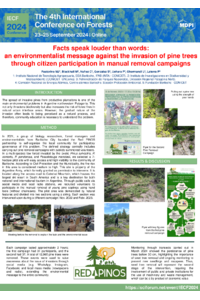
The spread of invasive pines from productive plantations is one of the main environmental problems in Argentine northern Patagonia. This not only threatens biodiversity but also increases the risk of forest fires in natural–urban interface areas. However, the gradual nature of the invasion often leads to its being perceived as a natural process, and therefore, community education is necessary to understand the problem. In 2021, a group of scientific researchers, forest managers and environmentalists from Bariloche founded the Red PINOS partnership to self-organize the local community for participatory governance of this problem. The defined strategy centrally includes carrying out pine removal campaigns with publicly summoned volunteers. So far, we have conducted two campaigns (November 2022 and February 2023) at a pilot site of 7 hectares in a central area of Bariloche, located on the access road to the most important ski center in South America. This area, a multi-specific low forest, is invaded by Pinus sylvestris, P. contorta, P. ponderosa and Pseudotsuga menziesii. Over the two campaigns, 12,965 pine trees, up to 1.5 m tall, were manually removed with the participation of 34 volunteers within two hours each time (an average of 195.5 pine trees per person). These events were used to raise awareness about the issue of invasions through social media (e.g. WhatsApp, Instagram, Facebook) and local mass media (newspapers and radio), extending the environmental message to the entire community. Monitoring through transects carried out in March 2024 showed the persistence of pine trees below 30 cm, highlighting the importance of seed tree removal and ongoing monitoring to prevent new seedlings and escapees. Thus, seed tree removal will represent the second stage of the intervention, requiring the involvement of public and private institutions for the use of machinery and waste management, which can be a by-product of economic value.
Keywords
Forest restoration
Patagonia
biological invasions
public awareness
Poster
sciforum-099988_MarioJuanPastorino.pdf
The Distribution and population structure of the coffee wild relative Coffea racemosa in southern and central Mozambique
Content of lutetium in wild soil mushrooms from Leicester city and surroundings areas in England