Event submissions
Published
This submission belongs to the session S2. Forest Biodiversity, Ecosystem Services, and Earth Observations of the event The 4th International Electronic Conference on Forests
Published date
19 Sep, 2024
Academic Editor
'%3e%3cpath%20d='M12.6657%2010.9104C12.4185%2010.325%2012.0599%209.79327%2011.6097%209.34482C11.1609%208.89508%2010.6293%208.5365%2010.0442%208.28888C10.0389%208.28626%2010.0337%208.28495%2010.0285%208.28233C10.8446%207.69279%2011.3752%206.73249%2011.3752%205.64904C11.3752%203.8542%209.92103%202.39999%208.1262%202.39999C6.33136%202.39999%204.87715%203.8542%204.87715%205.64904C4.87715%206.73249%205.40774%207.69279%206.22393%208.28364C6.21869%208.28626%206.21345%208.28757%206.20821%208.29019C5.62129%208.5378%205.09463%208.89284%204.64265%209.34613C4.1929%209.79493%203.83432%2010.3266%203.58671%2010.9117C3.34345%2011.4845%203.21226%2012.0987%203.20023%2012.7209C3.19988%2012.7349%203.20233%2012.7488%203.20744%2012.7619C3.21255%2012.7749%203.22022%2012.7867%203.22998%2012.7968C3.23975%2012.8068%203.25142%2012.8147%203.26431%2012.8202C3.2772%2012.8256%203.29105%2012.8284%203.30504%2012.8284H4.09109C4.14874%2012.8284%204.19459%2012.7825%204.1959%2012.7262C4.2221%2011.7148%204.62823%2010.7676%205.34617%2010.0497C6.08899%209.30683%207.0755%208.89808%208.1262%208.89808C9.17689%208.89808%2010.1634%209.30683%2010.9062%2010.0497C11.6242%2010.7676%2012.0303%2011.7148%2012.0565%2012.7262C12.0578%2012.7838%2012.1037%2012.8284%2012.1613%2012.8284H12.9474C12.9613%2012.8284%2012.9752%2012.8256%2012.9881%2012.8202C13.001%2012.8147%2013.0126%2012.8068%2013.0224%2012.7968C13.0322%2012.7867%2013.0398%2012.7749%2013.0449%2012.7619C13.0501%2012.7488%2013.0525%2012.7349%2013.0522%2012.7209C13.0391%2012.0947%2012.9094%2011.4855%2012.6657%2010.9104ZM8.1262%207.9024C7.52486%207.9024%206.9589%207.6679%206.53312%207.24211C6.10733%206.81633%205.87283%206.25037%205.87283%205.64904C5.87283%205.0477%206.10733%204.48174%206.53312%204.05596C6.9589%203.63018%207.52486%203.39567%208.1262%203.39567C8.72753%203.39567%209.29349%203.63018%209.71927%204.05596C10.1451%204.48174%2010.3796%205.0477%2010.3796%205.64904C10.3796%206.25037%2010.1451%206.81633%209.71927%207.24211C9.29349%207.6679%208.72753%207.9024%208.1262%207.9024Z'%20fill='%235D1EE1'/%3e%3c/g%3e%3c/svg%3e) Giovanna Battipaglia
Giovanna BattipagliaCitation
Panchali Sengupta, Exploration of forest resource by both man and butterflies—a case study on utilization of medicinal plants as a larval resource by nymphalinae butterflies, in Proceedings of The 4th International Electronic Conference on Forests, 23 September–25 September 2024, MDPI: Basel, Switzerland
Share
Email
Facebook
Twitter
LinkedIn
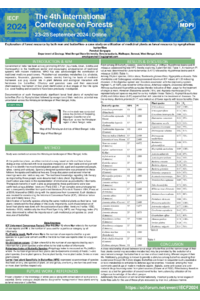
Exploration of forest resource by both man and butterflies—a case study on utilization of medicinal plants as a larval resource by nymphalinae butterflies

Panchali Sengupta 1
1. Department of Zoology , West Bengal State University, Berunanpukaria, Malikapur, Barasat, West Bengal 700126, India
Abstract
India is renowned for its rich medico-cultural heritage. Despite modernisation coupled with scientific advancement, the rich traditional medicinal system cannot be overlooked. Interestingly, the chemical constituents of such medicinally significant plants also form the basis of host plant recognition by butterflies. Olfactory and gustatory cues and their associated chemosensory mechanisms of host plant identification at dual stages of their life cycle (i.e. larval feeding and oviposition) have been previously investigated.
Documentation of such therapeutically significant larval food plants of nymphalinae butterflies (Family: Nymphalidae) followed by recognition of their medicinal potential was undertaken across the Himalayan landscape of West Bengal, India. A specially designed questionnaire was prepared for these folklore therapists and traditional healers. The database was created for ascertaining the Informant Consensus Factor (ICF), Utilization Value (Uv) and Fidelity levels (FL). Additionally, the Host Plant Specificity (HPS) and Polyphagy Index (PI) were determined to reflect the importance of such medicinal plant species as larval resource of butterflies. A total of 85 informants were interviewed, leading to the calculation of ICF, Uv and FL for each plant species.
Thus, the therapeutic benefits of 28 plant species used against several categories of ailments were listed. The highest ICF value (1.000) was cited for diseases of the digestive system and disorders associated with the respiratory system. The maximum FL of 100% was noted for Urtica dioica, Artemisia vulgaris, Dioscorea deltoides, Mimosa pudica and Hygrophila auriculata. Urtica dioica displayed the maximum Uv. Furthermore, Junonia lemonias, J. orithiya, Hypolimnas bolina and H. misippus possessed the highest HPS. A maximum PI value was determined for Junonia lemonias (5.477) followed by Hypolimnas bolina and H. missipus (5.000).
Thus, polyphagy is known to provide a stimulus among butterflies, enabling their sustenance through life history stages. Equally significant are such medicinal plants serving as botanical tools for traditional healers.
Keywords
Fidelity level
Host Plant Specificity
Informant Consensus Factor
Polyphagy Index
Utilization Value
Poster
sciforum-095159-Sengupta.pdf
Evaluation of Land Cover and Use through Artificial Intelligence in the Premontane Humid Forest of the Munchique Natural Reserve, Quilichao River Basin, Cauca, Colombia
A brief study on the true freshwater crab Potamon ibericum (Bieberstein, 1808) absence downstream of Kasilian River, Mazandaran, Iran