Event submissions
Published
This submission belongs to the session S1. Forest Ecology and Management of the event The 4th International Electronic Conference on Forests
Published date
19 Sep, 2024
Academic Editor
'%3e%3cpath%20d='M12.6657%2010.9104C12.4185%2010.325%2012.0599%209.79327%2011.6097%209.34482C11.1609%208.89508%2010.6293%208.5365%2010.0442%208.28888C10.0389%208.28626%2010.0337%208.28495%2010.0285%208.28233C10.8446%207.69279%2011.3752%206.73249%2011.3752%205.64904C11.3752%203.8542%209.92103%202.39999%208.1262%202.39999C6.33136%202.39999%204.87715%203.8542%204.87715%205.64904C4.87715%206.73249%205.40774%207.69279%206.22393%208.28364C6.21869%208.28626%206.21345%208.28757%206.20821%208.29019C5.62129%208.5378%205.09463%208.89284%204.64265%209.34613C4.1929%209.79493%203.83432%2010.3266%203.58671%2010.9117C3.34345%2011.4845%203.21226%2012.0987%203.20023%2012.7209C3.19988%2012.7349%203.20233%2012.7488%203.20744%2012.7619C3.21255%2012.7749%203.22022%2012.7867%203.22998%2012.7968C3.23975%2012.8068%203.25142%2012.8147%203.26431%2012.8202C3.2772%2012.8256%203.29105%2012.8284%203.30504%2012.8284H4.09109C4.14874%2012.8284%204.19459%2012.7825%204.1959%2012.7262C4.2221%2011.7148%204.62823%2010.7676%205.34617%2010.0497C6.08899%209.30683%207.0755%208.89808%208.1262%208.89808C9.17689%208.89808%2010.1634%209.30683%2010.9062%2010.0497C11.6242%2010.7676%2012.0303%2011.7148%2012.0565%2012.7262C12.0578%2012.7838%2012.1037%2012.8284%2012.1613%2012.8284H12.9474C12.9613%2012.8284%2012.9752%2012.8256%2012.9881%2012.8202C13.001%2012.8147%2013.0126%2012.8068%2013.0224%2012.7968C13.0322%2012.7867%2013.0398%2012.7749%2013.0449%2012.7619C13.0501%2012.7488%2013.0525%2012.7349%2013.0522%2012.7209C13.0391%2012.0947%2012.9094%2011.4855%2012.6657%2010.9104ZM8.1262%207.9024C7.52486%207.9024%206.9589%207.6679%206.53312%207.24211C6.10733%206.81633%205.87283%206.25037%205.87283%205.64904C5.87283%205.0477%206.10733%204.48174%206.53312%204.05596C6.9589%203.63018%207.52486%203.39567%208.1262%203.39567C8.72753%203.39567%209.29349%203.63018%209.71927%204.05596C10.1451%204.48174%2010.3796%205.0477%2010.3796%205.64904C10.3796%206.25037%2010.1451%206.81633%209.71927%207.24211C9.29349%207.6679%208.72753%207.9024%208.1262%207.9024Z'%20fill='%235D1EE1'/%3e%3c/g%3e%3c/svg%3e) Giovanna Battipaglia
Giovanna BattipagliaCitation
Jorgelina Franzese, Sofía González, Pedro Laterra, Wildland–Urban interface invasions by exotic conifers in NW Patagonia: Mapping public engagement, in Proceedings of The 4th International Electronic Conference on Forests, 23 September–25 September 2024, MDPI: Basel, Switzerland
Share
Email
Facebook
Twitter
LinkedIn
Wildland–Urban interface invasions by exotic conifers in NW Patagonia: Mapping public engagement
'%3e%3cpath%20d='M12.6647%2010.9104C12.4176%2010.325%2012.0589%209.7933%2011.6088%209.34485C11.16%208.89511%2010.6283%208.53653%2010.0432%208.28891C10.038%208.28629%2010.0327%208.28498%2010.0275%208.28236C10.8437%207.69282%2011.3743%206.73252%2011.3743%205.64907C11.3743%203.85423%209.92005%202.40002%208.12522%202.40002C6.33038%202.40002%204.87618%203.85423%204.87618%205.64907C4.87618%206.73252%205.40677%207.69282%206.22296%208.28367C6.21772%208.28629%206.21248%208.2876%206.20724%208.29022C5.62031%208.53783%205.09365%208.89287%204.64167%209.34616C4.19192%209.79496%203.83334%2010.3266%203.58573%2010.9117C3.34247%2011.4846%203.21128%2012.0987%203.19925%2012.721C3.1989%2012.735%203.20135%2012.7489%203.20646%2012.7619C3.21157%2012.7749%203.21924%2012.7868%203.22901%2012.7968C3.23877%2012.8068%203.25045%2012.8148%203.26334%2012.8202C3.27623%2012.8256%203.29007%2012.8284%203.30406%2012.8284H4.09012C4.14776%2012.8284%204.19362%2012.7825%204.19493%2012.7262C4.22113%2011.7148%204.62726%2010.7676%205.34519%2010.0497C6.08802%209.30686%207.07452%208.89811%208.12522%208.89811C9.17592%208.89811%2010.1624%209.30686%2010.9052%2010.0497C11.6232%2010.7676%2012.0293%2011.7148%2012.0555%2012.7262C12.0568%2012.7839%2012.1027%2012.8284%2012.1603%2012.8284H12.9464C12.9604%2012.8284%2012.9742%2012.8256%2012.9871%2012.8202C13%2012.8148%2013.0117%2012.8068%2013.0214%2012.7968C13.0312%2012.7868%2013.0389%2012.7749%2013.044%2012.7619C13.0491%2012.7489%2013.0515%2012.735%2013.0512%2012.721C13.0381%2012.0947%2012.9084%2011.4856%2012.6647%2010.9104ZM8.12522%207.90243C7.52388%207.90243%206.95792%207.66793%206.53214%207.24215C6.10636%206.81636%205.87185%206.2504%205.87185%205.64907C5.87185%205.04773%206.10636%204.48177%206.53214%204.05599C6.95792%203.63021%207.52388%203.3957%208.12522%203.3957C8.72655%203.3957%209.29252%203.63021%209.7183%204.05599C10.1441%204.48177%2010.3786%205.04773%2010.3786%205.64907C10.3786%206.2504%2010.1441%206.81636%209.7183%207.24215C9.29252%207.66793%208.72655%207.90243%208.12522%207.90243Z'%20fill='%235D1EE1'/%3e%3c/g%3e%3c/svg%3e)
Jorgelina Franzese 1
Sofía González 2
Pedro Laterra 3,4
1. Laboratorio Ecotono, INIBIOMA (Universidad Nacional del Comahue), CONICET, San Carlos de Bariloche, Argentina
2. Laboratorio Ecotono, INIBIOMA, Universidad Nacional del Comahue, CONICET, Pje. Gutiérrez 1415 R8400, San Carlos de Bariloche, Río Negro, Argentina
3. Fundación Bariloche , Av. Bustillo 9500, 8400 San Carlos de Bariloche, Argentina
4. CCT CONICET Patagonia Norte Av. De Los Pioneros 2350, (CP: 8400), San Carlos de Bariloche, Río Negro, Argentina
Abstract
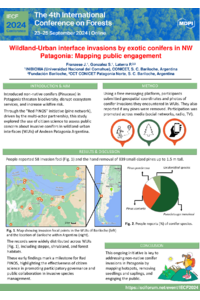
The introduction of non-native conifers in Patagonia poses a significant environmental threat. These invasive trees disrupt essential ecosystem services, diminish biodiversity, and heighten wildfire risks. This study, driven by the multi-actor partnership "Red PINOS," investigates the potential of citizen science to assess public concern regarding the encroachment of these conifers in wildland–urban interfaces (WUIs) around Bariloche, a Patagonian city (Argentina).
To engage the public in mapping invasive conifer invasions and to gather information on locations of concern, a popular messaging platform was used to collect geospatial data and photographic evidence of these trees within Patagonian WUIs. Participants were invited to join a dedicated group within the platform. Once they joined, the participants received instructions on how to capture and submit relevant data. Citizen participation was heavily promoted across media (social media, radio, TV, newspapers).
We received records of 58 invasion foci, which reported the removal of 839 small-sized individuals up to 1,5 m tall. The most reported species were Pseudotsuga menziesii (57%) and Pinus contorta (24%), followed by Pinus ponderosa (8%). The records were widely distributed across WUIs in Bariloche, including areas dominated by diverse habitats: steppe, shrubland, and forest. Despite being the first public call for citizen participation, the initiative generated a significant number of contributions, suggesting potential for public engagement regarding invasive conifer threats.
These early results represent a significant achievement for Red PINOS, demonstrating the effectiveness of citizen science in fostering participatory governance and highlighting the importance of incorporating public perspectives into invasive species management strategies. As Red PINOS continues to expand its outreach and engagement efforts, citizen science is poised to play an increasingly crucial role in addressing the complex issue of the invasive spread of non-native conifers in Patagonia.
Keywords
citizen science
invasive conifers
wildland-urban interface
Patagonia
Argentina
Poster
sciforum-099917_PedroLattera.pdf
Assessing Human Impact on Southern Mediterranean Forests: Novel Anthropogenic Pollen Indicators from Rif Mountains
Soil-based site conditions affect productivity of silver birch regeneration more than the plant species richness