Event submissions
Published
This submission belongs to the session S1. Forest Ecology and Management of the event The 4th International Electronic Conference on Forests
Published date
19 Sep, 2024
Academic Editor
'%3e%3cpath%20d='M12.6657%2010.9104C12.4185%2010.325%2012.0599%209.79327%2011.6097%209.34482C11.1609%208.89508%2010.6293%208.5365%2010.0442%208.28888C10.0389%208.28626%2010.0337%208.28495%2010.0285%208.28233C10.8446%207.69279%2011.3752%206.73249%2011.3752%205.64904C11.3752%203.8542%209.92103%202.39999%208.1262%202.39999C6.33136%202.39999%204.87715%203.8542%204.87715%205.64904C4.87715%206.73249%205.40774%207.69279%206.22393%208.28364C6.21869%208.28626%206.21345%208.28757%206.20821%208.29019C5.62129%208.5378%205.09463%208.89284%204.64265%209.34613C4.1929%209.79493%203.83432%2010.3266%203.58671%2010.9117C3.34345%2011.4845%203.21226%2012.0987%203.20023%2012.7209C3.19988%2012.7349%203.20233%2012.7488%203.20744%2012.7619C3.21255%2012.7749%203.22022%2012.7867%203.22998%2012.7968C3.23975%2012.8068%203.25142%2012.8147%203.26431%2012.8202C3.2772%2012.8256%203.29105%2012.8284%203.30504%2012.8284H4.09109C4.14874%2012.8284%204.19459%2012.7825%204.1959%2012.7262C4.2221%2011.7148%204.62823%2010.7676%205.34617%2010.0497C6.08899%209.30683%207.0755%208.89808%208.1262%208.89808C9.17689%208.89808%2010.1634%209.30683%2010.9062%2010.0497C11.6242%2010.7676%2012.0303%2011.7148%2012.0565%2012.7262C12.0578%2012.7838%2012.1037%2012.8284%2012.1613%2012.8284H12.9474C12.9613%2012.8284%2012.9752%2012.8256%2012.9881%2012.8202C13.001%2012.8147%2013.0126%2012.8068%2013.0224%2012.7968C13.0322%2012.7867%2013.0398%2012.7749%2013.0449%2012.7619C13.0501%2012.7488%2013.0525%2012.7349%2013.0522%2012.7209C13.0391%2012.0947%2012.9094%2011.4855%2012.6657%2010.9104ZM8.1262%207.9024C7.52486%207.9024%206.9589%207.6679%206.53312%207.24211C6.10733%206.81633%205.87283%206.25037%205.87283%205.64904C5.87283%205.0477%206.10733%204.48174%206.53312%204.05596C6.9589%203.63018%207.52486%203.39567%208.1262%203.39567C8.72753%203.39567%209.29349%203.63018%209.71927%204.05596C10.1451%204.48174%2010.3796%205.0477%2010.3796%205.64904C10.3796%206.25037%2010.1451%206.81633%209.71927%207.24211C9.29349%207.6679%208.72753%207.9024%208.1262%207.9024Z'%20fill='%235D1EE1'/%3e%3c/g%3e%3c/svg%3e) Giovanna Battipaglia
Giovanna BattipagliaCitation
Panagiotis Koulelis, Panos Petrakis, The Urgency of Implementing Field Research for Fir Forest Conservation and Management: Case Studies in Central Greece, in Proceedings of The 4th International Electronic Conference on Forests, 23 September–25 September 2024, MDPI: Basel, Switzerland
Share
Email
Facebook
Twitter
LinkedIn
The Urgency of Implementing Field Research for Fir Forest Conservation and Management: Case Studies in Central Greece

Panagiotis Koulelis 1

Panos Petrakis 1
1. Institute of Mediterranean Forest Ecosystems, ELGO DIMITRA, www.fria.gr, Terma Alkmanos 11528 Athens
Abstract
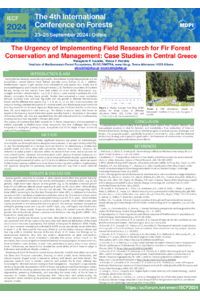
Findings from monitoring Greek fir forests in central Greece, regarding radial growth, insect infestations, plant communities, and climate response, have indicated the need for the immediate implementation of further field research within the fir forest ecosystem of the Giona and Parnassus mountains. This underscores the urgency of adopting measures to mitigate the impacts of both abiotic and biotic factors.
Our findings so far, encompassing biometric data, tree ring analysis, observations on plant communities, climatic response, and insect infestations—primarily Choristoneura murinana—across various stands on the mountains, have revealed significant local infestations of varying degrees. In many instances, these infestations were detected in adult trees, particularly in sunny areas or near country roads. Furthermore, our research has revealed the varied ability of the fir trees to adapt to both minor and significant climatic variations. The proposed research aims to monitor, preserve, and protect the fir trees, utilizing new knowledge for informed decision-making in their management. The project's scope includes studying the growth characteristics of the fir forest, mitigating threats from biological factors (primarily the moth Choristoneura murinana-Lepidoptera, Tortricidae) by involving pheromones and other biological methods, promoting natural regeneration, preserving biodiversity, and evaluating the water status of the fir trees in response to climate change. Investigating their interactions and understanding the ecosystem's status concerning the previously mentioned aspects is a significant priority for biological and genetic diversity, landscape aesthetics, recreation, and sustainable regional development (with economic impacts on local beekeepers and guesthouse owners).
The evaluation of the implementation of the National Biodiversity Strategy in Greece has shown partial or minimal progress in addressing new threats and challenges. The proposed project, with specific actions, aligns with the spirit of the National Biodiversity Strategy and contributes to the strategy goals, within the framework of conservation, restoration, and the strengthening of nationwide enhancement actions.
Keywords
Forest Management
Tree Growth
Biotic Factors
Choristoneura murinana
Climate
Greece
Poster
sciforum-089889_Panagiotis.pdf
Modern Genetic and Dynamic Forest Typology: Priority Development Areas and Outstanding Problems
Aerophotogrammetry and artificial intelligence to quantify trees and palms in Amazon native Rainforests