Event submissions
Published
This submission belongs to the session S4. Forest Wildfires of the event The 4th International Electronic Conference on Forests
Published date
19 Sep, 2024
Academic Editor
'%3e%3cpath%20d='M12.6657%2010.9104C12.4185%2010.325%2012.0599%209.79327%2011.6097%209.34482C11.1609%208.89508%2010.6293%208.5365%2010.0442%208.28888C10.0389%208.28626%2010.0337%208.28495%2010.0285%208.28233C10.8446%207.69279%2011.3752%206.73249%2011.3752%205.64904C11.3752%203.8542%209.92103%202.39999%208.1262%202.39999C6.33136%202.39999%204.87715%203.8542%204.87715%205.64904C4.87715%206.73249%205.40774%207.69279%206.22393%208.28364C6.21869%208.28626%206.21345%208.28757%206.20821%208.29019C5.62129%208.5378%205.09463%208.89284%204.64265%209.34613C4.1929%209.79493%203.83432%2010.3266%203.58671%2010.9117C3.34345%2011.4845%203.21226%2012.0987%203.20023%2012.7209C3.19988%2012.7349%203.20233%2012.7488%203.20744%2012.7619C3.21255%2012.7749%203.22022%2012.7867%203.22998%2012.7968C3.23975%2012.8068%203.25142%2012.8147%203.26431%2012.8202C3.2772%2012.8256%203.29105%2012.8284%203.30504%2012.8284H4.09109C4.14874%2012.8284%204.19459%2012.7825%204.1959%2012.7262C4.2221%2011.7148%204.62823%2010.7676%205.34617%2010.0497C6.08899%209.30683%207.0755%208.89808%208.1262%208.89808C9.17689%208.89808%2010.1634%209.30683%2010.9062%2010.0497C11.6242%2010.7676%2012.0303%2011.7148%2012.0565%2012.7262C12.0578%2012.7838%2012.1037%2012.8284%2012.1613%2012.8284H12.9474C12.9613%2012.8284%2012.9752%2012.8256%2012.9881%2012.8202C13.001%2012.8147%2013.0126%2012.8068%2013.0224%2012.7968C13.0322%2012.7867%2013.0398%2012.7749%2013.0449%2012.7619C13.0501%2012.7488%2013.0525%2012.7349%2013.0522%2012.7209C13.0391%2012.0947%2012.9094%2011.4855%2012.6657%2010.9104ZM8.1262%207.9024C7.52486%207.9024%206.9589%207.6679%206.53312%207.24211C6.10733%206.81633%205.87283%206.25037%205.87283%205.64904C5.87283%205.0477%206.10733%204.48174%206.53312%204.05596C6.9589%203.63018%207.52486%203.39567%208.1262%203.39567C8.72753%203.39567%209.29349%203.63018%209.71927%204.05596C10.1451%204.48174%2010.3796%205.0477%2010.3796%205.64904C10.3796%206.25037%2010.1451%206.81633%209.71927%207.24211C9.29349%207.6679%208.72753%207.9024%208.1262%207.9024Z'%20fill='%235D1EE1'/%3e%3c/g%3e%3c/svg%3e) Giorgos Mallinis
Giorgos MallinisCitation
Evgenii I. Ponomarev, Andrey N. Zabrodin, Evgenii G. Shvetsov, Tatiana V. Ponomareva, Evaluation of the Effects of Wildfires in Siberian Forests Based on Satellite Data for 1996–2023, in Proceedings of The 4th International Electronic Conference on Forests, 23 September–25 September 2024, MDPI: Basel, Switzerland
Share
Email
Facebook
Twitter
LinkedIn
Evaluation of the Effects of Wildfires in Siberian Forests Based on Satellite Data for 1996–2023

Evgenii I. Ponomarev 1,2
'%3e%3cpath%20d='M12.6647%2010.9104C12.4176%2010.325%2012.0589%209.7933%2011.6088%209.34485C11.16%208.89511%2010.6283%208.53653%2010.0432%208.28891C10.038%208.28629%2010.0327%208.28498%2010.0275%208.28236C10.8437%207.69282%2011.3743%206.73252%2011.3743%205.64907C11.3743%203.85423%209.92005%202.40002%208.12522%202.40002C6.33038%202.40002%204.87618%203.85423%204.87618%205.64907C4.87618%206.73252%205.40677%207.69282%206.22296%208.28367C6.21772%208.28629%206.21248%208.2876%206.20724%208.29022C5.62031%208.53783%205.09365%208.89287%204.64167%209.34616C4.19192%209.79496%203.83334%2010.3266%203.58573%2010.9117C3.34247%2011.4846%203.21128%2012.0987%203.19925%2012.721C3.1989%2012.735%203.20135%2012.7489%203.20646%2012.7619C3.21157%2012.7749%203.21924%2012.7868%203.22901%2012.7968C3.23877%2012.8068%203.25045%2012.8148%203.26334%2012.8202C3.27623%2012.8256%203.29007%2012.8284%203.30406%2012.8284H4.09012C4.14776%2012.8284%204.19362%2012.7825%204.19493%2012.7262C4.22113%2011.7148%204.62726%2010.7676%205.34519%2010.0497C6.08802%209.30686%207.07452%208.89811%208.12522%208.89811C9.17592%208.89811%2010.1624%209.30686%2010.9052%2010.0497C11.6232%2010.7676%2012.0293%2011.7148%2012.0555%2012.7262C12.0568%2012.7839%2012.1027%2012.8284%2012.1603%2012.8284H12.9464C12.9604%2012.8284%2012.9742%2012.8256%2012.9871%2012.8202C13%2012.8148%2013.0117%2012.8068%2013.0214%2012.7968C13.0312%2012.7868%2013.0389%2012.7749%2013.044%2012.7619C13.0491%2012.7489%2013.0515%2012.735%2013.0512%2012.721C13.0381%2012.0947%2012.9084%2011.4856%2012.6647%2010.9104ZM8.12522%207.90243C7.52388%207.90243%206.95792%207.66793%206.53214%207.24215C6.10636%206.81636%205.87185%206.2504%205.87185%205.64907C5.87185%205.04773%206.10636%204.48177%206.53214%204.05599C6.95792%203.63021%207.52388%203.3957%208.12522%203.3957C8.72655%203.3957%209.29252%203.63021%209.7183%204.05599C10.1441%204.48177%2010.3786%205.04773%2010.3786%205.64907C10.3786%206.2504%2010.1441%206.81636%209.7183%207.24215C9.29252%207.66793%208.72655%207.90243%208.12522%207.90243Z'%20fill='%235D1EE1'/%3e%3c/g%3e%3c/svg%3e)
Andrey N. Zabrodin 3,4
Evgenii G. Shvetsov 3
Tatiana V. Ponomareva 1,2
1. V.N.Sukachev Institute of Forest SB RAS - Federal Research Center “Krasnoyarsk Science Center”, Siberian Branch, Russian Academy of Sciences, 660036, Krasnoyarsk, Russia
2. Department of Ecology and Environment, Siberian Federal University, 660041 Krasnoyarsk, Russia
3. Federal Research Center “Krasnoyarsk Science Center, Siberian Branch, Russian Academy of Sciences”, 660036 Krasnoyarsk, Russia
4. Department of Thermophysics, Siberian Federal University, 660041 Krasnoyarsk, Russia
Abstract
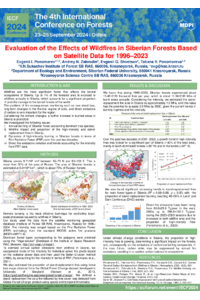
Wildfires are the most significant factor that affects the boreal ecosystems of Siberia. The issue of monitoring fire consequences such as tree stand losses, long-term changes in the thermal regime of soils, and direct emissions of carbon is very important for the region. Remote sensing data are the most effective technique for controlling large-scale processes caused by wildfires in Siberia.
Our study used fire data from the satellite monitoring bank (Institute of Forest SB RAS, Krasnoyarsk, Russia) for 1996–2023. Fire intensity was ranged based on the Fire Radiative Power (FRP) technology of MOD14/MYD14 products. We controlled vegetation cover using the “Vega-Pro” GIS service of the Space Research Institute RAS (Moscow, Russia). To evaluate fire emissions, we modified the Seiler–Crutzen method (1980), by accounting for fire intensity in terms of FRP.
We obtained the following results: firstly, we calculated that during 1996–2023, Siberian forests were impacted by 15.48±2.33 thousand fires per year, which is about 11.34±2.88 million hectares of burnt areas annually. Considering fire intensity, we estimated the stand-replacement fires in Siberia at approximately 1.0 million hectares, and this value has the potential to surpass 3.0 million hectares by 2050, given the current trends in burning regimes and fire intensity.
Next, over the two decades of 2002–2022, a growth trend in high-intensity fires was typical for a significant part of Siberia (~30% of the total area), mainly in larch-dominated forests (>60° N) and in the tundra zone (>67° N).
Finally, direct fire emissions have been rising from 60.0±25.8 Tg/year in the early 2000s up to 296.0±102.0 Tg/year during the 2020–2023 seasons due to increases in both wildfire area and the proportion of high-intensity fires. Thus, in the near future, carbon sinks may be suppressed by annual fire emissions, resulting in a positive carbon balance in some ecosystems of Siberia.
Keywords
wildfires
fire impact
Fire Radiative Power
direct fire emissions
Siberia
Poster
sciforum-094999_EvgeniiPonomarev.pdf
Effects of Wildfire Forest and the Impact of Heavy Machinery on Reforesting: Soil Compaction, Erosion, and Shock on the Biodiversity and Coopetition of the Forest Ecosystem
Evaluation method for selecting the most suitable intensity of silvicultural intervention in relation to the estimated reduction in combustion energy load within a forest ecosystem