Event submissions
Published
This submission belongs to the session S2. Forest Biodiversity, Ecosystem Services, and Earth Observations of the event The 4th International Electronic Conference on Forests
Published date
19 Sep, 2024
Academic Editor
'%3e%3cpath%20d='M12.6657%2010.9104C12.4185%2010.325%2012.0599%209.79327%2011.6097%209.34482C11.1609%208.89508%2010.6293%208.5365%2010.0442%208.28888C10.0389%208.28626%2010.0337%208.28495%2010.0285%208.28233C10.8446%207.69279%2011.3752%206.73249%2011.3752%205.64904C11.3752%203.8542%209.92103%202.39999%208.1262%202.39999C6.33136%202.39999%204.87715%203.8542%204.87715%205.64904C4.87715%206.73249%205.40774%207.69279%206.22393%208.28364C6.21869%208.28626%206.21345%208.28757%206.20821%208.29019C5.62129%208.5378%205.09463%208.89284%204.64265%209.34613C4.1929%209.79493%203.83432%2010.3266%203.58671%2010.9117C3.34345%2011.4845%203.21226%2012.0987%203.20023%2012.7209C3.19988%2012.7349%203.20233%2012.7488%203.20744%2012.7619C3.21255%2012.7749%203.22022%2012.7867%203.22998%2012.7968C3.23975%2012.8068%203.25142%2012.8147%203.26431%2012.8202C3.2772%2012.8256%203.29105%2012.8284%203.30504%2012.8284H4.09109C4.14874%2012.8284%204.19459%2012.7825%204.1959%2012.7262C4.2221%2011.7148%204.62823%2010.7676%205.34617%2010.0497C6.08899%209.30683%207.0755%208.89808%208.1262%208.89808C9.17689%208.89808%2010.1634%209.30683%2010.9062%2010.0497C11.6242%2010.7676%2012.0303%2011.7148%2012.0565%2012.7262C12.0578%2012.7838%2012.1037%2012.8284%2012.1613%2012.8284H12.9474C12.9613%2012.8284%2012.9752%2012.8256%2012.9881%2012.8202C13.001%2012.8147%2013.0126%2012.8068%2013.0224%2012.7968C13.0322%2012.7867%2013.0398%2012.7749%2013.0449%2012.7619C13.0501%2012.7488%2013.0525%2012.7349%2013.0522%2012.7209C13.0391%2012.0947%2012.9094%2011.4855%2012.6657%2010.9104ZM8.1262%207.9024C7.52486%207.9024%206.9589%207.6679%206.53312%207.24211C6.10733%206.81633%205.87283%206.25037%205.87283%205.64904C5.87283%205.0477%206.10733%204.48174%206.53312%204.05596C6.9589%203.63018%207.52486%203.39567%208.1262%203.39567C8.72753%203.39567%209.29349%203.63018%209.71927%204.05596C10.1451%204.48174%2010.3796%205.0477%2010.3796%205.64904C10.3796%206.25037%2010.1451%206.81633%209.71927%207.24211C9.29349%207.6679%208.72753%207.9024%208.1262%207.9024Z'%20fill='%235D1EE1'/%3e%3c/g%3e%3c/svg%3e) Tianxiang Yue
Tianxiang YueCitation
Valdivino Domingos de Oliveira Júnior, Edge Effects Up to 30-40 Meters Into Seasonal Forests Demonstrated Through Vegetation Indices and Floristic Similarity, in Proceedings of The 4th International Electronic Conference on Forests, 23 September–25 September 2024, MDPI: Basel, Switzerland
Share
Email
Facebook
Twitter
LinkedIn
Edge Effects Up to 30-40 Meters Into Seasonal Forests Demonstrated Through Vegetation Indices and Floristic Similarity

Valdivino Domingos de Oliveira Júnior 1
1. Universidade Federal de Viçosa
Abstract
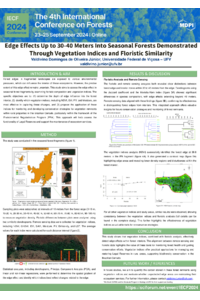
Forest edges in forest fragments are formed by natural or anthropogenic disturbances, where these forest fragments in a rural matrix experience environmental pressures at different levels. However, few studies indicate the actual size of the edge and how far its effects are perceived in the forest. This study aimed to evaluate the edge effect in forest fragments using floristic studies and vegetation indices, determining the gradient (meters) in which the edge penetrates the forest fragment and identifying the vegetation indices that best apply to edge effect studies. The research was conducted in five seasonal forests where floristic differences were verified, generating two similarity dendrograms using the average vegetation density per plot at each distance from the edge (0-10, 10-20, 20-30, 30-40, 40-50, 50-60, 60-70, 70-80, 80-90, 90-100 m). To verify differences between the values of vegetation indices (NDVI, GNDVI, EVI, SAVI, Moisture, PV, Emissivity, and LST) concerning the distance from the forest edge towards its interior, the average values for each distance from the edge to the interior of each forest fragment were used. A dendrogram, a PCA, and linear and non-linear regressions were performed to determine the edge gradient in the fragments. The study found a perceptible difference between the edge and the forest interior when the edge reaches 30-40 meters into the forest, both in floristic studies and vegetation indices. The work concludes that field research and remote sensing converge, with NDVI, EVI, and the indices PV and Moisture best reflecting the edge effect in forests, being complementary for vegetation quality analysis. The study proposes the adoption of vegetation indices during the implementation of the Environmental Regularization Program (PRA) to assess the real dimension of the functional Legal Reserve in rural properties and to formulate strategies for maintaining ecosystem services of these forest fragments.
Keywords
Seasonal Forests
Floristic Similarity
Environmental Regularization Program (PRA)
Remote Sensing
Ecosystem Services
Poster
sciforum-100495_Valdivino Domingos de Oliveira Júnior.pdf
Retrospective analysis of OSM road data of Siberian federal district, Russia for the forest transport modeling
Integral Evaluation of the Cellulose of Tibouchina lepidota (Bonpl.) Baill. for the Valorisation of Residues in Sustainable Forestry Management