Event submissions
Published
This submission belongs to the session S5. Wood Science, Production Chains, Fuelwood and Trade of the event The 4th International Electronic Conference on Forests
Published date
19 Sep, 2024
Academic Editor
'%3e%3cpath%20d='M12.6657%2010.9104C12.4185%2010.325%2012.0599%209.79327%2011.6097%209.34482C11.1609%208.89508%2010.6293%208.5365%2010.0442%208.28888C10.0389%208.28626%2010.0337%208.28495%2010.0285%208.28233C10.8446%207.69279%2011.3752%206.73249%2011.3752%205.64904C11.3752%203.8542%209.92103%202.39999%208.1262%202.39999C6.33136%202.39999%204.87715%203.8542%204.87715%205.64904C4.87715%206.73249%205.40774%207.69279%206.22393%208.28364C6.21869%208.28626%206.21345%208.28757%206.20821%208.29019C5.62129%208.5378%205.09463%208.89284%204.64265%209.34613C4.1929%209.79493%203.83432%2010.3266%203.58671%2010.9117C3.34345%2011.4845%203.21226%2012.0987%203.20023%2012.7209C3.19988%2012.7349%203.20233%2012.7488%203.20744%2012.7619C3.21255%2012.7749%203.22022%2012.7867%203.22998%2012.7968C3.23975%2012.8068%203.25142%2012.8147%203.26431%2012.8202C3.2772%2012.8256%203.29105%2012.8284%203.30504%2012.8284H4.09109C4.14874%2012.8284%204.19459%2012.7825%204.1959%2012.7262C4.2221%2011.7148%204.62823%2010.7676%205.34617%2010.0497C6.08899%209.30683%207.0755%208.89808%208.1262%208.89808C9.17689%208.89808%2010.1634%209.30683%2010.9062%2010.0497C11.6242%2010.7676%2012.0303%2011.7148%2012.0565%2012.7262C12.0578%2012.7838%2012.1037%2012.8284%2012.1613%2012.8284H12.9474C12.9613%2012.8284%2012.9752%2012.8256%2012.9881%2012.8202C13.001%2012.8147%2013.0126%2012.8068%2013.0224%2012.7968C13.0322%2012.7867%2013.0398%2012.7749%2013.0449%2012.7619C13.0501%2012.7488%2013.0525%2012.7349%2013.0522%2012.7209C13.0391%2012.0947%2012.9094%2011.4855%2012.6657%2010.9104ZM8.1262%207.9024C7.52486%207.9024%206.9589%207.6679%206.53312%207.24211C6.10733%206.81633%205.87283%206.25037%205.87283%205.64904C5.87283%205.0477%206.10733%204.48174%206.53312%204.05596C6.9589%203.63018%207.52486%203.39567%208.1262%203.39567C8.72753%203.39567%209.29349%203.63018%209.71927%204.05596C10.1451%204.48174%2010.3796%205.0477%2010.3796%205.64904C10.3796%206.25037%2010.1451%206.81633%209.71927%207.24211C9.29349%207.6679%208.72753%207.9024%208.1262%207.9024Z'%20fill='%235D1EE1'/%3e%3c/g%3e%3c/svg%3e) Angela Lo Monaco
Angela Lo MonacoCitation
Adewunmi Omobolaji Adenaiya, Sadiq Olateju Islamiat, Efficacy of Citrus Peel (Citrus sinensis (L.) OSBECK) as a preservative against termite attack on Hollarhena floribunda (G.DON) T. DURAND & SCHINZ. Wood, in Proceedings of The 4th International Electronic Conference on Forests, 23 September–25 September 2024, MDPI: Basel, Switzerland
Share
Email
Facebook
Twitter
LinkedIn
Efficacy of Citrus Peel (Citrus sinensis (L.) OSBECK) as a preservative against termite attack on Hollarhena floribunda (G.DON) T. DURAND & SCHINZ. Wood
'%3e%3cpath%20d='M12.6647%2010.9104C12.4176%2010.325%2012.0589%209.7933%2011.6088%209.34485C11.16%208.89511%2010.6283%208.53653%2010.0432%208.28891C10.038%208.28629%2010.0327%208.28498%2010.0275%208.28236C10.8437%207.69282%2011.3743%206.73252%2011.3743%205.64907C11.3743%203.85423%209.92005%202.40002%208.12522%202.40002C6.33038%202.40002%204.87618%203.85423%204.87618%205.64907C4.87618%206.73252%205.40677%207.69282%206.22296%208.28367C6.21772%208.28629%206.21248%208.2876%206.20724%208.29022C5.62031%208.53783%205.09365%208.89287%204.64167%209.34616C4.19192%209.79496%203.83334%2010.3266%203.58573%2010.9117C3.34247%2011.4846%203.21128%2012.0987%203.19925%2012.721C3.1989%2012.735%203.20135%2012.7489%203.20646%2012.7619C3.21157%2012.7749%203.21924%2012.7868%203.22901%2012.7968C3.23877%2012.8068%203.25045%2012.8148%203.26334%2012.8202C3.27623%2012.8256%203.29007%2012.8284%203.30406%2012.8284H4.09012C4.14776%2012.8284%204.19362%2012.7825%204.19493%2012.7262C4.22113%2011.7148%204.62726%2010.7676%205.34519%2010.0497C6.08802%209.30686%207.07452%208.89811%208.12522%208.89811C9.17592%208.89811%2010.1624%209.30686%2010.9052%2010.0497C11.6232%2010.7676%2012.0293%2011.7148%2012.0555%2012.7262C12.0568%2012.7839%2012.1027%2012.8284%2012.1603%2012.8284H12.9464C12.9604%2012.8284%2012.9742%2012.8256%2012.9871%2012.8202C13%2012.8148%2013.0117%2012.8068%2013.0214%2012.7968C13.0312%2012.7868%2013.0389%2012.7749%2013.044%2012.7619C13.0491%2012.7489%2013.0515%2012.735%2013.0512%2012.721C13.0381%2012.0947%2012.9084%2011.4856%2012.6647%2010.9104ZM8.12522%207.90243C7.52388%207.90243%206.95792%207.66793%206.53214%207.24215C6.10636%206.81636%205.87185%206.2504%205.87185%205.64907C5.87185%205.04773%206.10636%204.48177%206.53214%204.05599C6.95792%203.63021%207.52388%203.3957%208.12522%203.3957C8.72655%203.3957%209.29252%203.63021%209.7183%204.05599C10.1441%204.48177%2010.3786%205.04773%2010.3786%205.64907C10.3786%206.2504%2010.1441%206.81636%209.7183%207.24215C9.29252%207.66793%208.72655%207.90243%208.12522%207.90243Z'%20fill='%235D1EE1'/%3e%3c/g%3e%3c/svg%3e)
Adewunmi Omobolaji Adenaiya 1
Sadiq Olateju Islamiat 1
1. Department of Forest Production and Products, Faculty of Renewable Natural Resources, University of Ibadan, Ibadan, 200284, Nigeria
Abstract
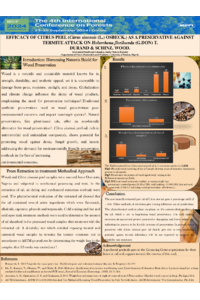
Introduction: The need for sustainable wood utilization whilst ensuring environmental protection necessitates aggressive research into the development of potent environmental benign wood preservatives. Developing such biocides from raw materials that are considered an environmental menace could help address serious environmental pollution peculiar to most developing countries like Nigeria. Hence, this study investigated the efficacy of Citrus (Citrus sinensis OSBECK.) peel oil in the protection of non-durable wood of Holarrhena floribunda (G.DON) T.
Materials and methods: Citrus sinensis peels were gathered from orange sellers at Agbowo market in Ibadan, Oyo State. The peels were air-dried, ground into powder, and oil was extracted from them mechanically. The extracted oil was used in the treatment of Holarrhena floribunda wood samples of dimensions 6 x 2 x 2 (cm), using the soaking method (SM) and the hot and cold open tank method (HCOTM), while the untreated samples served as a control. The treated and untreated wood samples were exposed to termite infestation for 12 weeks in accordance with the ASTM D 1758-06 method. The oil yield of the peels, oil absorption in the wood, phytochemical analysis of the oil, and weight loss of the wood after termite attack were evaluated. Data analysis was conducted using t-test and ANOVA at a 5% probability level.
Results: The mean oil yield of the peels was 1.41%. The phytochemical analysis revealed the presence of alkaloids (0.5 %w/w), flavonoids (0.12% w/w), saponins (0.25 %w/w), terpenoids (1.4 %w/w), and phenols (1.6 %w/w). The wood treated with the SM (319.47 Kg/m3) had significantly higher oil absorption than the HCOTM (71.58 Kg/m3). Both treatment methods significantly reduced the weight loss in the termite-infested wood samples (SM [3.49%]; HCOTM [7.02%]), comapred to the control samples (24.41%).
Conclusion: It is concluded that the oil from Citrus sinensis peels possesses biocidal efficacy against termite attack in the wood of Hollarhena floribunda.
Keywords
Oil yield
phytochemical content
weight loss
oil absortption
Poster
sciforum-100074_Adewunmi Omobolaji Adenaiya.pdf
Study of the best conditions for the acetylation of Uruguay-grown Pinus taeda.
Ecosystem services and biodiversity conservation: local demands and political guidelines