Event submissions
Published
This submission belongs to the session S5. Wood Science, Production Chains, Fuelwood and Trade of the event The 4th International Electronic Conference on Forests
Published date
19 Sep, 2024
Academic Editor
'%3e%3cpath%20d='M12.6657%2010.9104C12.4185%2010.325%2012.0599%209.79327%2011.6097%209.34482C11.1609%208.89508%2010.6293%208.5365%2010.0442%208.28888C10.0389%208.28626%2010.0337%208.28495%2010.0285%208.28233C10.8446%207.69279%2011.3752%206.73249%2011.3752%205.64904C11.3752%203.8542%209.92103%202.39999%208.1262%202.39999C6.33136%202.39999%204.87715%203.8542%204.87715%205.64904C4.87715%206.73249%205.40774%207.69279%206.22393%208.28364C6.21869%208.28626%206.21345%208.28757%206.20821%208.29019C5.62129%208.5378%205.09463%208.89284%204.64265%209.34613C4.1929%209.79493%203.83432%2010.3266%203.58671%2010.9117C3.34345%2011.4845%203.21226%2012.0987%203.20023%2012.7209C3.19988%2012.7349%203.20233%2012.7488%203.20744%2012.7619C3.21255%2012.7749%203.22022%2012.7867%203.22998%2012.7968C3.23975%2012.8068%203.25142%2012.8147%203.26431%2012.8202C3.2772%2012.8256%203.29105%2012.8284%203.30504%2012.8284H4.09109C4.14874%2012.8284%204.19459%2012.7825%204.1959%2012.7262C4.2221%2011.7148%204.62823%2010.7676%205.34617%2010.0497C6.08899%209.30683%207.0755%208.89808%208.1262%208.89808C9.17689%208.89808%2010.1634%209.30683%2010.9062%2010.0497C11.6242%2010.7676%2012.0303%2011.7148%2012.0565%2012.7262C12.0578%2012.7838%2012.1037%2012.8284%2012.1613%2012.8284H12.9474C12.9613%2012.8284%2012.9752%2012.8256%2012.9881%2012.8202C13.001%2012.8147%2013.0126%2012.8068%2013.0224%2012.7968C13.0322%2012.7867%2013.0398%2012.7749%2013.0449%2012.7619C13.0501%2012.7488%2013.0525%2012.7349%2013.0522%2012.7209C13.0391%2012.0947%2012.9094%2011.4855%2012.6657%2010.9104ZM8.1262%207.9024C7.52486%207.9024%206.9589%207.6679%206.53312%207.24211C6.10733%206.81633%205.87283%206.25037%205.87283%205.64904C5.87283%205.0477%206.10733%204.48174%206.53312%204.05596C6.9589%203.63018%207.52486%203.39567%208.1262%203.39567C8.72753%203.39567%209.29349%203.63018%209.71927%204.05596C10.1451%204.48174%2010.3796%205.0477%2010.3796%205.64904C10.3796%206.25037%2010.1451%206.81633%209.71927%207.24211C9.29349%207.6679%208.72753%207.9024%208.1262%207.9024Z'%20fill='%235D1EE1'/%3e%3c/g%3e%3c/svg%3e) Angela Lo Monaco
Angela Lo MonacoCitation
Dishari Chatterjee, Rakesh Kumar, SUPERHYDROPHOBIC AND UV-RESISTANT COATING USING NANOPARTICLES FOR THE PROTECTION OF WOOD, in Proceedings of The 4th International Electronic Conference on Forests, 23 September–25 September 2024, MDPI: Basel, Switzerland
Share
Email
Facebook
Twitter
LinkedIn
SUPERHYDROPHOBIC AND UV-RESISTANT COATING USING NANOPARTICLES FOR THE PROTECTION OF WOOD
'%3e%3cpath%20d='M12.6647%2010.9104C12.4176%2010.325%2012.0589%209.7933%2011.6088%209.34485C11.16%208.89511%2010.6283%208.53653%2010.0432%208.28891C10.038%208.28629%2010.0327%208.28498%2010.0275%208.28236C10.8437%207.69282%2011.3743%206.73252%2011.3743%205.64907C11.3743%203.85423%209.92005%202.40002%208.12522%202.40002C6.33038%202.40002%204.87618%203.85423%204.87618%205.64907C4.87618%206.73252%205.40677%207.69282%206.22296%208.28367C6.21772%208.28629%206.21248%208.2876%206.20724%208.29022C5.62031%208.53783%205.09365%208.89287%204.64167%209.34616C4.19192%209.79496%203.83334%2010.3266%203.58573%2010.9117C3.34247%2011.4846%203.21128%2012.0987%203.19925%2012.721C3.1989%2012.735%203.20135%2012.7489%203.20646%2012.7619C3.21157%2012.7749%203.21924%2012.7868%203.22901%2012.7968C3.23877%2012.8068%203.25045%2012.8148%203.26334%2012.8202C3.27623%2012.8256%203.29007%2012.8284%203.30406%2012.8284H4.09012C4.14776%2012.8284%204.19362%2012.7825%204.19493%2012.7262C4.22113%2011.7148%204.62726%2010.7676%205.34519%2010.0497C6.08802%209.30686%207.07452%208.89811%208.12522%208.89811C9.17592%208.89811%2010.1624%209.30686%2010.9052%2010.0497C11.6232%2010.7676%2012.0293%2011.7148%2012.0555%2012.7262C12.0568%2012.7839%2012.1027%2012.8284%2012.1603%2012.8284H12.9464C12.9604%2012.8284%2012.9742%2012.8256%2012.9871%2012.8202C13%2012.8148%2013.0117%2012.8068%2013.0214%2012.7968C13.0312%2012.7868%2013.0389%2012.7749%2013.044%2012.7619C13.0491%2012.7489%2013.0515%2012.735%2013.0512%2012.721C13.0381%2012.0947%2012.9084%2011.4856%2012.6647%2010.9104ZM8.12522%207.90243C7.52388%207.90243%206.95792%207.66793%206.53214%207.24215C6.10636%206.81636%205.87185%206.2504%205.87185%205.64907C5.87185%205.04773%206.10636%204.48177%206.53214%204.05599C6.95792%203.63021%207.52388%203.3957%208.12522%203.3957C8.72655%203.3957%209.29252%203.63021%209.7183%204.05599C10.1441%204.48177%2010.3786%205.04773%2010.3786%205.64907C10.3786%206.2504%2010.1441%206.81636%209.7183%207.24215C9.29252%207.66793%208.72655%207.90243%208.12522%207.90243Z'%20fill='%235D1EE1'/%3e%3c/g%3e%3c/svg%3e)
Dishari Chatterjee 1
Rakesh Kumar 2
1. Wood Properties and Processing Division, Institute of Wood Science and Technology, Malleshwaram 18th cross, Bengaluru, India-560003
2. Wood Properties and Processing Division, Institute of Wood Science and Technology, Malleshwaram 18th cross, Bengaluru 560003
Abstract
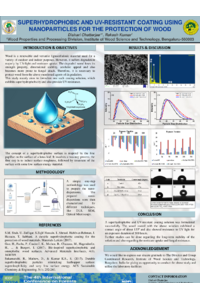
Wood is a renewable and versatile material comprising cellulose, hemicellulose and lignin as its main structural components, and is widely used for both outdoor and indoor purposes. However, as a lignocellulosic material, wood suffers degradation mainly from UV radiation and moisture uptake. The degraded wood not only loses its strength and dimensional stability, but also its aesthetic appeal. Therefore, it is necessary to protect wood from the above-mentioned agents of degradation. This study focuses on the preparation of a superhydrophobic and UV-resistant coating for the protection of wood. Superhydrophobic coatings are a smart class of coatings which repel water from the surface of wood, thus increasing its longevity. Achieving hydrophobicity is a two-step procedure which includes inducing surface roughness, followed by treatment with a low-surface-energy material. Certain metal oxide nanoparticles like ZnO, CeO2, and TiO2 nanoparticles additionally provide protection against UV light along with adequate surface roughness, and materials like silanes act as low-surface-energy materials. A simple one-step method was used to prepare the nanodispersions. ZnO/TiO2 nanoparticles and silane were mixed together with a suitable non-volatile and non-corrosive solvent, and homogenised together, followed by ultrasonication to obtain the desired nanodispersion. The size of the nanoparticles was analysed using DLS and found to be within 100nm. The solution was then coated on the wood surface. Hydrophobicity was measured using a contact angle analyser and the results were between 150º and 160º, which confirmed the coating's superhydrophobicity. The morphology was analysed using SEM. The coated samples were then tested for UV stability in an indoor accelerated UV weathering tester and were analysed on the basis of their colour change, seen with the help of a HunterLab Labscan XE spectrocolorimeter. The photodegradation of the coated samples was analysed using FTIR. The samples thus exhibited superhydrophobicity as well as UV stability.
Keywords
Photodegradation
Wood protection
Superhydrophobicity
UV-resistance
Nanoparticles
Coatings
Poster
sciforum-100013_Dishari Chatterjee.pdf
The role of extractives on the fire performance of Tectona grandis L.f. (teak) wood
The dark coniferous taiga of the Russian North is drying out against the backdrop of modern climate change