Event submissions
Published
This submission belongs to the session S2. Forest Biodiversity, Ecosystem Services, and Earth Observations of the event The 4th International Electronic Conference on Forests
Published date
19 Sep, 2024
Academic Editor
'%3e%3cpath%20d='M12.6657%2010.9104C12.4185%2010.325%2012.0599%209.79327%2011.6097%209.34482C11.1609%208.89508%2010.6293%208.5365%2010.0442%208.28888C10.0389%208.28626%2010.0337%208.28495%2010.0285%208.28233C10.8446%207.69279%2011.3752%206.73249%2011.3752%205.64904C11.3752%203.8542%209.92103%202.39999%208.1262%202.39999C6.33136%202.39999%204.87715%203.8542%204.87715%205.64904C4.87715%206.73249%205.40774%207.69279%206.22393%208.28364C6.21869%208.28626%206.21345%208.28757%206.20821%208.29019C5.62129%208.5378%205.09463%208.89284%204.64265%209.34613C4.1929%209.79493%203.83432%2010.3266%203.58671%2010.9117C3.34345%2011.4845%203.21226%2012.0987%203.20023%2012.7209C3.19988%2012.7349%203.20233%2012.7488%203.20744%2012.7619C3.21255%2012.7749%203.22022%2012.7867%203.22998%2012.7968C3.23975%2012.8068%203.25142%2012.8147%203.26431%2012.8202C3.2772%2012.8256%203.29105%2012.8284%203.30504%2012.8284H4.09109C4.14874%2012.8284%204.19459%2012.7825%204.1959%2012.7262C4.2221%2011.7148%204.62823%2010.7676%205.34617%2010.0497C6.08899%209.30683%207.0755%208.89808%208.1262%208.89808C9.17689%208.89808%2010.1634%209.30683%2010.9062%2010.0497C11.6242%2010.7676%2012.0303%2011.7148%2012.0565%2012.7262C12.0578%2012.7838%2012.1037%2012.8284%2012.1613%2012.8284H12.9474C12.9613%2012.8284%2012.9752%2012.8256%2012.9881%2012.8202C13.001%2012.8147%2013.0126%2012.8068%2013.0224%2012.7968C13.0322%2012.7867%2013.0398%2012.7749%2013.0449%2012.7619C13.0501%2012.7488%2013.0525%2012.7349%2013.0522%2012.7209C13.0391%2012.0947%2012.9094%2011.4855%2012.6657%2010.9104ZM8.1262%207.9024C7.52486%207.9024%206.9589%207.6679%206.53312%207.24211C6.10733%206.81633%205.87283%206.25037%205.87283%205.64904C5.87283%205.0477%206.10733%204.48174%206.53312%204.05596C6.9589%203.63018%207.52486%203.39567%208.1262%203.39567C8.72753%203.39567%209.29349%203.63018%209.71927%204.05596C10.1451%204.48174%2010.3796%205.0477%2010.3796%205.64904C10.3796%206.25037%2010.1451%206.81633%209.71927%207.24211C9.29349%207.6679%208.72753%207.9024%208.1262%207.9024Z'%20fill='%235D1EE1'/%3e%3c/g%3e%3c/svg%3e) Giorgos Mallinis
Giorgos MallinisCitation
Sunday Oladipo OLAJESU, Dorcas Ayobami Odejinmi, ABUNDANCE AND DIVERSITY OF BUTTERFLY SPECIES ACROSS DIFFERENT LAND USE IN UNIVERSITY OF IBADAN, IBADAN, NIGERIA, in Proceedings of The 4th International Electronic Conference on Forests, 23 September–25 September 2024, MDPI: Basel, Switzerland
Share
Email
Facebook
Twitter
LinkedIn
ABUNDANCE AND DIVERSITY OF BUTTERFLY SPECIES ACROSS DIFFERENT LAND USE IN UNIVERSITY OF IBADAN, IBADAN, NIGERIA
'%3e%3cpath%20d='M12.6647%2010.9104C12.4176%2010.325%2012.0589%209.7933%2011.6088%209.34485C11.16%208.89511%2010.6283%208.53653%2010.0432%208.28891C10.038%208.28629%2010.0327%208.28498%2010.0275%208.28236C10.8437%207.69282%2011.3743%206.73252%2011.3743%205.64907C11.3743%203.85423%209.92005%202.40002%208.12522%202.40002C6.33038%202.40002%204.87618%203.85423%204.87618%205.64907C4.87618%206.73252%205.40677%207.69282%206.22296%208.28367C6.21772%208.28629%206.21248%208.2876%206.20724%208.29022C5.62031%208.53783%205.09365%208.89287%204.64167%209.34616C4.19192%209.79496%203.83334%2010.3266%203.58573%2010.9117C3.34247%2011.4846%203.21128%2012.0987%203.19925%2012.721C3.1989%2012.735%203.20135%2012.7489%203.20646%2012.7619C3.21157%2012.7749%203.21924%2012.7868%203.22901%2012.7968C3.23877%2012.8068%203.25045%2012.8148%203.26334%2012.8202C3.27623%2012.8256%203.29007%2012.8284%203.30406%2012.8284H4.09012C4.14776%2012.8284%204.19362%2012.7825%204.19493%2012.7262C4.22113%2011.7148%204.62726%2010.7676%205.34519%2010.0497C6.08802%209.30686%207.07452%208.89811%208.12522%208.89811C9.17592%208.89811%2010.1624%209.30686%2010.9052%2010.0497C11.6232%2010.7676%2012.0293%2011.7148%2012.0555%2012.7262C12.0568%2012.7839%2012.1027%2012.8284%2012.1603%2012.8284H12.9464C12.9604%2012.8284%2012.9742%2012.8256%2012.9871%2012.8202C13%2012.8148%2013.0117%2012.8068%2013.0214%2012.7968C13.0312%2012.7868%2013.0389%2012.7749%2013.044%2012.7619C13.0491%2012.7489%2013.0515%2012.735%2013.0512%2012.721C13.0381%2012.0947%2012.9084%2011.4856%2012.6647%2010.9104ZM8.12522%207.90243C7.52388%207.90243%206.95792%207.66793%206.53214%207.24215C6.10636%206.81636%205.87185%206.2504%205.87185%205.64907C5.87185%205.04773%206.10636%204.48177%206.53214%204.05599C6.95792%203.63021%207.52388%203.3957%208.12522%203.3957C8.72655%203.3957%209.29252%203.63021%209.7183%204.05599C10.1441%204.48177%2010.3786%205.04773%2010.3786%205.64907C10.3786%206.2504%2010.1441%206.81636%209.7183%207.24215C9.29252%207.66793%208.72655%207.90243%208.12522%207.90243Z'%20fill='%235D1EE1'/%3e%3c/g%3e%3c/svg%3e)
Sunday Oladipo OLAJESU 1,2
Dorcas Ayobami Odejinmi 1
1. Department of Wildlife and Ecotourism Management, University of Ibadan, Ibadan. Nigeria
2. University of Ibadan, Ibadan. Oyo State. Nigeria
Abstract
Abstract
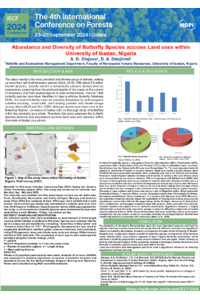
The University of Ibadan is renowned for its urban forest environment and biodiversity. This study therefore assessed butterfly species abundance and diversity across different land use in the University to enhance forest management practices and encourage biodiversity conservation . The University was stratified into five land use categories: Farming, Residential, Recreational, Aquatic and Utility areas. Three 500m x10m line transects at least 100m apart were established in each stratum and surveyed from 9:00hr to 12:00hr, twice a month for a period of 5 months (January-May). Visual encounter survey was employed to enumerate all butterflies encountered, while standard field guide was used to identify butterfly species. Point Centre Quadrant method was used to assess the tree species present. Data obtained were analyzed using percentages, means, ANOVA and Shannon-Wiener index.Tree species identified include; Milicia excelsa, Terminalia superba, Terminalia Africana, Alstonia boonei. A total of 2660 butterflies from 41 species belonging to 5 families: Nymphalidae (52.0%), Pieridae (23%), Papillionidae (9.0%), Lycaenidae (9.0%), and Hesperiidae (7.0%) were recorded. The highest (83.6%) and least (41.2%) butterfly populations were recorded in Aquatic and Residential areas, respectively. Shannon –Wiener Index was highest in Aquatic (2.80), followed by Residential (2.54) and least in Farm (2.35) areas. Species richness was highest (24.22±5.03) and lowest (16±2.98) in Aquatic and Recreational areas, respectively. Junonia oenone is the most (300) abundant, followed by Eurema hecabe (237) and the least are; Nepheronia thalassina, and Hypolimnas misippus (2 each). There was significant difference in species abundance across land use in the University (α0.05 ). Although land use has significant effect on the abundance and diversity of butterfly species, the University is a healthy environment considering the butterfly diversity. .
Keywords
Urban forest
Butterfly population
Species richness
Land use
Line transect
Poster
sciforum-099999_Sunday Oladipo OLAJESU.pdf
Site Management Models for Optimum Yield of Tectona grandis Linn.f Plantations in Southern Nigeria
Genome downsize insight into plant biodiversity conservation: a case study of polyploid Morus spp.