Event submissions
Published
This submission belongs to the session S2. Forest Biodiversity, Ecosystem Services, and Earth Observations of the event The 4th International Electronic Conference on Forests
Published date
19 Sep, 2024
Academic Editor
'%3e%3cpath%20d='M12.6657%2010.9104C12.4185%2010.325%2012.0599%209.79327%2011.6097%209.34482C11.1609%208.89508%2010.6293%208.5365%2010.0442%208.28888C10.0389%208.28626%2010.0337%208.28495%2010.0285%208.28233C10.8446%207.69279%2011.3752%206.73249%2011.3752%205.64904C11.3752%203.8542%209.92103%202.39999%208.1262%202.39999C6.33136%202.39999%204.87715%203.8542%204.87715%205.64904C4.87715%206.73249%205.40774%207.69279%206.22393%208.28364C6.21869%208.28626%206.21345%208.28757%206.20821%208.29019C5.62129%208.5378%205.09463%208.89284%204.64265%209.34613C4.1929%209.79493%203.83432%2010.3266%203.58671%2010.9117C3.34345%2011.4845%203.21226%2012.0987%203.20023%2012.7209C3.19988%2012.7349%203.20233%2012.7488%203.20744%2012.7619C3.21255%2012.7749%203.22022%2012.7867%203.22998%2012.7968C3.23975%2012.8068%203.25142%2012.8147%203.26431%2012.8202C3.2772%2012.8256%203.29105%2012.8284%203.30504%2012.8284H4.09109C4.14874%2012.8284%204.19459%2012.7825%204.1959%2012.7262C4.2221%2011.7148%204.62823%2010.7676%205.34617%2010.0497C6.08899%209.30683%207.0755%208.89808%208.1262%208.89808C9.17689%208.89808%2010.1634%209.30683%2010.9062%2010.0497C11.6242%2010.7676%2012.0303%2011.7148%2012.0565%2012.7262C12.0578%2012.7838%2012.1037%2012.8284%2012.1613%2012.8284H12.9474C12.9613%2012.8284%2012.9752%2012.8256%2012.9881%2012.8202C13.001%2012.8147%2013.0126%2012.8068%2013.0224%2012.7968C13.0322%2012.7867%2013.0398%2012.7749%2013.0449%2012.7619C13.0501%2012.7488%2013.0525%2012.7349%2013.0522%2012.7209C13.0391%2012.0947%2012.9094%2011.4855%2012.6657%2010.9104ZM8.1262%207.9024C7.52486%207.9024%206.9589%207.6679%206.53312%207.24211C6.10733%206.81633%205.87283%206.25037%205.87283%205.64904C5.87283%205.0477%206.10733%204.48174%206.53312%204.05596C6.9589%203.63018%207.52486%203.39567%208.1262%203.39567C8.72753%203.39567%209.29349%203.63018%209.71927%204.05596C10.1451%204.48174%2010.3796%205.0477%2010.3796%205.64904C10.3796%206.25037%2010.1451%206.81633%209.71927%207.24211C9.29349%207.6679%208.72753%207.9024%208.1262%207.9024Z'%20fill='%235D1EE1'/%3e%3c/g%3e%3c/svg%3e) Tianxiang Yue
Tianxiang YueCitation
RAJU MONDAL, Dr. V. Nishitha Naik, Dr. Manthira Moorthy, Genome downsize insight into plant biodiversity conservation: a case study of polyploid Morus spp., in Proceedings of The 4th International Electronic Conference on Forests, 23 September–25 September 2024, MDPI: Basel, Switzerland
Share
Email
Facebook
Twitter
LinkedIn
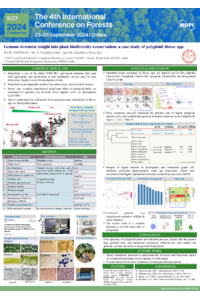
Genome downsize insight into plant biodiversity conservation: a case study of polyploid Morus spp.

RAJU MONDAL 1
'%3e%3cpath%20d='M12.6647%2010.9104C12.4176%2010.325%2012.0589%209.7933%2011.6088%209.34485C11.16%208.89511%2010.6283%208.53653%2010.0432%208.28891C10.038%208.28629%2010.0327%208.28498%2010.0275%208.28236C10.8437%207.69282%2011.3743%206.73252%2011.3743%205.64907C11.3743%203.85423%209.92005%202.40002%208.12522%202.40002C6.33038%202.40002%204.87618%203.85423%204.87618%205.64907C4.87618%206.73252%205.40677%207.69282%206.22296%208.28367C6.21772%208.28629%206.21248%208.2876%206.20724%208.29022C5.62031%208.53783%205.09365%208.89287%204.64167%209.34616C4.19192%209.79496%203.83334%2010.3266%203.58573%2010.9117C3.34247%2011.4846%203.21128%2012.0987%203.19925%2012.721C3.1989%2012.735%203.20135%2012.7489%203.20646%2012.7619C3.21157%2012.7749%203.21924%2012.7868%203.22901%2012.7968C3.23877%2012.8068%203.25045%2012.8148%203.26334%2012.8202C3.27623%2012.8256%203.29007%2012.8284%203.30406%2012.8284H4.09012C4.14776%2012.8284%204.19362%2012.7825%204.19493%2012.7262C4.22113%2011.7148%204.62726%2010.7676%205.34519%2010.0497C6.08802%209.30686%207.07452%208.89811%208.12522%208.89811C9.17592%208.89811%2010.1624%209.30686%2010.9052%2010.0497C11.6232%2010.7676%2012.0293%2011.7148%2012.0555%2012.7262C12.0568%2012.7839%2012.1027%2012.8284%2012.1603%2012.8284H12.9464C12.9604%2012.8284%2012.9742%2012.8256%2012.9871%2012.8202C13%2012.8148%2013.0117%2012.8068%2013.0214%2012.7968C13.0312%2012.7868%2013.0389%2012.7749%2013.044%2012.7619C13.0491%2012.7489%2013.0515%2012.735%2013.0512%2012.721C13.0381%2012.0947%2012.9084%2011.4856%2012.6647%2010.9104ZM8.12522%207.90243C7.52388%207.90243%206.95792%207.66793%206.53214%207.24215C6.10636%206.81636%205.87185%206.2504%205.87185%205.64907C5.87185%205.04773%206.10636%204.48177%206.53214%204.05599C6.95792%203.63021%207.52388%203.3957%208.12522%203.3957C8.72655%203.3957%209.29252%203.63021%209.7183%204.05599C10.1441%204.48177%2010.3786%205.04773%2010.3786%205.64907C10.3786%206.2504%2010.1441%206.81636%209.7183%207.24215C9.29252%207.66793%208.72655%207.90243%208.12522%207.90243Z'%20fill='%235D1EE1'/%3e%3c/g%3e%3c/svg%3e)
Dr. V. Nishitha Naik 1
Dr. Manthira Moorthy 2
1. CSB-Central Sericultural Germplasm Resources Centre (CSGRC), Hosur, Tamil Nady 635 109, India
2. Central Silk Board, Bengaluru, Karnataka 560068, India
Abstract
Biotechnological involvement in gene pool conservation is limited, particularly among natural polyploid tree species such as mulberry (Morus spp.), due to the diversity in genome sizes and the additional complexity imposed by heterozygosity. Plant performance may be greatly influenced by variations in the number, size, and structure of chromosomes. The current work has devised a step-by-step, cost-effective procedure for the chromosomal analysis of Morus spp. shoot tips. We identified various cytotypes of Morus spp. available at Central Sericultural Germplasm Resources Centre (CSGRC), Hosur, Tamil Nadu, India, including diploid (2n=2x=28), aneuploid (2n=2x=30), triploids (2n=3x=42), tetraploids (2n=4x=56), hexaploidy (2n=6x=84), and decasoploidy (2n=22x=308). Flow cytometry (FCM) analysis was performed to confirm the genome size of highly polyploid species such as M. tiliaefolia Makino. (2n=6x=84; ~1188.83 Mbp), M. serrata Roxb. (2n=6x=84; ~1386.32 Mbp), and slow-growing phenotype M. nigra L. (2n=22x=308; ~4239.86 Mbp). This study identified considerable genome downsize in decosaploid M. nigra L. (1Cx, ~353.25±07.23). Furthermore, morpho-anatomical, physiological, and biochemical traits were estimated for the selected 50 accessions, considering all cytotypes. Overall, current research suggests that over episodes of polyploidization and selection pressure, factors like the growth rate, genome size, and nutritional constraints enforced not only reduce the genome size but also restrict the growth (slow-growing) of polyploid mulberry. As a consequence, immediate attention is necessary to understand the structural and functional implications for polyploid conservation, particularly in tree species of wild origin. [The present research was supported by the Central Silk Board, MoT, and GoI funded projects PIG06004SI and POG06010SIC.]
Keywords
cytotypes
genome size
mulberry
polyploid
trait
Poster
sciforum-099465_RAJU MONDAL.pdf
ABUNDANCE AND DIVERSITY OF BUTTERFLY SPECIES ACROSS DIFFERENT LAND USE IN UNIVERSITY OF IBADAN, IBADAN, NIGERIA
Influence of different pre-sowing seed treatments on the germination and growth performance of Sida cordifolia Linn.