Event submissions
Published
This submission belongs to the session S2. Forest Biodiversity, Ecosystem Services, and Earth Observations of the event The 4th International Electronic Conference on Forests
Published date
19 Sep, 2024
Academic Editor
'%3e%3cpath%20d='M12.6657%2010.9104C12.4185%2010.325%2012.0599%209.79327%2011.6097%209.34482C11.1609%208.89508%2010.6293%208.5365%2010.0442%208.28888C10.0389%208.28626%2010.0337%208.28495%2010.0285%208.28233C10.8446%207.69279%2011.3752%206.73249%2011.3752%205.64904C11.3752%203.8542%209.92103%202.39999%208.1262%202.39999C6.33136%202.39999%204.87715%203.8542%204.87715%205.64904C4.87715%206.73249%205.40774%207.69279%206.22393%208.28364C6.21869%208.28626%206.21345%208.28757%206.20821%208.29019C5.62129%208.5378%205.09463%208.89284%204.64265%209.34613C4.1929%209.79493%203.83432%2010.3266%203.58671%2010.9117C3.34345%2011.4845%203.21226%2012.0987%203.20023%2012.7209C3.19988%2012.7349%203.20233%2012.7488%203.20744%2012.7619C3.21255%2012.7749%203.22022%2012.7867%203.22998%2012.7968C3.23975%2012.8068%203.25142%2012.8147%203.26431%2012.8202C3.2772%2012.8256%203.29105%2012.8284%203.30504%2012.8284H4.09109C4.14874%2012.8284%204.19459%2012.7825%204.1959%2012.7262C4.2221%2011.7148%204.62823%2010.7676%205.34617%2010.0497C6.08899%209.30683%207.0755%208.89808%208.1262%208.89808C9.17689%208.89808%2010.1634%209.30683%2010.9062%2010.0497C11.6242%2010.7676%2012.0303%2011.7148%2012.0565%2012.7262C12.0578%2012.7838%2012.1037%2012.8284%2012.1613%2012.8284H12.9474C12.9613%2012.8284%2012.9752%2012.8256%2012.9881%2012.8202C13.001%2012.8147%2013.0126%2012.8068%2013.0224%2012.7968C13.0322%2012.7867%2013.0398%2012.7749%2013.0449%2012.7619C13.0501%2012.7488%2013.0525%2012.7349%2013.0522%2012.7209C13.0391%2012.0947%2012.9094%2011.4855%2012.6657%2010.9104ZM8.1262%207.9024C7.52486%207.9024%206.9589%207.6679%206.53312%207.24211C6.10733%206.81633%205.87283%206.25037%205.87283%205.64904C5.87283%205.0477%206.10733%204.48174%206.53312%204.05596C6.9589%203.63018%207.52486%203.39567%208.1262%203.39567C8.72753%203.39567%209.29349%203.63018%209.71927%204.05596C10.1451%204.48174%2010.3796%205.0477%2010.3796%205.64904C10.3796%206.25037%2010.1451%206.81633%209.71927%207.24211C9.29349%207.6679%208.72753%207.9024%208.1262%207.9024Z'%20fill='%235D1EE1'/%3e%3c/g%3e%3c/svg%3e) Giovanna Battipaglia
Giovanna BattipagliaCitation
Celestina Fazia, Forest biodiversity at risk, and rural and peri-urban land consumption, in Proceedings of The 4th International Electronic Conference on Forests, 23 September–25 September 2024, MDPI: Basel, Switzerland
Share
Email
Facebook
Twitter
LinkedIn
Forest biodiversity at risk, and rural and peri-urban land consumption

Celestina Fazia 1
1. Department of Engineering and Architecture, University of Enna "Kore" University Citadel - 94100 Enna. Italy.
Abstract
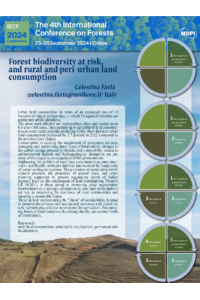
We often talk about urban land consumption in terms of an estimated loss of 19 hectares of natural soil per day, of which 15 square kilometers are permanent artificializations. We try to contain this with measures and regulatory rules. The areas most affected are metropolitan cities and coastal areas but also rural areas. Data pertaining to agricultural land consumption in some Italian regions, including Sicily, show that peri-urban land consumption increased by 2.7 percent in 2022 compared to the previous year (Ispra). The continuous transformation of soil causes serious damage to natural habitats by altering already delicate systems, increasing the risk of hydrogeological disruption and the loss of fertile and productive land. Consumption is causing the impairment of ecosystem services, damaging and minimizing them. Loss of biodiversity, changes in the carbon storage process by forests, and vulnerability related to environmental hazards and hydrogeological disruption are just some of the negative consequences of this phenomenon. The ability of communities and natural habitats to adapt and respond to change is being compromised, putting the long-term sustainability of peri-urban areas at risk. Addressing the problem of rural land consumption requires innovative and flexible strategies that take into account the complexity of social–ecological systems. The promotion of sustainable development practices, the protection of natural areas, and urban planning supported by precise regulations (think of Italian regional laws on the containment of land consumption, Veneto's LR 14/2017, or those aimed at promoting urban regeneration interventions as a strategic alternative to new land consumption) are key to preserving the resilience of local communities and ensuring a sustainable future. These include implementing the "chain" of sustainability, helping to preserve the environment and natural resources with measures, new technologies and eco-innovations for agriculture. Encouraging forms of rural tourism with a strong identity can counter forms of overtourism.
Keywords
rural land consumption
sustainable development
permanent artificializations
Poster
sciforum_095422_Fazia.pdf
The dendrochronological Potential of Salix lederbouriana Trautv. on the Patch Ecosystem of the Desert-Steppe, Mongolia
Identyfing suitable thinning areas in pure stands of Scots and maritine pine through Sentinel-2 imagery and LiDAR