Event submissions
Published
This submission belongs to the session S1. Forest Ecology and Management of the event The 4th International Electronic Conference on Forests
Published date
19 Sep, 2024
Academic Editor
'%3e%3cpath%20d='M12.6657%2010.9104C12.4185%2010.325%2012.0599%209.79327%2011.6097%209.34482C11.1609%208.89508%2010.6293%208.5365%2010.0442%208.28888C10.0389%208.28626%2010.0337%208.28495%2010.0285%208.28233C10.8446%207.69279%2011.3752%206.73249%2011.3752%205.64904C11.3752%203.8542%209.92103%202.39999%208.1262%202.39999C6.33136%202.39999%204.87715%203.8542%204.87715%205.64904C4.87715%206.73249%205.40774%207.69279%206.22393%208.28364C6.21869%208.28626%206.21345%208.28757%206.20821%208.29019C5.62129%208.5378%205.09463%208.89284%204.64265%209.34613C4.1929%209.79493%203.83432%2010.3266%203.58671%2010.9117C3.34345%2011.4845%203.21226%2012.0987%203.20023%2012.7209C3.19988%2012.7349%203.20233%2012.7488%203.20744%2012.7619C3.21255%2012.7749%203.22022%2012.7867%203.22998%2012.7968C3.23975%2012.8068%203.25142%2012.8147%203.26431%2012.8202C3.2772%2012.8256%203.29105%2012.8284%203.30504%2012.8284H4.09109C4.14874%2012.8284%204.19459%2012.7825%204.1959%2012.7262C4.2221%2011.7148%204.62823%2010.7676%205.34617%2010.0497C6.08899%209.30683%207.0755%208.89808%208.1262%208.89808C9.17689%208.89808%2010.1634%209.30683%2010.9062%2010.0497C11.6242%2010.7676%2012.0303%2011.7148%2012.0565%2012.7262C12.0578%2012.7838%2012.1037%2012.8284%2012.1613%2012.8284H12.9474C12.9613%2012.8284%2012.9752%2012.8256%2012.9881%2012.8202C13.001%2012.8147%2013.0126%2012.8068%2013.0224%2012.7968C13.0322%2012.7867%2013.0398%2012.7749%2013.0449%2012.7619C13.0501%2012.7488%2013.0525%2012.7349%2013.0522%2012.7209C13.0391%2012.0947%2012.9094%2011.4855%2012.6657%2010.9104ZM8.1262%207.9024C7.52486%207.9024%206.9589%207.6679%206.53312%207.24211C6.10733%206.81633%205.87283%206.25037%205.87283%205.64904C5.87283%205.0477%206.10733%204.48174%206.53312%204.05596C6.9589%203.63018%207.52486%203.39567%208.1262%203.39567C8.72753%203.39567%209.29349%203.63018%209.71927%204.05596C10.1451%204.48174%2010.3796%205.0477%2010.3796%205.64904C10.3796%206.25037%2010.1451%206.81633%209.71927%207.24211C9.29349%207.6679%208.72753%207.9024%208.1262%207.9024Z'%20fill='%235D1EE1'/%3e%3c/g%3e%3c/svg%3e) Giovanna Battipaglia
Giovanna BattipagliaCitation
Valentyna Meshkova, Olga Zinchenko, Vladyslav Us, Yuriy SKRYLNYK, Emerald ash borer in the park with a long-time history of black ash sawfly defoliation, in Proceedings of The 4th International Electronic Conference on Forests, 23 September–25 September 2024, MDPI: Basel, Switzerland
Share
Email
Facebook
Twitter
LinkedIn
Emerald ash borer in the park with a long-time history of black ash sawfly defoliation

Valentyna Meshkova 1
'%3e%3cpath%20d='M12.6647%2010.9104C12.4176%2010.325%2012.0589%209.7933%2011.6088%209.34485C11.16%208.89511%2010.6283%208.53653%2010.0432%208.28891C10.038%208.28629%2010.0327%208.28498%2010.0275%208.28236C10.8437%207.69282%2011.3743%206.73252%2011.3743%205.64907C11.3743%203.85423%209.92005%202.40002%208.12522%202.40002C6.33038%202.40002%204.87618%203.85423%204.87618%205.64907C4.87618%206.73252%205.40677%207.69282%206.22296%208.28367C6.21772%208.28629%206.21248%208.2876%206.20724%208.29022C5.62031%208.53783%205.09365%208.89287%204.64167%209.34616C4.19192%209.79496%203.83334%2010.3266%203.58573%2010.9117C3.34247%2011.4846%203.21128%2012.0987%203.19925%2012.721C3.1989%2012.735%203.20135%2012.7489%203.20646%2012.7619C3.21157%2012.7749%203.21924%2012.7868%203.22901%2012.7968C3.23877%2012.8068%203.25045%2012.8148%203.26334%2012.8202C3.27623%2012.8256%203.29007%2012.8284%203.30406%2012.8284H4.09012C4.14776%2012.8284%204.19362%2012.7825%204.19493%2012.7262C4.22113%2011.7148%204.62726%2010.7676%205.34519%2010.0497C6.08802%209.30686%207.07452%208.89811%208.12522%208.89811C9.17592%208.89811%2010.1624%209.30686%2010.9052%2010.0497C11.6232%2010.7676%2012.0293%2011.7148%2012.0555%2012.7262C12.0568%2012.7839%2012.1027%2012.8284%2012.1603%2012.8284H12.9464C12.9604%2012.8284%2012.9742%2012.8256%2012.9871%2012.8202C13%2012.8148%2013.0117%2012.8068%2013.0214%2012.7968C13.0312%2012.7868%2013.0389%2012.7749%2013.044%2012.7619C13.0491%2012.7489%2013.0515%2012.735%2013.0512%2012.721C13.0381%2012.0947%2012.9084%2011.4856%2012.6647%2010.9104ZM8.12522%207.90243C7.52388%207.90243%206.95792%207.66793%206.53214%207.24215C6.10636%206.81636%205.87185%206.2504%205.87185%205.64907C5.87185%205.04773%206.10636%204.48177%206.53214%204.05599C6.95792%203.63021%207.52388%203.3957%208.12522%203.3957C8.72655%203.3957%209.29252%203.63021%209.7183%204.05599C10.1441%204.48177%2010.3786%205.04773%2010.3786%205.64907C10.3786%206.2504%2010.1441%206.81636%209.7183%207.24215C9.29252%207.66793%208.72655%207.90243%208.12522%207.90243Z'%20fill='%235D1EE1'/%3e%3c/g%3e%3c/svg%3e)
Olga Zinchenko 2
Vladyslav Us 3
Yuriy SKRYLNYK 4
1. Department of Entomology, Phytopathology and Physiology, Ukrainian Research Institute of Forestry & Forest Melioration, Kharkiv, 61024, Pushkinska str. 86
2. Department of Entomology, Phytopathology and Physiology, Ukrainian Research Institute of Forestry & Forest Melioration, Kharkiv, 61024, Pushkinska str. 86.
3. B.M. Litvinov Department of Zoology, Entomology, Phytopathology, Integrated Protection and Quarantine of Plants, State Biotechnological Universityсampus KhNAU, p/o "Dokuchayevs'ke-2", Kharkiv raion, Kharkiv oblast, 62483 Dokuchaievsk, Ukraine
4. Department of Entomology, Phytopathology and Physiology. Ukrainian Research Institute of Forestry & Forest Melioration, Kharkiv, 61024, Pudhkinska str. 86
Abstract
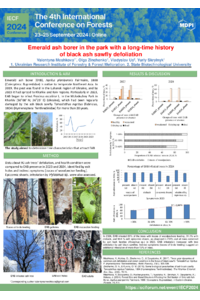
Emerald ash borer (EAB), Agrilus planipennis Fairmaire, 1888 (Coleoptera: Buprestidae) is native to temperate Northeast Asia. It invades Fraxinus sp. in large parts of the USA, Canada, and European Russia. In 2019, the pest was found in the Luhansk region of Ukraine, and by 2023 it had spread to forests and urban stands of the Luhansk, Kharkiv, and Kyiv regions. Particularly in 2023, EAB began to infest Fraxinus excelsior L. in the Molodezhny Park in Kharkiv (50°00' N; 36°25' E) (Ukraine), which had been regularly damaged by the ash black sawfly Tomostethus nigritus (Fabricius, 1804) (Hymenoptera: Tenthredinidae) for more than 20 years. The data on each tree's defoliation and health history were documented. Usually, EAB infestation is identified by the exit holes of beetles. However, in the case of infestation of the upper crown parts, the identification of the new spread of this pest can be late. Therefore, the purpose of our study was to determine tree characteristics that attract EAB. Long-term (since 2013) data about 90 ash trees’ diameter, crown type, defoliation, health condition, epicormic shoot occurrence, etc., were compared to EAB presence in 2023 and 2024, identified by exit holes. In 2024, EAB infested 80% of the trees with traces of woodpeckers feeding, 91.1% with dieback, and 90.6 % with epicormic shoots, asobserved in 2023. EAB infestation increased with tree defoliation by ash black sawflies. In 2024, EAB had infested all trees colonized by ash bark beetles (Hylesinus sp.) in 2023, and 88 % of trees colonized by ash bark beetles in 2024. For 2023–2024, the proportion of trees with EAB exit holes increased from 8.9 to 79.2%, and those with dieback from 13.5 to 81.1 %. Indirect symptoms (dieback and traces of birds feeding) suggest an additional infestation of more than 13% of trees.
Keywords
Fraxinus excelsior L.
Agrilus planipennis
Tomostethus nigritus
Hylesinus sp.
tree health
traces of woodpeckers feeding
Poster
sciforum-099899_Valentyna Meshkova.pdf
Spatiotemporal patterns of global tropical forest loss before and after 2015 and its implications for mitigation, biodiversity conservation and disaster risk reduction
Changes in photosynthetic pigment concentrations induced by pinewood nematode infection on in vitro pine shoots