Event submissions
Published
This submission belongs to the session S1. Forest Ecology and Management of the event The 4th International Electronic Conference on Forests
Published date
19 Sep, 2024
Academic Editor
'%3e%3cpath%20d='M12.6657%2010.9104C12.4185%2010.325%2012.0599%209.79327%2011.6097%209.34482C11.1609%208.89508%2010.6293%208.5365%2010.0442%208.28888C10.0389%208.28626%2010.0337%208.28495%2010.0285%208.28233C10.8446%207.69279%2011.3752%206.73249%2011.3752%205.64904C11.3752%203.8542%209.92103%202.39999%208.1262%202.39999C6.33136%202.39999%204.87715%203.8542%204.87715%205.64904C4.87715%206.73249%205.40774%207.69279%206.22393%208.28364C6.21869%208.28626%206.21345%208.28757%206.20821%208.29019C5.62129%208.5378%205.09463%208.89284%204.64265%209.34613C4.1929%209.79493%203.83432%2010.3266%203.58671%2010.9117C3.34345%2011.4845%203.21226%2012.0987%203.20023%2012.7209C3.19988%2012.7349%203.20233%2012.7488%203.20744%2012.7619C3.21255%2012.7749%203.22022%2012.7867%203.22998%2012.7968C3.23975%2012.8068%203.25142%2012.8147%203.26431%2012.8202C3.2772%2012.8256%203.29105%2012.8284%203.30504%2012.8284H4.09109C4.14874%2012.8284%204.19459%2012.7825%204.1959%2012.7262C4.2221%2011.7148%204.62823%2010.7676%205.34617%2010.0497C6.08899%209.30683%207.0755%208.89808%208.1262%208.89808C9.17689%208.89808%2010.1634%209.30683%2010.9062%2010.0497C11.6242%2010.7676%2012.0303%2011.7148%2012.0565%2012.7262C12.0578%2012.7838%2012.1037%2012.8284%2012.1613%2012.8284H12.9474C12.9613%2012.8284%2012.9752%2012.8256%2012.9881%2012.8202C13.001%2012.8147%2013.0126%2012.8068%2013.0224%2012.7968C13.0322%2012.7867%2013.0398%2012.7749%2013.0449%2012.7619C13.0501%2012.7488%2013.0525%2012.7349%2013.0522%2012.7209C13.0391%2012.0947%2012.9094%2011.4855%2012.6657%2010.9104ZM8.1262%207.9024C7.52486%207.9024%206.9589%207.6679%206.53312%207.24211C6.10733%206.81633%205.87283%206.25037%205.87283%205.64904C5.87283%205.0477%206.10733%204.48174%206.53312%204.05596C6.9589%203.63018%207.52486%203.39567%208.1262%203.39567C8.72753%203.39567%209.29349%203.63018%209.71927%204.05596C10.1451%204.48174%2010.3796%205.0477%2010.3796%205.64904C10.3796%206.25037%2010.1451%206.81633%209.71927%207.24211C9.29349%207.6679%208.72753%207.9024%208.1262%207.9024Z'%20fill='%235D1EE1'/%3e%3c/g%3e%3c/svg%3e) Giorgos Mallinis
Giorgos MallinisCitation
Yohana Claribel Mutio, Ana Laura Gallo, Paloma Moncaleán, María Laura Vélez, Factors affecting bud induction in Fitzroya Cupressoides (alerce) embryos cultured in vitro, in Proceedings of The 4th International Electronic Conference on Forests, 23 September–25 September 2024, MDPI: Basel, Switzerland
Share
Email
Facebook
Twitter
LinkedIn
Factors affecting bud induction in Fitzroya Cupressoides (alerce) embryos cultured in vitro
'%3e%3cpath%20d='M12.6647%2010.9104C12.4176%2010.325%2012.0589%209.7933%2011.6088%209.34485C11.16%208.89511%2010.6283%208.53653%2010.0432%208.28891C10.038%208.28629%2010.0327%208.28498%2010.0275%208.28236C10.8437%207.69282%2011.3743%206.73252%2011.3743%205.64907C11.3743%203.85423%209.92005%202.40002%208.12522%202.40002C6.33038%202.40002%204.87618%203.85423%204.87618%205.64907C4.87618%206.73252%205.40677%207.69282%206.22296%208.28367C6.21772%208.28629%206.21248%208.2876%206.20724%208.29022C5.62031%208.53783%205.09365%208.89287%204.64167%209.34616C4.19192%209.79496%203.83334%2010.3266%203.58573%2010.9117C3.34247%2011.4846%203.21128%2012.0987%203.19925%2012.721C3.1989%2012.735%203.20135%2012.7489%203.20646%2012.7619C3.21157%2012.7749%203.21924%2012.7868%203.22901%2012.7968C3.23877%2012.8068%203.25045%2012.8148%203.26334%2012.8202C3.27623%2012.8256%203.29007%2012.8284%203.30406%2012.8284H4.09012C4.14776%2012.8284%204.19362%2012.7825%204.19493%2012.7262C4.22113%2011.7148%204.62726%2010.7676%205.34519%2010.0497C6.08802%209.30686%207.07452%208.89811%208.12522%208.89811C9.17592%208.89811%2010.1624%209.30686%2010.9052%2010.0497C11.6232%2010.7676%2012.0293%2011.7148%2012.0555%2012.7262C12.0568%2012.7839%2012.1027%2012.8284%2012.1603%2012.8284H12.9464C12.9604%2012.8284%2012.9742%2012.8256%2012.9871%2012.8202C13%2012.8148%2013.0117%2012.8068%2013.0214%2012.7968C13.0312%2012.7868%2013.0389%2012.7749%2013.044%2012.7619C13.0491%2012.7489%2013.0515%2012.735%2013.0512%2012.721C13.0381%2012.0947%2012.9084%2011.4856%2012.6647%2010.9104ZM8.12522%207.90243C7.52388%207.90243%206.95792%207.66793%206.53214%207.24215C6.10636%206.81636%205.87185%206.2504%205.87185%205.64907C5.87185%205.04773%206.10636%204.48177%206.53214%204.05599C6.95792%203.63021%207.52388%203.3957%208.12522%203.3957C8.72655%203.3957%209.29252%203.63021%209.7183%204.05599C10.1441%204.48177%2010.3786%205.04773%2010.3786%205.64907C10.3786%206.2504%2010.1441%206.81636%209.7183%207.24215C9.29252%207.66793%208.72655%207.90243%208.12522%207.90243Z'%20fill='%235D1EE1'/%3e%3c/g%3e%3c/svg%3e)
Yohana Claribel Mutio 1
Ana Laura Gallo 2
Paloma Moncaleán 3
María Laura Vélez 2
1. Centro de Investigación y Extensión Forestal Andino Patagónico (CIEFAP)-Consejo Nacional de Investigaciones Científicas y Técnicas (CONICET)-Secretaría de Ciencia y Tecnología de la Provincia del Chubut, 9200 Esquel, Chubut, Argentina
2. Centro de Investigación y Extensión Forestal Andino Patagónico (CIEFAP)-Consejo Nacional de Investigaciones Científicas y Técnicas (CONICET), Universidad Nacional de la Patagonia San Juan Bosco (UNPSJB), 9200 Esquel, Chubut, Argentina
3. NEIKER-BRTA, Department of Forestry Sciences, 01192 Arkaute
Abstract
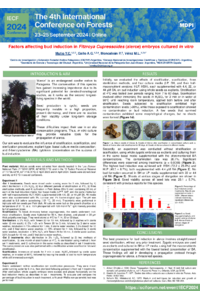
‘Alerce’ is an endangered conifer native to Patagonia. Seed production is cyclic; seeds are frequently inviable in a high proportion, present dormancy, and there are no studies of their viability under long-term storage conditions. These difficulties impact their use in ex situ conservation programs. Thus, in vitro culture may provide valuable tools for the propagation of ‘alerce’. We aimed to analyse the influence of stratification, scarification, and sterilization procedures; explant type; basal culture media composition; and 6-benzyladenine (BA) concentration on the success of bud induction. Firstly, we tested the effect of stratification, scarification, three sterilization methods, and four culture media (LP, SH, and the same media but with half macronutrients: HLP, HSH) supplemented with 4.4, 22, or 44 µM BA on bud induction, using whole seeds as explants. Stratification at 4°C was evaluated in a period of 7-60 days; scarification was performed by immersing the seeds in H2SO4 for 2 min or in H2O at 90°C until reaching room temperature (before or after stratification). All seed lots that underwent stratification exhibited high contamination levels (>90%), whereas those subjected to scarification showed neither contamination nor bud induction. Secondly, an experiment without stratification nor scarification was conducted using the same media and BA concentrations mentioned above. Seeds were sterilized with 3% H2O2 + Tween 20 for 10 min, and whole zygotic embryos were used as explants. The contamination rate was 26.7%. Significantly higher bud induction was obtained with HSH (72.2 ± 25.4%) and with HLP (48.5 ± 8.7%), both supplemented with 4.4 µM BA. Bud formation was not observed with SH or LP supplemented with 22 or 44 µM BA. Seed viability (20.1 ± 5.7%) was similar to that reported for this species. These results will contribute to the development of a propagation protocol through organogenesis for alerce, a threatened species.
Keywords
micropropagation
organogenesis
cytokinin
conifers
Cupressaceae
Poster
sciforum-099859_Maria Velez.pdf
Dendrochronological Study of Manilkara Huberi (Ducke) A. Chev. (SAPOTACEAE) in a Upland Forest of Central Amazonia using High-Frequency Densitometry
Climate response of ring width in some shrub species in the forest-steppe of northern Mongolia