Event submissions
Published
This submission belongs to the session S1. Forest Ecology and Management of the event The 4th International Electronic Conference on Forests
Published date
19 Sep, 2024
Academic Editor
'%3e%3cpath%20d='M12.6657%2010.9104C12.4185%2010.325%2012.0599%209.79327%2011.6097%209.34482C11.1609%208.89508%2010.6293%208.5365%2010.0442%208.28888C10.0389%208.28626%2010.0337%208.28495%2010.0285%208.28233C10.8446%207.69279%2011.3752%206.73249%2011.3752%205.64904C11.3752%203.8542%209.92103%202.39999%208.1262%202.39999C6.33136%202.39999%204.87715%203.8542%204.87715%205.64904C4.87715%206.73249%205.40774%207.69279%206.22393%208.28364C6.21869%208.28626%206.21345%208.28757%206.20821%208.29019C5.62129%208.5378%205.09463%208.89284%204.64265%209.34613C4.1929%209.79493%203.83432%2010.3266%203.58671%2010.9117C3.34345%2011.4845%203.21226%2012.0987%203.20023%2012.7209C3.19988%2012.7349%203.20233%2012.7488%203.20744%2012.7619C3.21255%2012.7749%203.22022%2012.7867%203.22998%2012.7968C3.23975%2012.8068%203.25142%2012.8147%203.26431%2012.8202C3.2772%2012.8256%203.29105%2012.8284%203.30504%2012.8284H4.09109C4.14874%2012.8284%204.19459%2012.7825%204.1959%2012.7262C4.2221%2011.7148%204.62823%2010.7676%205.34617%2010.0497C6.08899%209.30683%207.0755%208.89808%208.1262%208.89808C9.17689%208.89808%2010.1634%209.30683%2010.9062%2010.0497C11.6242%2010.7676%2012.0303%2011.7148%2012.0565%2012.7262C12.0578%2012.7838%2012.1037%2012.8284%2012.1613%2012.8284H12.9474C12.9613%2012.8284%2012.9752%2012.8256%2012.9881%2012.8202C13.001%2012.8147%2013.0126%2012.8068%2013.0224%2012.7968C13.0322%2012.7867%2013.0398%2012.7749%2013.0449%2012.7619C13.0501%2012.7488%2013.0525%2012.7349%2013.0522%2012.7209C13.0391%2012.0947%2012.9094%2011.4855%2012.6657%2010.9104ZM8.1262%207.9024C7.52486%207.9024%206.9589%207.6679%206.53312%207.24211C6.10733%206.81633%205.87283%206.25037%205.87283%205.64904C5.87283%205.0477%206.10733%204.48174%206.53312%204.05596C6.9589%203.63018%207.52486%203.39567%208.1262%203.39567C8.72753%203.39567%209.29349%203.63018%209.71927%204.05596C10.1451%204.48174%2010.3796%205.0477%2010.3796%205.64904C10.3796%206.25037%2010.1451%206.81633%209.71927%207.24211C9.29349%207.6679%208.72753%207.9024%208.1262%207.9024Z'%20fill='%235D1EE1'/%3e%3c/g%3e%3c/svg%3e) Giorgos Mallinis
Giorgos MallinisCitation
Alessandra Manzini, Saliou Boni Biao, Safietou Soumaré, Luc Descroix, Mixed methods to assess Sacred Forest management practices in Guinean Forest of West Africa biodiversity hotspot, in Proceedings of The 4th International Electronic Conference on Forests, 23 September–25 September 2024, MDPI: Basel, Switzerland
Share
Email
Facebook
Twitter
LinkedIn
Mixed methods to assess Sacred Forest management practices in Guinean Forest of West Africa biodiversity hotspot
'%3e%3cpath%20d='M12.6647%2010.9104C12.4176%2010.325%2012.0589%209.7933%2011.6088%209.34485C11.16%208.89511%2010.6283%208.53653%2010.0432%208.28891C10.038%208.28629%2010.0327%208.28498%2010.0275%208.28236C10.8437%207.69282%2011.3743%206.73252%2011.3743%205.64907C11.3743%203.85423%209.92005%202.40002%208.12522%202.40002C6.33038%202.40002%204.87618%203.85423%204.87618%205.64907C4.87618%206.73252%205.40677%207.69282%206.22296%208.28367C6.21772%208.28629%206.21248%208.2876%206.20724%208.29022C5.62031%208.53783%205.09365%208.89287%204.64167%209.34616C4.19192%209.79496%203.83334%2010.3266%203.58573%2010.9117C3.34247%2011.4846%203.21128%2012.0987%203.19925%2012.721C3.1989%2012.735%203.20135%2012.7489%203.20646%2012.7619C3.21157%2012.7749%203.21924%2012.7868%203.22901%2012.7968C3.23877%2012.8068%203.25045%2012.8148%203.26334%2012.8202C3.27623%2012.8256%203.29007%2012.8284%203.30406%2012.8284H4.09012C4.14776%2012.8284%204.19362%2012.7825%204.19493%2012.7262C4.22113%2011.7148%204.62726%2010.7676%205.34519%2010.0497C6.08802%209.30686%207.07452%208.89811%208.12522%208.89811C9.17592%208.89811%2010.1624%209.30686%2010.9052%2010.0497C11.6232%2010.7676%2012.0293%2011.7148%2012.0555%2012.7262C12.0568%2012.7839%2012.1027%2012.8284%2012.1603%2012.8284H12.9464C12.9604%2012.8284%2012.9742%2012.8256%2012.9871%2012.8202C13%2012.8148%2013.0117%2012.8068%2013.0214%2012.7968C13.0312%2012.7868%2013.0389%2012.7749%2013.044%2012.7619C13.0491%2012.7489%2013.0515%2012.735%2013.0512%2012.721C13.0381%2012.0947%2012.9084%2011.4856%2012.6647%2010.9104ZM8.12522%207.90243C7.52388%207.90243%206.95792%207.66793%206.53214%207.24215C6.10636%206.81636%205.87185%206.2504%205.87185%205.64907C5.87185%205.04773%206.10636%204.48177%206.53214%204.05599C6.95792%203.63021%207.52388%203.3957%208.12522%203.3957C8.72655%203.3957%209.29252%203.63021%209.7183%204.05599C10.1441%204.48177%2010.3786%205.04773%2010.3786%205.64907C10.3786%206.2504%2010.1441%206.81636%209.7183%207.24215C9.29252%207.66793%208.72655%207.90243%208.12522%207.90243Z'%20fill='%235D1EE1'/%3e%3c/g%3e%3c/svg%3e)
Alessandra Manzini 1
Saliou Boni Biao 2
Safietou Soumaré 3
Luc Descroix 4
1. EUTOPIA SIF Post Doctoral Research fellow, SPIRAL Project at PLACES LAB, CYU Cergy Paris, France and CASES group University Pompeu Fabra Barcelona Spain
2. Laboratoire d'Analyse et de Recherche sur les Dynamiques Economiques et Sociales pour le Développement (Lardes), Faculté de Lettre, Arts et Sciences Humaines, Université de Parakou, Bénin. BP 123 Parakou, Bénin
3. PhD Université Iba der Thiam de Thies, Université Côte d’Azur, Advanced Study in Geomatics Université du Québec à Chicoutim
4. Senior Investigator, UMR PALOC IRD/MNHN, French National Museum of Natural History, Paris. Hydrologist at IRD (French Research Institute for Sustainable Development).
Abstract
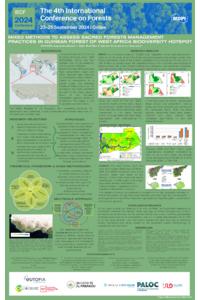
According to the FAO's Global Forest Resources Assessment 2020, the planet has lost 178 million hectares of forest since 1990. Africa had the highest annual rate of net forest loss, 3.9 million hectares in 2010–2020, due to human activities. Sacred Forests (SFs) are unique ecosystems, deeply intertwined with religious or traditional belief systems, key historical events, and specific burial practices. Sacred forests represent a holistic approach to the sustainable management of forests and are one response to the accelerating biodiversity loss. This research aims to describe how Sacred Forests in the Guinean forest of West Africa hotspot (Guinea, Senegal, and Benin) have been preserved, comparing their ecological dynamics with other forest management models. The case studies apply mixed methodologies to observe forest dynamics and survey Traditional Ecological Knowledge (TEK). Satellite remote sensing series help to diachronically monitor ecosystem dynamics. Interactive qualitative methodologies include socio-anthropological research, questionnaires, participant observations, and interviews with stakeholders of Sacred Forests' socio-ecological systems. The results show that the case studies are not subjected to the same anthropogenic pressures as other surrounding forests. Leveraging TEK and integrating scientific ecological knowledge (SEK) on SFs' socio-ecological systems, the paper advocates for a more holistic and inclusive approach to understanding and managing forests. Recognizing that local communities have long-standing relationships and deep-rooted knowledge systems can contribute significantly to sustainable forest management and conservation efforts.
Keywords
forest management
traditional ecological knowledge
sacred forest
mixed methods
remote sensing
socio-ecological systems
forest degradation
Poster
sciforum-095961_MANZINI ALESSANDRA_revised.pdf
Microwave drying of Melia dubia and its effect on mechanical properties
Forest Bathing: A study in Três Picos State Park, Rio de janeiro Brazil