Event submissions
Published
This submission belongs to the session S2. Forest Biodiversity, Ecosystem Services, and Earth Observations of the event The 4th International Electronic Conference on Forests
Published date
23 Sep, 2024
Academic Editor
'%3e%3cpath%20d='M12.6657%2010.9104C12.4185%2010.325%2012.0599%209.79327%2011.6097%209.34482C11.1609%208.89508%2010.6293%208.5365%2010.0442%208.28888C10.0389%208.28626%2010.0337%208.28495%2010.0285%208.28233C10.8446%207.69279%2011.3752%206.73249%2011.3752%205.64904C11.3752%203.8542%209.92103%202.39999%208.1262%202.39999C6.33136%202.39999%204.87715%203.8542%204.87715%205.64904C4.87715%206.73249%205.40774%207.69279%206.22393%208.28364C6.21869%208.28626%206.21345%208.28757%206.20821%208.29019C5.62129%208.5378%205.09463%208.89284%204.64265%209.34613C4.1929%209.79493%203.83432%2010.3266%203.58671%2010.9117C3.34345%2011.4845%203.21226%2012.0987%203.20023%2012.7209C3.19988%2012.7349%203.20233%2012.7488%203.20744%2012.7619C3.21255%2012.7749%203.22022%2012.7867%203.22998%2012.7968C3.23975%2012.8068%203.25142%2012.8147%203.26431%2012.8202C3.2772%2012.8256%203.29105%2012.8284%203.30504%2012.8284H4.09109C4.14874%2012.8284%204.19459%2012.7825%204.1959%2012.7262C4.2221%2011.7148%204.62823%2010.7676%205.34617%2010.0497C6.08899%209.30683%207.0755%208.89808%208.1262%208.89808C9.17689%208.89808%2010.1634%209.30683%2010.9062%2010.0497C11.6242%2010.7676%2012.0303%2011.7148%2012.0565%2012.7262C12.0578%2012.7838%2012.1037%2012.8284%2012.1613%2012.8284H12.9474C12.9613%2012.8284%2012.9752%2012.8256%2012.9881%2012.8202C13.001%2012.8147%2013.0126%2012.8068%2013.0224%2012.7968C13.0322%2012.7867%2013.0398%2012.7749%2013.0449%2012.7619C13.0501%2012.7488%2013.0525%2012.7349%2013.0522%2012.7209C13.0391%2012.0947%2012.9094%2011.4855%2012.6657%2010.9104ZM8.1262%207.9024C7.52486%207.9024%206.9589%207.6679%206.53312%207.24211C6.10733%206.81633%205.87283%206.25037%205.87283%205.64904C5.87283%205.0477%206.10733%204.48174%206.53312%204.05596C6.9589%203.63018%207.52486%203.39567%208.1262%203.39567C8.72753%203.39567%209.29349%203.63018%209.71927%204.05596C10.1451%204.48174%2010.3796%205.0477%2010.3796%205.64904C10.3796%206.25037%2010.1451%206.81633%209.71927%207.24211C9.29349%207.6679%208.72753%207.9024%208.1262%207.9024Z'%20fill='%235D1EE1'/%3e%3c/g%3e%3c/svg%3e) Giovanna Battipaglia
Giovanna BattipagliaCitation
Chenyi Xu, Qingyun Luo, Tiefeng Zheng, Yingying Wang, Yuyan Cai, Zhaojiang Zuo, Eucalyptol serves a signaling function to enhance Cinnamomum camphora thermotolerance, in Proceedings of The 4th International Electronic Conference on Forests, 23 September–25 September 2024, MDPI: Basel, Switzerland
Share
Email
Facebook
Twitter
LinkedIn
Eucalyptol serves a signaling function to enhance Cinnamomum camphora thermotolerance
'%3e%3cpath%20d='M12.6647%2010.9104C12.4176%2010.325%2012.0589%209.7933%2011.6088%209.34485C11.16%208.89511%2010.6283%208.53653%2010.0432%208.28891C10.038%208.28629%2010.0327%208.28498%2010.0275%208.28236C10.8437%207.69282%2011.3743%206.73252%2011.3743%205.64907C11.3743%203.85423%209.92005%202.40002%208.12522%202.40002C6.33038%202.40002%204.87618%203.85423%204.87618%205.64907C4.87618%206.73252%205.40677%207.69282%206.22296%208.28367C6.21772%208.28629%206.21248%208.2876%206.20724%208.29022C5.62031%208.53783%205.09365%208.89287%204.64167%209.34616C4.19192%209.79496%203.83334%2010.3266%203.58573%2010.9117C3.34247%2011.4846%203.21128%2012.0987%203.19925%2012.721C3.1989%2012.735%203.20135%2012.7489%203.20646%2012.7619C3.21157%2012.7749%203.21924%2012.7868%203.22901%2012.7968C3.23877%2012.8068%203.25045%2012.8148%203.26334%2012.8202C3.27623%2012.8256%203.29007%2012.8284%203.30406%2012.8284H4.09012C4.14776%2012.8284%204.19362%2012.7825%204.19493%2012.7262C4.22113%2011.7148%204.62726%2010.7676%205.34519%2010.0497C6.08802%209.30686%207.07452%208.89811%208.12522%208.89811C9.17592%208.89811%2010.1624%209.30686%2010.9052%2010.0497C11.6232%2010.7676%2012.0293%2011.7148%2012.0555%2012.7262C12.0568%2012.7839%2012.1027%2012.8284%2012.1603%2012.8284H12.9464C12.9604%2012.8284%2012.9742%2012.8256%2012.9871%2012.8202C13%2012.8148%2013.0117%2012.8068%2013.0214%2012.7968C13.0312%2012.7868%2013.0389%2012.7749%2013.044%2012.7619C13.0491%2012.7489%2013.0515%2012.735%2013.0512%2012.721C13.0381%2012.0947%2012.9084%2011.4856%2012.6647%2010.9104ZM8.12522%207.90243C7.52388%207.90243%206.95792%207.66793%206.53214%207.24215C6.10636%206.81636%205.87185%206.2504%205.87185%205.64907C5.87185%205.04773%206.10636%204.48177%206.53214%204.05599C6.95792%203.63021%207.52388%203.3957%208.12522%203.3957C8.72655%203.3957%209.29252%203.63021%209.7183%204.05599C10.1441%204.48177%2010.3786%205.04773%2010.3786%205.64907C10.3786%206.2504%2010.1441%206.81636%209.7183%207.24215C9.29252%207.66793%208.72655%207.90243%208.12522%207.90243Z'%20fill='%235D1EE1'/%3e%3c/g%3e%3c/svg%3e)
Chenyi Xu 1,2
Qingyun Luo 1,2
Tiefeng Zheng 1,2
Yingying Wang 1,2
Yuyan Cai 1,2

Zhaojiang Zuo 1,2
1. State Key Laboratory of Subtropical Silviculture, Zhejiang A & F University, Hangzhou 311300, China
2. Zhejiang Provincial Key Laboratory of Forest Aromatic Plants-based Healthcare Functions, Zhejiang A & F University, Hangzhou 311300, China
Abstract
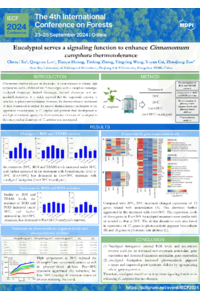
Terpenes serve important functions in enhancing plant thermotolerance, but the thermotolerance mechanism is still unknown. Cinnamomum camphora releases an abundance of monoterpenes to tolerate high temperature, and is subdivided into five chemotypes, such as camphor chemotype, eucalyptol chemotype, linalool chemotype, borneol chemotype, and iso-nerolidol chemotype. To uncover the thermotolerance mechanism of the uppermost monoterpenes in C. camphora and promote their development as anti-high temperature agents, the thermotolerance functions of eucalyptol in the corresponding chemotype of C. camphora were investigated. In contrast to normal temperature (28oC), reactive oxygen species (ROS), thiobarbituric acid reactive substance (TBARS) levels, and antioxidant enzyme activities increased under 38oC, and further increased in the treatment with fosmidomycin (Fos), inhibiting monoterpene synthesis at 38oC (Fos+38oC) due to alterations in the expression of the genes related to non-enzymatic and enzymatic antioxidant formations. Compared with Fos+38oC treatment, Fos+38oC treatment with eucalyptol fumigation (Fos+38oC+eucalyptol) lowered ROS levels and antioxidant enzyme activities for increased non-enzymatic antioxidant gene expression and decreased enzymatic antioxidant gene expression. High temperature at 38oC reduced the chlorophyll and carotenoid content as well as photosynthetic abilities by reducing the expression of the genes associated with photosynthetic pigment biosynthesis, light reaction, and carbon fixation. Fos+38oC treatment aggravated the reduction. In contrast to Fos+38oC treatment, Fos+38oC+eucalyptol treatment increased photosynthetic pigment content and improved photosynthetic abilities by up-regulating related gene expression. Therefore, the findings first uncover that the uppermost monoterpenes should serve important signaling functions in enhancing C. camphora thermotolerance, which provides a new thought for uncovering the thermotolerance mechanism of terpenes.
Keywords
Cinnamomum camphora
Gene expression
Photosynthetic ability
Reactive oxygen species
Thermotolerance mechanism
Poster
sciforum-097409_ZhaoJiangZuo.pdf
Preliminary studies on the selection of Uruguayan woods for the production of transparent wood.
Effects of landscape homogenization on biodiversity conservation and ecosystem services