Event submissions
Published
This submission belongs to the session S1. Forest Ecology and Management of the event The 4th International Electronic Conference on Forests
Published date
23 Sep, 2024
Academic Editor
'%3e%3cpath%20d='M12.6657%2010.9104C12.4185%2010.325%2012.0599%209.79327%2011.6097%209.34482C11.1609%208.89508%2010.6293%208.5365%2010.0442%208.28888C10.0389%208.28626%2010.0337%208.28495%2010.0285%208.28233C10.8446%207.69279%2011.3752%206.73249%2011.3752%205.64904C11.3752%203.8542%209.92103%202.39999%208.1262%202.39999C6.33136%202.39999%204.87715%203.8542%204.87715%205.64904C4.87715%206.73249%205.40774%207.69279%206.22393%208.28364C6.21869%208.28626%206.21345%208.28757%206.20821%208.29019C5.62129%208.5378%205.09463%208.89284%204.64265%209.34613C4.1929%209.79493%203.83432%2010.3266%203.58671%2010.9117C3.34345%2011.4845%203.21226%2012.0987%203.20023%2012.7209C3.19988%2012.7349%203.20233%2012.7488%203.20744%2012.7619C3.21255%2012.7749%203.22022%2012.7867%203.22998%2012.7968C3.23975%2012.8068%203.25142%2012.8147%203.26431%2012.8202C3.2772%2012.8256%203.29105%2012.8284%203.30504%2012.8284H4.09109C4.14874%2012.8284%204.19459%2012.7825%204.1959%2012.7262C4.2221%2011.7148%204.62823%2010.7676%205.34617%2010.0497C6.08899%209.30683%207.0755%208.89808%208.1262%208.89808C9.17689%208.89808%2010.1634%209.30683%2010.9062%2010.0497C11.6242%2010.7676%2012.0303%2011.7148%2012.0565%2012.7262C12.0578%2012.7838%2012.1037%2012.8284%2012.1613%2012.8284H12.9474C12.9613%2012.8284%2012.9752%2012.8256%2012.9881%2012.8202C13.001%2012.8147%2013.0126%2012.8068%2013.0224%2012.7968C13.0322%2012.7867%2013.0398%2012.7749%2013.0449%2012.7619C13.0501%2012.7488%2013.0525%2012.7349%2013.0522%2012.7209C13.0391%2012.0947%2012.9094%2011.4855%2012.6657%2010.9104ZM8.1262%207.9024C7.52486%207.9024%206.9589%207.6679%206.53312%207.24211C6.10733%206.81633%205.87283%206.25037%205.87283%205.64904C5.87283%205.0477%206.10733%204.48174%206.53312%204.05596C6.9589%203.63018%207.52486%203.39567%208.1262%203.39567C8.72753%203.39567%209.29349%203.63018%209.71927%204.05596C10.1451%204.48174%2010.3796%205.0477%2010.3796%205.64904C10.3796%206.25037%2010.1451%206.81633%209.71927%207.24211C9.29349%207.6679%208.72753%207.9024%208.1262%207.9024Z'%20fill='%235D1EE1'/%3e%3c/g%3e%3c/svg%3e) Giorgos Mallinis
Giorgos MallinisCitation
Alberto Bernacchi, Roberto Danti, Gianni Della Rocca, Giovanni Emiliani, Lorenzo Arcidiaco, David Pellegrini, Elisa Pellegrini, Pippi Lorenzo, Samuele Risoli, Claudia Pisuttu, Cristina Nali, Lorenzo Cotrozzi, Sara Barberini, Monitoring the biotic stressors in a Mediterranean Holm oak forest: outcomes of the project SpecFor, in Proceedings of The 4th International Electronic Conference on Forests, 23 September–25 September 2024, MDPI: Basel, Switzerland
Share
Email
Facebook
Twitter
LinkedIn
Monitoring the biotic stressors in a Mediterranean Holm oak forest: outcomes of the project SpecFor
'%3e%3cpath%20d='M12.6647%2010.9104C12.4176%2010.325%2012.0589%209.7933%2011.6088%209.34485C11.16%208.89511%2010.6283%208.53653%2010.0432%208.28891C10.038%208.28629%2010.0327%208.28498%2010.0275%208.28236C10.8437%207.69282%2011.3743%206.73252%2011.3743%205.64907C11.3743%203.85423%209.92005%202.40002%208.12522%202.40002C6.33038%202.40002%204.87618%203.85423%204.87618%205.64907C4.87618%206.73252%205.40677%207.69282%206.22296%208.28367C6.21772%208.28629%206.21248%208.2876%206.20724%208.29022C5.62031%208.53783%205.09365%208.89287%204.64167%209.34616C4.19192%209.79496%203.83334%2010.3266%203.58573%2010.9117C3.34247%2011.4846%203.21128%2012.0987%203.19925%2012.721C3.1989%2012.735%203.20135%2012.7489%203.20646%2012.7619C3.21157%2012.7749%203.21924%2012.7868%203.22901%2012.7968C3.23877%2012.8068%203.25045%2012.8148%203.26334%2012.8202C3.27623%2012.8256%203.29007%2012.8284%203.30406%2012.8284H4.09012C4.14776%2012.8284%204.19362%2012.7825%204.19493%2012.7262C4.22113%2011.7148%204.62726%2010.7676%205.34519%2010.0497C6.08802%209.30686%207.07452%208.89811%208.12522%208.89811C9.17592%208.89811%2010.1624%209.30686%2010.9052%2010.0497C11.6232%2010.7676%2012.0293%2011.7148%2012.0555%2012.7262C12.0568%2012.7839%2012.1027%2012.8284%2012.1603%2012.8284H12.9464C12.9604%2012.8284%2012.9742%2012.8256%2012.9871%2012.8202C13%2012.8148%2013.0117%2012.8068%2013.0214%2012.7968C13.0312%2012.7868%2013.0389%2012.7749%2013.044%2012.7619C13.0491%2012.7489%2013.0515%2012.735%2013.0512%2012.721C13.0381%2012.0947%2012.9084%2011.4856%2012.6647%2010.9104ZM8.12522%207.90243C7.52388%207.90243%206.95792%207.66793%206.53214%207.24215C6.10636%206.81636%205.87185%206.2504%205.87185%205.64907C5.87185%205.04773%206.10636%204.48177%206.53214%204.05599C6.95792%203.63021%207.52388%203.3957%208.12522%203.3957C8.72655%203.3957%209.29252%203.63021%209.7183%204.05599C10.1441%204.48177%2010.3786%205.04773%2010.3786%205.64907C10.3786%206.2504%2010.1441%206.81636%209.7183%207.24215C9.29252%207.66793%208.72655%207.90243%208.12522%207.90243Z'%20fill='%235D1EE1'/%3e%3c/g%3e%3c/svg%3e)
Alberto Bernacchi 1
Roberto Danti 1

Gianni Della Rocca 1

Giovanni Emiliani 1

Lorenzo Arcidiaco 2
David Pellegrini 2
Elisa Pellegrini 3
Pippi Lorenzo 3

Samuele Risoli 3
Claudia Pisuttu 3

Cristina Nali 3
Lorenzo Cotrozzi 3
Sara Barberini 1
1. Institute for Sustainable Plant Protection (IPSP), National Reasearch Council (CNR). Via Madonna del Piano 10, 50019, Sesto Fiorentino, Italy.
2. Institute for BioEconomy (IBE), National Research Council (CNR). Via Madonna del Piano 10, 50019, Sesto Fiorentino, Italy.
3. University of Pisa (UNIPI), Department of Agriculture, Food and Environment (DAFE). Via del Borghetto, 80, 56124, Pisa, Italy.
Abstract
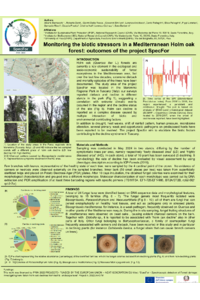
Holm oak forests are currently a key element in the ecological and socio-economic sustainability of forest ecosystems in the Mediterranean area, but over the last few decades, extensive dieback and mortality episodes of Quercus ilex L. have been documented after severe drought events.
The project “SpecFor” focused on a typical Mediterranean forest ecosystem located along the southern coast of Tuscany (Parco Regionale della Maremma) where severe holm oak declines have recently been reported (Summer 2017). The goal is to develop an accurate and high-throughput framework for detecting forest damage and monitoring forest responses to biotic stresses based on the use of satellite imagery: hyperspectral and optical data.
A climatological analysis from 1950 to 2023 has been carried out, involving the analysis of temperature and precipitation variables extracted from the ERA5 Land dataset produced and distributed by ECMWF (Copernicus Climate Service). The climatological analysis allowed us to derive the anomaly time series of temperature and precipitation, both annual and monthly, and the most scientifically used drought index (SPEI—Standardised Precipitation--Evapotranspiration Index).
Three plots characterized by low, medium, or high degrees of three decline, were evaluated by phytopatological surveys (visual inspection and fungal identification by culturomic approach), and the ecological role of the fungal communities was investigated using Next-Generation Sequencing metabarcoding. Then, the assessment of forest health and tree growth was correlated with the vegetation index (NDVI) derived from satellite images. By combining advanced remote sensing techniques with traditional field methods and molecular analysis, the project aimed to develop a comprehensive approach to understanding the complex interactions between environmental factors, tree health, and fungal communities in Mediterranean Holm oak forests.
Keywords
Holm oak
decline
mediterranean forests
vegetation index
climate change
Poster
sciforum-099741_Alberto Bernacchi.pdf
The Impact of Extreme Weather conditions on the forest dieback in the Polish Mountains
Quantitative wood anatomy of Scots pine over 270 years in the foothills of the Western Sayan, Siberia