Event submissions
EventsThe 5th International Conference on Materials: Advances in Material Innovation
Published
This submission belongs to the session S1. Materials Characterization, Processing and Manufacturing of the event The 5th International Conference on Materials: Advances in Material Innovation
Published date
25 Sep, 2024
Academic Editor
'%3e%3cpath%20d='M12.6657%2010.9104C12.4185%2010.325%2012.0599%209.79327%2011.6097%209.34482C11.1609%208.89508%2010.6293%208.5365%2010.0442%208.28888C10.0389%208.28626%2010.0337%208.28495%2010.0285%208.28233C10.8446%207.69279%2011.3752%206.73249%2011.3752%205.64904C11.3752%203.8542%209.92103%202.39999%208.1262%202.39999C6.33136%202.39999%204.87715%203.8542%204.87715%205.64904C4.87715%206.73249%205.40774%207.69279%206.22393%208.28364C6.21869%208.28626%206.21345%208.28757%206.20821%208.29019C5.62129%208.5378%205.09463%208.89284%204.64265%209.34613C4.1929%209.79493%203.83432%2010.3266%203.58671%2010.9117C3.34345%2011.4845%203.21226%2012.0987%203.20023%2012.7209C3.19988%2012.7349%203.20233%2012.7488%203.20744%2012.7619C3.21255%2012.7749%203.22022%2012.7867%203.22998%2012.7968C3.23975%2012.8068%203.25142%2012.8147%203.26431%2012.8202C3.2772%2012.8256%203.29105%2012.8284%203.30504%2012.8284H4.09109C4.14874%2012.8284%204.19459%2012.7825%204.1959%2012.7262C4.2221%2011.7148%204.62823%2010.7676%205.34617%2010.0497C6.08899%209.30683%207.0755%208.89808%208.1262%208.89808C9.17689%208.89808%2010.1634%209.30683%2010.9062%2010.0497C11.6242%2010.7676%2012.0303%2011.7148%2012.0565%2012.7262C12.0578%2012.7838%2012.1037%2012.8284%2012.1613%2012.8284H12.9474C12.9613%2012.8284%2012.9752%2012.8256%2012.9881%2012.8202C13.001%2012.8147%2013.0126%2012.8068%2013.0224%2012.7968C13.0322%2012.7867%2013.0398%2012.7749%2013.0449%2012.7619C13.0501%2012.7488%2013.0525%2012.7349%2013.0522%2012.7209C13.0391%2012.0947%2012.9094%2011.4855%2012.6657%2010.9104ZM8.1262%207.9024C7.52486%207.9024%206.9589%207.6679%206.53312%207.24211C6.10733%206.81633%205.87283%206.25037%205.87283%205.64904C5.87283%205.0477%206.10733%204.48174%206.53312%204.05596C6.9589%203.63018%207.52486%203.39567%208.1262%203.39567C8.72753%203.39567%209.29349%203.63018%209.71927%204.05596C10.1451%204.48174%2010.3796%205.0477%2010.3796%205.64904C10.3796%206.25037%2010.1451%206.81633%209.71927%207.24211C9.29349%207.6679%208.72753%207.9024%208.1262%207.9024Z'%20fill='%235D1EE1'/%3e%3c/g%3e%3c/svg%3e) Maryam Tabrizian
Maryam TabrizianCitation
Rahul Samyal, Ashok Kumar Bagha, Raman Bedi, Anupam Singhal, Srikanta Routroy, Study of Heat-Affected Zone (HAZ) for Microwave-Welded Stainless Steel Dissimilar Lap Joint, in Proceedings of The 5th International Conference on Materials: Advances in Material Innovation, Basel, 25 September–27 September 2024, MDPI: Basel, Switzerland
Share
Email
Facebook
Twitter
LinkedIn
Study of Heat-Affected Zone (HAZ) for Microwave-Welded Stainless Steel Dissimilar Lap Joint
'%3e%3cpath%20d='M12.6647%2010.9104C12.4176%2010.325%2012.0589%209.7933%2011.6088%209.34485C11.16%208.89511%2010.6283%208.53653%2010.0432%208.28891C10.038%208.28629%2010.0327%208.28498%2010.0275%208.28236C10.8437%207.69282%2011.3743%206.73252%2011.3743%205.64907C11.3743%203.85423%209.92005%202.40002%208.12522%202.40002C6.33038%202.40002%204.87618%203.85423%204.87618%205.64907C4.87618%206.73252%205.40677%207.69282%206.22296%208.28367C6.21772%208.28629%206.21248%208.2876%206.20724%208.29022C5.62031%208.53783%205.09365%208.89287%204.64167%209.34616C4.19192%209.79496%203.83334%2010.3266%203.58573%2010.9117C3.34247%2011.4846%203.21128%2012.0987%203.19925%2012.721C3.1989%2012.735%203.20135%2012.7489%203.20646%2012.7619C3.21157%2012.7749%203.21924%2012.7868%203.22901%2012.7968C3.23877%2012.8068%203.25045%2012.8148%203.26334%2012.8202C3.27623%2012.8256%203.29007%2012.8284%203.30406%2012.8284H4.09012C4.14776%2012.8284%204.19362%2012.7825%204.19493%2012.7262C4.22113%2011.7148%204.62726%2010.7676%205.34519%2010.0497C6.08802%209.30686%207.07452%208.89811%208.12522%208.89811C9.17592%208.89811%2010.1624%209.30686%2010.9052%2010.0497C11.6232%2010.7676%2012.0293%2011.7148%2012.0555%2012.7262C12.0568%2012.7839%2012.1027%2012.8284%2012.1603%2012.8284H12.9464C12.9604%2012.8284%2012.9742%2012.8256%2012.9871%2012.8202C13%2012.8148%2013.0117%2012.8068%2013.0214%2012.7968C13.0312%2012.7868%2013.0389%2012.7749%2013.044%2012.7619C13.0491%2012.7489%2013.0515%2012.735%2013.0512%2012.721C13.0381%2012.0947%2012.9084%2011.4856%2012.6647%2010.9104ZM8.12522%207.90243C7.52388%207.90243%206.95792%207.66793%206.53214%207.24215C6.10636%206.81636%205.87185%206.2504%205.87185%205.64907C5.87185%205.04773%206.10636%204.48177%206.53214%204.05599C6.95792%203.63021%207.52388%203.3957%208.12522%203.3957C8.72655%203.3957%209.29252%203.63021%209.7183%204.05599C10.1441%204.48177%2010.3786%205.04773%2010.3786%205.64907C10.3786%206.2504%2010.1441%206.81636%209.7183%207.24215C9.29252%207.66793%208.72655%207.90243%208.12522%207.90243Z'%20fill='%235D1EE1'/%3e%3c/g%3e%3c/svg%3e)
Rahul Samyal 1
Ashok Kumar Bagha 2
Raman Bedi 2
Anupam Singhal 3
Srikanta Routroy 1
1. Department of Mechanical Engineering, Birla Institute of Technology and Sciences, Pilani, Rajasthan, 333031, India
2. Department of Mechanical Engineering, Dr. B R Ambedkar National Institute of Technology, Jalandhar, Punjab, 144008, India
3. Department of Civil Engineering, Birla Institute of Technology & Science, Pilani- 333031, Rajasthan, India
Abstract
In welding, the heat-affected zone (HAZ) refers to the region of the base metal that has been subjected to a temperature change during the welding process. The HAZ is a critical area in welding because it can have significant impacts on the mechanical properties and overall quality of the welded joint. Microwave welding is a technique of joining metals through susceptor heating which is extensively used by researchers. However, limited studies have been reported studying the HAZ in microwave-welded joints.
In the present study, lap joints between SS202 and SS304 were developed through a novel selective microwave hybrid heating (SMHH) process utilizing nickel powder as the filler. Study of the HAZ was carried out through electron back-scattered diffraction (EBSD) analysis. EBSD is a SEM-assisted technique used to reveal the crystallographic data within the microstructural data of a specimen. Different locations were considered for the EBSD scans, moving towards the joint. For the upper plate (SS202), P1, P2, P3, P4 and P5 were the designated locations, whereas for the lower plate (SS304), R1, R2, R3, R4, and R5 were the designated locations.
A fine-grain heat-affected zone (FGHAZ) was observed at the P3 and P4 locations. For the upper plate, the length of the FGHAZ was approximately 30 mm, whereas for the lower plate, no such FGHAZ was observed. Further, for location P4, the average grain size diameter (AGSD) increased significantly to 19.974 µm, characterizing it as a coarse-grain heat-affected zone (CGHAZ). A relatively high fraction of the average angle from 0.4 to 0.8˚ for the KAM histograms corroborates the presence of residual stresses. Increased KAM values at locations P2, P3 and R2 were revealed, pointing towards the evolution of slip lines at different locations. The rapid thermal cycling caused a significant increase in the average KAM values at locations P2, P3 and R2.
Keywords
Stainless Steel
HAZ
Microwave
Welding
EBSD
Poster
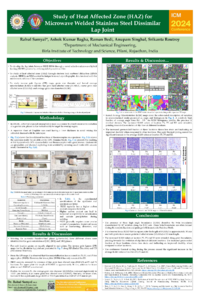
Poster, sciforum-100398 Rahul Samyal, India.pdf
Applications of Nanomaterials in Pediatrics
Research on the manufacturing process of tools with a L-PBF M300 steel working layer for sheet metal forming