Event submissions
Published
This submission belongs to the session S2. Innovation in Dietary Choices of the event The 4th International Electronic Conference on Nutrients
Published date
11 Oct, 2024
Academic Editor
'%3e%3cpath%20d='M12.6657%2010.9104C12.4185%2010.325%2012.0599%209.79327%2011.6097%209.34482C11.1609%208.89508%2010.6293%208.5365%2010.0442%208.28888C10.0389%208.28626%2010.0337%208.28495%2010.0285%208.28233C10.8446%207.69279%2011.3752%206.73249%2011.3752%205.64904C11.3752%203.8542%209.92103%202.39999%208.1262%202.39999C6.33136%202.39999%204.87715%203.8542%204.87715%205.64904C4.87715%206.73249%205.40774%207.69279%206.22393%208.28364C6.21869%208.28626%206.21345%208.28757%206.20821%208.29019C5.62129%208.5378%205.09463%208.89284%204.64265%209.34613C4.1929%209.79493%203.83432%2010.3266%203.58671%2010.9117C3.34345%2011.4845%203.21226%2012.0987%203.20023%2012.7209C3.19988%2012.7349%203.20233%2012.7488%203.20744%2012.7619C3.21255%2012.7749%203.22022%2012.7867%203.22998%2012.7968C3.23975%2012.8068%203.25142%2012.8147%203.26431%2012.8202C3.2772%2012.8256%203.29105%2012.8284%203.30504%2012.8284H4.09109C4.14874%2012.8284%204.19459%2012.7825%204.1959%2012.7262C4.2221%2011.7148%204.62823%2010.7676%205.34617%2010.0497C6.08899%209.30683%207.0755%208.89808%208.1262%208.89808C9.17689%208.89808%2010.1634%209.30683%2010.9062%2010.0497C11.6242%2010.7676%2012.0303%2011.7148%2012.0565%2012.7262C12.0578%2012.7838%2012.1037%2012.8284%2012.1613%2012.8284H12.9474C12.9613%2012.8284%2012.9752%2012.8256%2012.9881%2012.8202C13.001%2012.8147%2013.0126%2012.8068%2013.0224%2012.7968C13.0322%2012.7867%2013.0398%2012.7749%2013.0449%2012.7619C13.0501%2012.7488%2013.0525%2012.7349%2013.0522%2012.7209C13.0391%2012.0947%2012.9094%2011.4855%2012.6657%2010.9104ZM8.1262%207.9024C7.52486%207.9024%206.9589%207.6679%206.53312%207.24211C6.10733%206.81633%205.87283%206.25037%205.87283%205.64904C5.87283%205.0477%206.10733%204.48174%206.53312%204.05596C6.9589%203.63018%207.52486%203.39567%208.1262%203.39567C8.72753%203.39567%209.29349%203.63018%209.71927%204.05596C10.1451%204.48174%2010.3796%205.0477%2010.3796%205.64904C10.3796%206.25037%2010.1451%206.81633%209.71927%207.24211C9.29349%207.6679%208.72753%207.9024%208.1262%207.9024Z'%20fill='%235D1EE1'/%3e%3c/g%3e%3c/svg%3e) Mauro Lombardo
Mauro LombardoCitation
JAYSHREE MAJUMDAR, Hari Niwas Mishra, A sustainable, extruded legume-based protein source: antioxidant, anti-nutrient, and structural profile, in Proceedings of The 4th International Electronic Conference on Nutrients, 16 October–18 October 2024, MDPI: Basel, Switzerland
Share
Email
Facebook
Twitter
LinkedIn
A sustainable, extruded legume-based protein source: antioxidant, anti-nutrient, and structural profile
'%3e%3cpath%20d='M12.6647%2010.9104C12.4176%2010.325%2012.0589%209.7933%2011.6088%209.34485C11.16%208.89511%2010.6283%208.53653%2010.0432%208.28891C10.038%208.28629%2010.0327%208.28498%2010.0275%208.28236C10.8437%207.69282%2011.3743%206.73252%2011.3743%205.64907C11.3743%203.85423%209.92005%202.40002%208.12522%202.40002C6.33038%202.40002%204.87618%203.85423%204.87618%205.64907C4.87618%206.73252%205.40677%207.69282%206.22296%208.28367C6.21772%208.28629%206.21248%208.2876%206.20724%208.29022C5.62031%208.53783%205.09365%208.89287%204.64167%209.34616C4.19192%209.79496%203.83334%2010.3266%203.58573%2010.9117C3.34247%2011.4846%203.21128%2012.0987%203.19925%2012.721C3.1989%2012.735%203.20135%2012.7489%203.20646%2012.7619C3.21157%2012.7749%203.21924%2012.7868%203.22901%2012.7968C3.23877%2012.8068%203.25045%2012.8148%203.26334%2012.8202C3.27623%2012.8256%203.29007%2012.8284%203.30406%2012.8284H4.09012C4.14776%2012.8284%204.19362%2012.7825%204.19493%2012.7262C4.22113%2011.7148%204.62726%2010.7676%205.34519%2010.0497C6.08802%209.30686%207.07452%208.89811%208.12522%208.89811C9.17592%208.89811%2010.1624%209.30686%2010.9052%2010.0497C11.6232%2010.7676%2012.0293%2011.7148%2012.0555%2012.7262C12.0568%2012.7839%2012.1027%2012.8284%2012.1603%2012.8284H12.9464C12.9604%2012.8284%2012.9742%2012.8256%2012.9871%2012.8202C13%2012.8148%2013.0117%2012.8068%2013.0214%2012.7968C13.0312%2012.7868%2013.0389%2012.7749%2013.044%2012.7619C13.0491%2012.7489%2013.0515%2012.735%2013.0512%2012.721C13.0381%2012.0947%2012.9084%2011.4856%2012.6647%2010.9104ZM8.12522%207.90243C7.52388%207.90243%206.95792%207.66793%206.53214%207.24215C6.10636%206.81636%205.87185%206.2504%205.87185%205.64907C5.87185%205.04773%206.10636%204.48177%206.53214%204.05599C6.95792%203.63021%207.52388%203.3957%208.12522%203.3957C8.72655%203.3957%209.29252%203.63021%209.7183%204.05599C10.1441%204.48177%2010.3786%205.04773%2010.3786%205.64907C10.3786%206.2504%2010.1441%206.81636%209.7183%207.24215C9.29252%207.66793%208.72655%207.90243%208.12522%207.90243Z'%20fill='%235D1EE1'/%3e%3c/g%3e%3c/svg%3e)
JAYSHREE MAJUMDAR 1,2

Hari Niwas Mishra 3,4
1. Research scholar
Agricultural and Food Engineering Department , Indian Institute of Technology Kharagpur
2. Assistant professor, Department of Food Technology Guru Nanak Institute of Technology
3. Professor of Food Technology
Agricultural and Food Engineering Department
Indian Institute of Technology Kharagpur
4. Professor I/C & Nodal Officer, Agri Business Incubation Centre
Indian Institute of Technology Kharagpur
Abstract
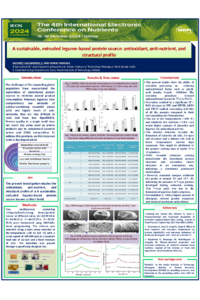
The challenges of the expanding global population have necessitated the exploration of plant-based protein sources to minimize animal product consumption. Pulses and legumes may be worth investigating.
However, legumes have comparatively low amounts of sulphur-containing essential amino acids and higher levels of anti-nutrients; they are also difficult to cook and have low digestibility. The goal of this study was to manufacture essential amino acids in balanced legumes through extrusion. Thus, several types of broken legumes and lentils (byproducts of the milling process) were collected and pulverized. Powdered legumes and lentils were combined with a plant-based protein isolate.
Four combinations containing chickpeas/lentils/mung beans/protein isolate at different ratios (A—42:20:34:4, B—35:30:31:4; C—45:27:25:3; D—37:25: 35:3) were formulated using MATLAB's linear programming. The mixture was extruded using a twin screw extruder at die temperature (100 to 115 °C) with a screw speed of 100-200 rpm at a constant feed rate of 12 rpm and a feed moisture of 22%. The extrudate was passed through a specifically designed die. Antioxidant activity was calculated by TPC, total flavonoid content (TFC), ABTS, FRAP, and DPPH. Anti-nutrient percentage was analysed by the percentage reduction in anti-nutrients, and structural qualities were studied by scanning electron microscopy (SEM) and X-ray diffraction (XRD).
The extrusion procedure lowered antinutritional factors by 77.2 to 93.6%. Higher temperatures resulted in a considerable reduction in antioxidant capacity. However, a low temperature and high rpm retained substantial (p<0.5) TPC and TFC. The interior structure revealed the formation of extensive air cells. An open cell structure and a thinner cell wall at lower temperatures showed high expansion. This might be attributed to the quicker cooking time of lentils (9 to 15 minutes). XRD revealed extrusion cooking transformed the disordered protein structure and crystalline starch structure to an amorphous one, indicating a continuous gelatinized starch phase. Formulation C, with a higher amount of chickpeas, showed greater expansion and retained maximum antioxidants.
Keywords
legume
protein source
SEM
XRD
Anti nutirnt
antioxidant
extrusion
Poster
JAYSHREE_NUTRI LENTIL.pdf
Future Trends and Challenges in Social Internet of Things (SIoT)
"Evaluating the Viability of Plant-Based Milk: A Sustainable Alternative to Dairy"