Event submissions
Published
This submission belongs to the session S1. Plant-Based Diets: Health and Well-Being of the event The 4th International Electronic Conference on Nutrients
Published date
11 Oct, 2024
Academic Editor
'%3e%3cpath%20d='M12.6657%2010.9104C12.4185%2010.325%2012.0599%209.79327%2011.6097%209.34482C11.1609%208.89508%2010.6293%208.5365%2010.0442%208.28888C10.0389%208.28626%2010.0337%208.28495%2010.0285%208.28233C10.8446%207.69279%2011.3752%206.73249%2011.3752%205.64904C11.3752%203.8542%209.92103%202.39999%208.1262%202.39999C6.33136%202.39999%204.87715%203.8542%204.87715%205.64904C4.87715%206.73249%205.40774%207.69279%206.22393%208.28364C6.21869%208.28626%206.21345%208.28757%206.20821%208.29019C5.62129%208.5378%205.09463%208.89284%204.64265%209.34613C4.1929%209.79493%203.83432%2010.3266%203.58671%2010.9117C3.34345%2011.4845%203.21226%2012.0987%203.20023%2012.7209C3.19988%2012.7349%203.20233%2012.7488%203.20744%2012.7619C3.21255%2012.7749%203.22022%2012.7867%203.22998%2012.7968C3.23975%2012.8068%203.25142%2012.8147%203.26431%2012.8202C3.2772%2012.8256%203.29105%2012.8284%203.30504%2012.8284H4.09109C4.14874%2012.8284%204.19459%2012.7825%204.1959%2012.7262C4.2221%2011.7148%204.62823%2010.7676%205.34617%2010.0497C6.08899%209.30683%207.0755%208.89808%208.1262%208.89808C9.17689%208.89808%2010.1634%209.30683%2010.9062%2010.0497C11.6242%2010.7676%2012.0303%2011.7148%2012.0565%2012.7262C12.0578%2012.7838%2012.1037%2012.8284%2012.1613%2012.8284H12.9474C12.9613%2012.8284%2012.9752%2012.8256%2012.9881%2012.8202C13.001%2012.8147%2013.0126%2012.8068%2013.0224%2012.7968C13.0322%2012.7867%2013.0398%2012.7749%2013.0449%2012.7619C13.0501%2012.7488%2013.0525%2012.7349%2013.0522%2012.7209C13.0391%2012.0947%2012.9094%2011.4855%2012.6657%2010.9104ZM8.1262%207.9024C7.52486%207.9024%206.9589%207.6679%206.53312%207.24211C6.10733%206.81633%205.87283%206.25037%205.87283%205.64904C5.87283%205.0477%206.10733%204.48174%206.53312%204.05596C6.9589%203.63018%207.52486%203.39567%208.1262%203.39567C8.72753%203.39567%209.29349%203.63018%209.71927%204.05596C10.1451%204.48174%2010.3796%205.0477%2010.3796%205.64904C10.3796%206.25037%2010.1451%206.81633%209.71927%207.24211C9.29349%207.6679%208.72753%207.9024%208.1262%207.9024Z'%20fill='%235D1EE1'/%3e%3c/g%3e%3c/svg%3e) Mauro Lombardo
Mauro LombardoCitation
Abosede Oyeyemi Fawole, Kunle Ogungbemi, Olalekan Smart Akinnugba, Olalekan Olarewaju Oke, Adelodun Lawrence Kolapo, Omobayonle Ajao, Comparative effect of chitosan, clove oil, and their combination on the shelf life of tomato (Solanum lycopersicum) and bell pepper (Capsicum annuum), in Proceedings of The 4th International Electronic Conference on Nutrients, 16 October–18 October 2024, MDPI: Basel, Switzerland
Share
Email
Facebook
Twitter
LinkedIn
Comparative effect of chitosan, clove oil, and their combination on the shelf life of tomato (Solanum lycopersicum) and bell pepper (Capsicum annuum)
'%3e%3cpath%20d='M12.6647%2010.9104C12.4176%2010.325%2012.0589%209.7933%2011.6088%209.34485C11.16%208.89511%2010.6283%208.53653%2010.0432%208.28891C10.038%208.28629%2010.0327%208.28498%2010.0275%208.28236C10.8437%207.69282%2011.3743%206.73252%2011.3743%205.64907C11.3743%203.85423%209.92005%202.40002%208.12522%202.40002C6.33038%202.40002%204.87618%203.85423%204.87618%205.64907C4.87618%206.73252%205.40677%207.69282%206.22296%208.28367C6.21772%208.28629%206.21248%208.2876%206.20724%208.29022C5.62031%208.53783%205.09365%208.89287%204.64167%209.34616C4.19192%209.79496%203.83334%2010.3266%203.58573%2010.9117C3.34247%2011.4846%203.21128%2012.0987%203.19925%2012.721C3.1989%2012.735%203.20135%2012.7489%203.20646%2012.7619C3.21157%2012.7749%203.21924%2012.7868%203.22901%2012.7968C3.23877%2012.8068%203.25045%2012.8148%203.26334%2012.8202C3.27623%2012.8256%203.29007%2012.8284%203.30406%2012.8284H4.09012C4.14776%2012.8284%204.19362%2012.7825%204.19493%2012.7262C4.22113%2011.7148%204.62726%2010.7676%205.34519%2010.0497C6.08802%209.30686%207.07452%208.89811%208.12522%208.89811C9.17592%208.89811%2010.1624%209.30686%2010.9052%2010.0497C11.6232%2010.7676%2012.0293%2011.7148%2012.0555%2012.7262C12.0568%2012.7839%2012.1027%2012.8284%2012.1603%2012.8284H12.9464C12.9604%2012.8284%2012.9742%2012.8256%2012.9871%2012.8202C13%2012.8148%2013.0117%2012.8068%2013.0214%2012.7968C13.0312%2012.7868%2013.0389%2012.7749%2013.044%2012.7619C13.0491%2012.7489%2013.0515%2012.735%2013.0512%2012.721C13.0381%2012.0947%2012.9084%2011.4856%2012.6647%2010.9104ZM8.12522%207.90243C7.52388%207.90243%206.95792%207.66793%206.53214%207.24215C6.10636%206.81636%205.87185%206.2504%205.87185%205.64907C5.87185%205.04773%206.10636%204.48177%206.53214%204.05599C6.95792%203.63021%207.52388%203.3957%208.12522%203.3957C8.72655%203.3957%209.29252%203.63021%209.7183%204.05599C10.1441%204.48177%2010.3786%205.04773%2010.3786%205.64907C10.3786%206.2504%2010.1441%206.81636%209.7183%207.24215C9.29252%207.66793%208.72655%207.90243%208.12522%207.90243Z'%20fill='%235D1EE1'/%3e%3c/g%3e%3c/svg%3e)
Abosede Oyeyemi Fawole 1
Kunle Ogungbemi 2
Olalekan Smart Akinnugba 1
Olalekan Olarewaju Oke 1
Adelodun Lawrence Kolapo 3
Omobayonle Ajao 3
1. Department of Biology, The Polytechnic, Ibadan, 200283, Nigeria
2. Chemistry/Biochemistry Unit, Nigerian Stored Products Research Institute, Oko Erin, Nigeria
3. Department of Biological Sciences, Augustine University, Nigeria
Abstract
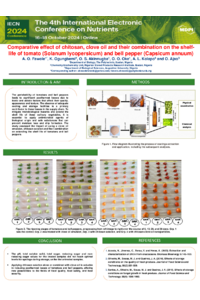
Introduction: Tomatoes and bell peppers, essential vegetables rich in nutrients and antioxidants, are also highly perishable. This study, therefore, examined the potential of chitosan solution (CS), clove oil emulsion (COE), and chitosan nanoparticle-loaded clove oil (CNLCO) as edible coatings to extend the shelf life of these vegetables.
Methods: Coated samples were stored at room temperature (28 ± 7 °C) for a period of 30 days. Changes in sample ripening were evaluated based on colour and weight every 3 days, and chemical analyses were conducted every 5 days.
Results: Only CNLCO-coated bell peppers lasted 15 days before turning red, while all categories of tomatoes turned red by day 12. There was a substantial weight loss of up to 71.9% in the first 2 weeks of storage for the bell pepper groups, while the tomato groups experienced an average weekly weight loss of 5.2%. The pH, total soluble solid (TSS), total sugar (TS), reducing sugar (RS) and non-reducing sugar (NRS) values of the treated samples' ranges were as follows: pH (4.3-4.9), TSS (2.9-3.8 Brix), TS (1.5-2.1%), RS (0.9-1.0%), and NRS (0.5-0.9%) for tomatoes and pH (4.9-6.0), TSS (3.1-5.5 Brix), TS (2.1-5.2%), RS (0.2-0.4%), and NRS (0.5-1.0%)] for bell peppers. The titratable acidity (TTA) values for the tomato groups (0.5-0.9%) were normal, while both bell pepper groups with chitosan in their coating showed deteriorating values (CS: 1.2%; CNLCO: 0.6%) on day 25.
Conclusion: The pH, TSS, TS, RS, and NRS values of the treated samples did not reach levels indicative of spoilage during storage, unlike the untreated samples. Applying the studied edible coatings, alone or in combination, is important in reducing postharvest losses of tomatoes and bell peppers and will offer new possibilities for the field.
Keywords
Bell pepper
chitosan
clove oil
nanoparticle
shelf-life
tomato.
Poster
sciforum-101428-Fawole.pdf
Apple fermentation: valorization of surpluses from the fruit industry
EDIBLE INSECTS AS A NEW CULINARY TREND IN GASTRONOMY: ATTITUDES OF GASTRONOMY AND CULINARY ARTS STUDENTS TOWARDS EDIBLE INSECTS