Event submissions
Published
This submission belongs to the session S2. Innovation in Dietary Choices of the event The 4th International Electronic Conference on Nutrients
Published date
11 Oct, 2024
Academic Editor
'%3e%3cpath%20d='M12.6657%2010.9104C12.4185%2010.325%2012.0599%209.79327%2011.6097%209.34482C11.1609%208.89508%2010.6293%208.5365%2010.0442%208.28888C10.0389%208.28626%2010.0337%208.28495%2010.0285%208.28233C10.8446%207.69279%2011.3752%206.73249%2011.3752%205.64904C11.3752%203.8542%209.92103%202.39999%208.1262%202.39999C6.33136%202.39999%204.87715%203.8542%204.87715%205.64904C4.87715%206.73249%205.40774%207.69279%206.22393%208.28364C6.21869%208.28626%206.21345%208.28757%206.20821%208.29019C5.62129%208.5378%205.09463%208.89284%204.64265%209.34613C4.1929%209.79493%203.83432%2010.3266%203.58671%2010.9117C3.34345%2011.4845%203.21226%2012.0987%203.20023%2012.7209C3.19988%2012.7349%203.20233%2012.7488%203.20744%2012.7619C3.21255%2012.7749%203.22022%2012.7867%203.22998%2012.7968C3.23975%2012.8068%203.25142%2012.8147%203.26431%2012.8202C3.2772%2012.8256%203.29105%2012.8284%203.30504%2012.8284H4.09109C4.14874%2012.8284%204.19459%2012.7825%204.1959%2012.7262C4.2221%2011.7148%204.62823%2010.7676%205.34617%2010.0497C6.08899%209.30683%207.0755%208.89808%208.1262%208.89808C9.17689%208.89808%2010.1634%209.30683%2010.9062%2010.0497C11.6242%2010.7676%2012.0303%2011.7148%2012.0565%2012.7262C12.0578%2012.7838%2012.1037%2012.8284%2012.1613%2012.8284H12.9474C12.9613%2012.8284%2012.9752%2012.8256%2012.9881%2012.8202C13.001%2012.8147%2013.0126%2012.8068%2013.0224%2012.7968C13.0322%2012.7867%2013.0398%2012.7749%2013.0449%2012.7619C13.0501%2012.7488%2013.0525%2012.7349%2013.0522%2012.7209C13.0391%2012.0947%2012.9094%2011.4855%2012.6657%2010.9104ZM8.1262%207.9024C7.52486%207.9024%206.9589%207.6679%206.53312%207.24211C6.10733%206.81633%205.87283%206.25037%205.87283%205.64904C5.87283%205.0477%206.10733%204.48174%206.53312%204.05596C6.9589%203.63018%207.52486%203.39567%208.1262%203.39567C8.72753%203.39567%209.29349%203.63018%209.71927%204.05596C10.1451%204.48174%2010.3796%205.0477%2010.3796%205.64904C10.3796%206.25037%2010.1451%206.81633%209.71927%207.24211C9.29349%207.6679%208.72753%207.9024%208.1262%207.9024Z'%20fill='%235D1EE1'/%3e%3c/g%3e%3c/svg%3e) Mauro Lombardo
Mauro LombardoCitation
Antonio Peña-Fernández, Manuel Higueras, Edna Segura, Mark D. Evans, Mª Ángeles Peña Fernández, Inadequacies of iron dietary intake of normal- and overweight young university students from Leicester, England., in Proceedings of The 4th International Electronic Conference on Nutrients, 16 October–18 October 2024, MDPI: Basel, Switzerland
Share
Email
Facebook
Twitter
LinkedIn
Inadequacies of iron dietary intake of normal- and overweight young university students from Leicester, England.

Antonio Peña-Fernández 1
'%3e%3cpath%20d='M12.6647%2010.9104C12.4176%2010.325%2012.0589%209.7933%2011.6088%209.34485C11.16%208.89511%2010.6283%208.53653%2010.0432%208.28891C10.038%208.28629%2010.0327%208.28498%2010.0275%208.28236C10.8437%207.69282%2011.3743%206.73252%2011.3743%205.64907C11.3743%203.85423%209.92005%202.40002%208.12522%202.40002C6.33038%202.40002%204.87618%203.85423%204.87618%205.64907C4.87618%206.73252%205.40677%207.69282%206.22296%208.28367C6.21772%208.28629%206.21248%208.2876%206.20724%208.29022C5.62031%208.53783%205.09365%208.89287%204.64167%209.34616C4.19192%209.79496%203.83334%2010.3266%203.58573%2010.9117C3.34247%2011.4846%203.21128%2012.0987%203.19925%2012.721C3.1989%2012.735%203.20135%2012.7489%203.20646%2012.7619C3.21157%2012.7749%203.21924%2012.7868%203.22901%2012.7968C3.23877%2012.8068%203.25045%2012.8148%203.26334%2012.8202C3.27623%2012.8256%203.29007%2012.8284%203.30406%2012.8284H4.09012C4.14776%2012.8284%204.19362%2012.7825%204.19493%2012.7262C4.22113%2011.7148%204.62726%2010.7676%205.34519%2010.0497C6.08802%209.30686%207.07452%208.89811%208.12522%208.89811C9.17592%208.89811%2010.1624%209.30686%2010.9052%2010.0497C11.6232%2010.7676%2012.0293%2011.7148%2012.0555%2012.7262C12.0568%2012.7839%2012.1027%2012.8284%2012.1603%2012.8284H12.9464C12.9604%2012.8284%2012.9742%2012.8256%2012.9871%2012.8202C13%2012.8148%2013.0117%2012.8068%2013.0214%2012.7968C13.0312%2012.7868%2013.0389%2012.7749%2013.044%2012.7619C13.0491%2012.7489%2013.0515%2012.735%2013.0512%2012.721C13.0381%2012.0947%2012.9084%2011.4856%2012.6647%2010.9104ZM8.12522%207.90243C7.52388%207.90243%206.95792%207.66793%206.53214%207.24215C6.10636%206.81636%205.87185%206.2504%205.87185%205.64907C5.87185%205.04773%206.10636%204.48177%206.53214%204.05599C6.95792%203.63021%207.52388%203.3957%208.12522%203.3957C8.72655%203.3957%209.29252%203.63021%209.7183%204.05599C10.1441%204.48177%2010.3786%205.04773%2010.3786%205.64907C10.3786%206.2504%2010.1441%206.81636%209.7183%207.24215C9.29252%207.66793%208.72655%207.90243%208.12522%207.90243Z'%20fill='%235D1EE1'/%3e%3c/g%3e%3c/svg%3e)
Manuel Higueras 2
Edna Segura 3
Mark D. Evans 4

Mª Ángeles Peña Fernández 5
1. Professor in Department of Surgery, Medical and Social Sciences, Faculty of Medicine and Health Sciences, University of Alcalá
2. Scientific Computation & Technological Innovation Center (SCoTIC), Universidad de La Rioja
3. Scientific Computation & Technological Innovation Center (SCoTIC), Universidad de La Rioja,
4. Leicester School of Allied Health Sciences, De Montfort University, Leicester, LE1 9BH, UK.
5. University of Alcalá
Abstract
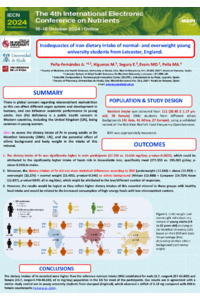
The dietary intake of iron (Fe) was assessed in young adults at De Montfort University (DMU, UK). Comprehensive nutrient intake was collected from 111 (20.45 yrs old; 78 female) DMU students between 2015 and 2016 from three major ethnic backgrounds (41 Asia, 41 Africa, 27 Europe), using a validated variant of the Nutrition Norfolk Food Frequency Questionnaire. According to their BMI values, 25.7% and 8.3% of this population were overweight and obese; meanwhile, 9.2% were underweight. The overweight status is three times that of the national average in this age group, 10.6%. The dietary intake of Fe was significantly higher in male participants (17.700 vs. 13.634 mg/day; p-value=0.0023), which could be attributed to the significantly higher intake of foods rich in bioavailable iron, specifically meat (271.553 vs. 193.063 g/day; p-value=0.016), in males. Moreover, the dietary intakes of Fe did not show statistical differences according to BMI [underweight (11.684) < obese (12.953) < overweight (15.276) < normal weight (15.405), p-value=0.546] or ethnic background [African (13.888) < European (14.724) < Asian (15.837), p-value=0.249; all in mg/day], which might be attributed to the low/different number of responses. However, the results would be logical as they reflect higher dietary intakes of this essential mineral in those groups with healthy food intake and would be related to the increased consumption of high-energy foods with low-micronutrient content. The dietary intakes of Fe recorded were higher than the reference nutrient intake (RNI) established for male (8.7, range=6.257-43.809) and female (14.7, range=4.748-40.693; all in mg/day) populations in the UK for most of the participants. Suboptimal iron status is associated with anemia and physical weakness, work capacity, and tolerance, which could have a negative impact in academic performance that should be tackled by implementing public health strategies and interventions to enhance body Fe status in university students.
Keywords
Fe dietary intake
university students
Leicester.
Poster
IECN 2024 Nutrients Fe DMU students Leicester_APF.pdf
EDIBLE INSECTS AS A NEW CULINARY TREND IN GASTRONOMY: ATTITUDES OF GASTRONOMY AND CULINARY ARTS STUDENTS TOWARDS EDIBLE INSECTS
Biomonitoring the heavy rare earth of ytterbium in wild soil mushrooms: potential risks