Event submissions
Published
This submission belongs to the session S3. Diet and Chronic Disease Management of the event The 4th International Electronic Conference on Nutrients
Published date
11 Oct, 2024
Academic Editor
'%3e%3cpath%20d='M12.6657%2010.9104C12.4185%2010.325%2012.0599%209.79327%2011.6097%209.34482C11.1609%208.89508%2010.6293%208.5365%2010.0442%208.28888C10.0389%208.28626%2010.0337%208.28495%2010.0285%208.28233C10.8446%207.69279%2011.3752%206.73249%2011.3752%205.64904C11.3752%203.8542%209.92103%202.39999%208.1262%202.39999C6.33136%202.39999%204.87715%203.8542%204.87715%205.64904C4.87715%206.73249%205.40774%207.69279%206.22393%208.28364C6.21869%208.28626%206.21345%208.28757%206.20821%208.29019C5.62129%208.5378%205.09463%208.89284%204.64265%209.34613C4.1929%209.79493%203.83432%2010.3266%203.58671%2010.9117C3.34345%2011.4845%203.21226%2012.0987%203.20023%2012.7209C3.19988%2012.7349%203.20233%2012.7488%203.20744%2012.7619C3.21255%2012.7749%203.22022%2012.7867%203.22998%2012.7968C3.23975%2012.8068%203.25142%2012.8147%203.26431%2012.8202C3.2772%2012.8256%203.29105%2012.8284%203.30504%2012.8284H4.09109C4.14874%2012.8284%204.19459%2012.7825%204.1959%2012.7262C4.2221%2011.7148%204.62823%2010.7676%205.34617%2010.0497C6.08899%209.30683%207.0755%208.89808%208.1262%208.89808C9.17689%208.89808%2010.1634%209.30683%2010.9062%2010.0497C11.6242%2010.7676%2012.0303%2011.7148%2012.0565%2012.7262C12.0578%2012.7838%2012.1037%2012.8284%2012.1613%2012.8284H12.9474C12.9613%2012.8284%2012.9752%2012.8256%2012.9881%2012.8202C13.001%2012.8147%2013.0126%2012.8068%2013.0224%2012.7968C13.0322%2012.7867%2013.0398%2012.7749%2013.0449%2012.7619C13.0501%2012.7488%2013.0525%2012.7349%2013.0522%2012.7209C13.0391%2012.0947%2012.9094%2011.4855%2012.6657%2010.9104ZM8.1262%207.9024C7.52486%207.9024%206.9589%207.6679%206.53312%207.24211C6.10733%206.81633%205.87283%206.25037%205.87283%205.64904C5.87283%205.0477%206.10733%204.48174%206.53312%204.05596C6.9589%203.63018%207.52486%203.39567%208.1262%203.39567C8.72753%203.39567%209.29349%203.63018%209.71927%204.05596C10.1451%204.48174%2010.3796%205.0477%2010.3796%205.64904C10.3796%206.25037%2010.1451%206.81633%209.71927%207.24211C9.29349%207.6679%208.72753%207.9024%208.1262%207.9024Z'%20fill='%235D1EE1'/%3e%3c/g%3e%3c/svg%3e) Mauro Lombardo
Mauro LombardoCitation
Ana Emilia Nava, Shirley Arbizu, Susanne Talcott, Giuliana Noratto, Dark Sweet Cherry (DSC) phenolics enriched in anthocyanins suppressed the expression of genes associated with metastasis in a triple-negative breast cancer (TNBC) BALB/c mouse syngeneic model., in Proceedings of The 4th International Electronic Conference on Nutrients, 16 October–18 October 2024, MDPI: Basel, Switzerland
Share
Email
Facebook
Twitter
LinkedIn
Dark Sweet Cherry (DSC) phenolics enriched in anthocyanins suppressed the expression of genes associated with metastasis in a triple-negative breast cancer (TNBC) BALB/c mouse syngeneic model.
'%3e%3cpath%20d='M12.6647%2010.9104C12.4176%2010.325%2012.0589%209.7933%2011.6088%209.34485C11.16%208.89511%2010.6283%208.53653%2010.0432%208.28891C10.038%208.28629%2010.0327%208.28498%2010.0275%208.28236C10.8437%207.69282%2011.3743%206.73252%2011.3743%205.64907C11.3743%203.85423%209.92005%202.40002%208.12522%202.40002C6.33038%202.40002%204.87618%203.85423%204.87618%205.64907C4.87618%206.73252%205.40677%207.69282%206.22296%208.28367C6.21772%208.28629%206.21248%208.2876%206.20724%208.29022C5.62031%208.53783%205.09365%208.89287%204.64167%209.34616C4.19192%209.79496%203.83334%2010.3266%203.58573%2010.9117C3.34247%2011.4846%203.21128%2012.0987%203.19925%2012.721C3.1989%2012.735%203.20135%2012.7489%203.20646%2012.7619C3.21157%2012.7749%203.21924%2012.7868%203.22901%2012.7968C3.23877%2012.8068%203.25045%2012.8148%203.26334%2012.8202C3.27623%2012.8256%203.29007%2012.8284%203.30406%2012.8284H4.09012C4.14776%2012.8284%204.19362%2012.7825%204.19493%2012.7262C4.22113%2011.7148%204.62726%2010.7676%205.34519%2010.0497C6.08802%209.30686%207.07452%208.89811%208.12522%208.89811C9.17592%208.89811%2010.1624%209.30686%2010.9052%2010.0497C11.6232%2010.7676%2012.0293%2011.7148%2012.0555%2012.7262C12.0568%2012.7839%2012.1027%2012.8284%2012.1603%2012.8284H12.9464C12.9604%2012.8284%2012.9742%2012.8256%2012.9871%2012.8202C13%2012.8148%2013.0117%2012.8068%2013.0214%2012.7968C13.0312%2012.7868%2013.0389%2012.7749%2013.044%2012.7619C13.0491%2012.7489%2013.0515%2012.735%2013.0512%2012.721C13.0381%2012.0947%2012.9084%2011.4856%2012.6647%2010.9104ZM8.12522%207.90243C7.52388%207.90243%206.95792%207.66793%206.53214%207.24215C6.10636%206.81636%205.87185%206.2504%205.87185%205.64907C5.87185%205.04773%206.10636%204.48177%206.53214%204.05599C6.95792%203.63021%207.52388%203.3957%208.12522%203.3957C8.72655%203.3957%209.29252%203.63021%209.7183%204.05599C10.1441%204.48177%2010.3786%205.04773%2010.3786%205.64907C10.3786%206.2504%2010.1441%206.81636%209.7183%207.24215C9.29252%207.66793%208.72655%207.90243%208.12522%207.90243Z'%20fill='%235D1EE1'/%3e%3c/g%3e%3c/svg%3e)
Ana Emilia Nava 1
Shirley Arbizu 1

Susanne Talcott 1
Giuliana Noratto 1
1. Texas A&M University
Abstract
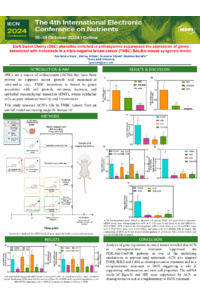
DSCs are a source of anthocyanins (ACNs) that have been proven to suppress tumor growth and metastasis in vitro and in vivo. TNBC metastasis is linked to genes associated with cell growth, stemness, hypoxia, and epithelial–mesenchymal transition (EMT), where epithelial cells acquire enhanced motility and invasiveness. This study assessed ACN’s role in TNBC tumors from an animal model mimicking stage-IV human BC.
4T1 TNBC cells were implanted into BALB/c mice mammary fat pads. The control group received saline solution by gavage every other day. The ACN group was fed 150mg of ACN (Cyanidin-3-O-Rutinoside) per kg body weight by gavage every other day. The DOX group received 2mg/kg body weight (I.P. injection) every 4 days, and the COMB group received both ACN and DOX at the same doses and times. Mice were euthanized when primary tumors reached 2000mm³. Tumors were analyzed for mRNA levels of genes associated with invasion and metastasis.
ACN treatment downregulated mRNA levels at 0.15-(CD44), 0.24-(HIF-1a), 0.22-(SNAI1), 0.31-(mTOR), 0.53-(RGC-32), 0.20-(SIRT1), 0.12-(STAT3), 0.14-(TGFb), and 0.18-(Tjp)-fold of control. Moreover, when compared to DOX, ACN downregulated genes linked to aberrant cell growth, EMT, and poor clinical outcomes such as CREB, HIF-1a, PIK3CA, and RGC-32 (0.04-, 0.20-, 0.05-, and 0.52-fold of DOX, respectively). Furthermore, DOX alone failed to suppress RGC-32, but COMB showed downregulation to 0.4-fold of DOX, suggesting a role of ACNs in enhancing the therapeutic efficacy of DOX.
ACNs effectively downregulated genes pivotal in TNBC metastasis, promoting angiogenesis, EMT, invasion, metabolic reprogramming, and stem cell maintenance. This suggests ACN’s potential to improve TNBC patient outcomes in chemoprevention and combination therapy. Further research is needed to investigate correlations between tumor gene expression and metastasis in harvested organs from this animal model.
Keywords
cancer
anthocyanins
metastasis
Poster
DietandChronicDiseaseManagement_18511_Dark_Sweet_Cherry_DSC_phenol_slides.pdf
Biomonitoring the heavy rare earth of ytterbium in wild soil mushrooms: potential risks
Higher Alcohol Preference is not Necessarily Linked to Higher Consumption of Palatable Food in Rats