Event submissions
Published
This submission belongs to the session S3. Diet and Chronic Disease Management of the event The 4th International Electronic Conference on Nutrients
Published date
11 Oct, 2024
Academic Editor
'%3e%3cpath%20d='M12.6657%2010.9104C12.4185%2010.325%2012.0599%209.79327%2011.6097%209.34482C11.1609%208.89508%2010.6293%208.5365%2010.0442%208.28888C10.0389%208.28626%2010.0337%208.28495%2010.0285%208.28233C10.8446%207.69279%2011.3752%206.73249%2011.3752%205.64904C11.3752%203.8542%209.92103%202.39999%208.1262%202.39999C6.33136%202.39999%204.87715%203.8542%204.87715%205.64904C4.87715%206.73249%205.40774%207.69279%206.22393%208.28364C6.21869%208.28626%206.21345%208.28757%206.20821%208.29019C5.62129%208.5378%205.09463%208.89284%204.64265%209.34613C4.1929%209.79493%203.83432%2010.3266%203.58671%2010.9117C3.34345%2011.4845%203.21226%2012.0987%203.20023%2012.7209C3.19988%2012.7349%203.20233%2012.7488%203.20744%2012.7619C3.21255%2012.7749%203.22022%2012.7867%203.22998%2012.7968C3.23975%2012.8068%203.25142%2012.8147%203.26431%2012.8202C3.2772%2012.8256%203.29105%2012.8284%203.30504%2012.8284H4.09109C4.14874%2012.8284%204.19459%2012.7825%204.1959%2012.7262C4.2221%2011.7148%204.62823%2010.7676%205.34617%2010.0497C6.08899%209.30683%207.0755%208.89808%208.1262%208.89808C9.17689%208.89808%2010.1634%209.30683%2010.9062%2010.0497C11.6242%2010.7676%2012.0303%2011.7148%2012.0565%2012.7262C12.0578%2012.7838%2012.1037%2012.8284%2012.1613%2012.8284H12.9474C12.9613%2012.8284%2012.9752%2012.8256%2012.9881%2012.8202C13.001%2012.8147%2013.0126%2012.8068%2013.0224%2012.7968C13.0322%2012.7867%2013.0398%2012.7749%2013.0449%2012.7619C13.0501%2012.7488%2013.0525%2012.7349%2013.0522%2012.7209C13.0391%2012.0947%2012.9094%2011.4855%2012.6657%2010.9104ZM8.1262%207.9024C7.52486%207.9024%206.9589%207.6679%206.53312%207.24211C6.10733%206.81633%205.87283%206.25037%205.87283%205.64904C5.87283%205.0477%206.10733%204.48174%206.53312%204.05596C6.9589%203.63018%207.52486%203.39567%208.1262%203.39567C8.72753%203.39567%209.29349%203.63018%209.71927%204.05596C10.1451%204.48174%2010.3796%205.0477%2010.3796%205.64904C10.3796%206.25037%2010.1451%206.81633%209.71927%207.24211C9.29349%207.6679%208.72753%207.9024%208.1262%207.9024Z'%20fill='%235D1EE1'/%3e%3c/g%3e%3c/svg%3e) Jaime Uribarri
Jaime UribarriCitation
Farah Jribi, Khansa Chaabouni, Fatma Mnif, Mohamed Abid, Study of the Nutritional Composition of Three Types of Bread from a Local Tunisian Bakery and an Assessment of Their Postprandial Glucose, Insulin, and Metabolic Responses and Glycemic Indexes in Healthy Subjects, in Proceedings of The 4th International Electronic Conference on Nutrients, 16 October–18 October 2024, MDPI: Basel, Switzerland
Share
Email
Facebook
Twitter
LinkedIn
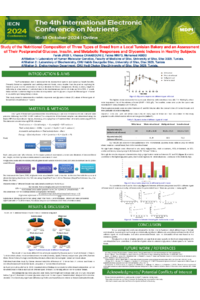
Study of the Nutritional Composition of Three Types of Bread from a Local Tunisian Bakery and an Assessment of Their Postprandial Glucose, Insulin, and Metabolic Responses and Glycemic Indexes in Healthy Subjects
'%3e%3cpath%20d='M12.6647%2010.9104C12.4176%2010.325%2012.0589%209.7933%2011.6088%209.34485C11.16%208.89511%2010.6283%208.53653%2010.0432%208.28891C10.038%208.28629%2010.0327%208.28498%2010.0275%208.28236C10.8437%207.69282%2011.3743%206.73252%2011.3743%205.64907C11.3743%203.85423%209.92005%202.40002%208.12522%202.40002C6.33038%202.40002%204.87618%203.85423%204.87618%205.64907C4.87618%206.73252%205.40677%207.69282%206.22296%208.28367C6.21772%208.28629%206.21248%208.2876%206.20724%208.29022C5.62031%208.53783%205.09365%208.89287%204.64167%209.34616C4.19192%209.79496%203.83334%2010.3266%203.58573%2010.9117C3.34247%2011.4846%203.21128%2012.0987%203.19925%2012.721C3.1989%2012.735%203.20135%2012.7489%203.20646%2012.7619C3.21157%2012.7749%203.21924%2012.7868%203.22901%2012.7968C3.23877%2012.8068%203.25045%2012.8148%203.26334%2012.8202C3.27623%2012.8256%203.29007%2012.8284%203.30406%2012.8284H4.09012C4.14776%2012.8284%204.19362%2012.7825%204.19493%2012.7262C4.22113%2011.7148%204.62726%2010.7676%205.34519%2010.0497C6.08802%209.30686%207.07452%208.89811%208.12522%208.89811C9.17592%208.89811%2010.1624%209.30686%2010.9052%2010.0497C11.6232%2010.7676%2012.0293%2011.7148%2012.0555%2012.7262C12.0568%2012.7839%2012.1027%2012.8284%2012.1603%2012.8284H12.9464C12.9604%2012.8284%2012.9742%2012.8256%2012.9871%2012.8202C13%2012.8148%2013.0117%2012.8068%2013.0214%2012.7968C13.0312%2012.7868%2013.0389%2012.7749%2013.044%2012.7619C13.0491%2012.7489%2013.0515%2012.735%2013.0512%2012.721C13.0381%2012.0947%2012.9084%2011.4856%2012.6647%2010.9104ZM8.12522%207.90243C7.52388%207.90243%206.95792%207.66793%206.53214%207.24215C6.10636%206.81636%205.87185%206.2504%205.87185%205.64907C5.87185%205.04773%206.10636%204.48177%206.53214%204.05599C6.95792%203.63021%207.52388%203.3957%208.12522%203.3957C8.72655%203.3957%209.29252%203.63021%209.7183%204.05599C10.1441%204.48177%2010.3786%205.04773%2010.3786%205.64907C10.3786%206.2504%2010.1441%206.81636%209.7183%207.24215C9.29252%207.66793%208.72655%207.90243%208.12522%207.90243Z'%20fill='%235D1EE1'/%3e%3c/g%3e%3c/svg%3e)
Farah Jribi 1
Khansa Chaabouni 2
Fatma Mnif 3
Mohamed Abid 3
1. Laboratory of Human Molecular Genetics, Faculty of Medicine of Sfax, University of Sfax, Sfax 3029, Tunisia.
2. Laboratory of Biochemistry, CHU Habib Bourguiba Sfax, University of Sfax, Sfax 3029, Tunisia
3. Endocrinology Department, CHU Hedi Chaker Sfax,University of Sfax, Sfax 3029, Tunisia.
Abstract
The Mediterranean diet is renowned for its health benefits, with bread being a primary source of carbohydrates. Understanding the nutritional composition and the glycemic impact of different types of bread is crucial for optimizing dietary choices.
This study aimed to determine the blood glucose responses and glycemic index (GI) values of three types of bread from a local bakery in Tunisia.
Ten healthy adult volunteers (aged 19-29 years) participated in this study. The breads tested were whole wheat bread, semolina bread, and multigrain bread. White bread was used as a reference. Participants consumed, on different occasions after an overnight fast, the equivalent of 50g of assimilable carbohydrates from each tested bread. Capillary blood samples were taken immediately at 0 min and at 15, 30, 45, 60, 90, and 120 minutes after consumption, and venous blood was obtained at 0, 60, and 120 min. The blood glucose responses were obtained by calculating the incremental area under the curve. The GI values were determined using standardized methodology.
Our results showed that among the tested breads, semolina bread had the highest variability in glucose response with the highest GI value, categorizing it as a high-GI food (92.5) after conversion to the glucose reference, while whole wheat bread (64.39) and multigrain bread (62.5) were categorized as intermediate-GI foods. No significant differences (p>0.05) in GI values were seen between the reference bread and the tested breads. We also observed that white bread had the lowest insulin peak (25.8±5.29), while multigrain bread had the highest peak (40.84±4.70) at T60. No significant changes were observed in uric acid, triglycerides, total cholesterol, HDL-cholesterol, or LDL-cholesterol for any bread type (p>0.05).
These findings provide valuable nutritional information for dietitians and the public, aiding in the selection of bread types that support the health benefits of the Mediterranean diet.
Keywords
Mediterranean diet
Glycemic index
Bread
Blood glucose
Insulin response
Nutritional composition
Poster
Submission ID sciforum-101119_Farah Jribi.pdf
Innovative Dietary Solutions: Macroalgae Amino Acids for Differentiated Nutrition
Individual- and Community-Level Interventions for Obesity Reduction in Africa: A Systematic Review