Event submissions
Published
This submission belongs to the session S3. Diet and Chronic Disease Management of the event The 4th International Electronic Conference on Nutrients
Published date
11 Oct, 2024
Academic Editor
'%3e%3cpath%20d='M12.6657%2010.9104C12.4185%2010.325%2012.0599%209.79327%2011.6097%209.34482C11.1609%208.89508%2010.6293%208.5365%2010.0442%208.28888C10.0389%208.28626%2010.0337%208.28495%2010.0285%208.28233C10.8446%207.69279%2011.3752%206.73249%2011.3752%205.64904C11.3752%203.8542%209.92103%202.39999%208.1262%202.39999C6.33136%202.39999%204.87715%203.8542%204.87715%205.64904C4.87715%206.73249%205.40774%207.69279%206.22393%208.28364C6.21869%208.28626%206.21345%208.28757%206.20821%208.29019C5.62129%208.5378%205.09463%208.89284%204.64265%209.34613C4.1929%209.79493%203.83432%2010.3266%203.58671%2010.9117C3.34345%2011.4845%203.21226%2012.0987%203.20023%2012.7209C3.19988%2012.7349%203.20233%2012.7488%203.20744%2012.7619C3.21255%2012.7749%203.22022%2012.7867%203.22998%2012.7968C3.23975%2012.8068%203.25142%2012.8147%203.26431%2012.8202C3.2772%2012.8256%203.29105%2012.8284%203.30504%2012.8284H4.09109C4.14874%2012.8284%204.19459%2012.7825%204.1959%2012.7262C4.2221%2011.7148%204.62823%2010.7676%205.34617%2010.0497C6.08899%209.30683%207.0755%208.89808%208.1262%208.89808C9.17689%208.89808%2010.1634%209.30683%2010.9062%2010.0497C11.6242%2010.7676%2012.0303%2011.7148%2012.0565%2012.7262C12.0578%2012.7838%2012.1037%2012.8284%2012.1613%2012.8284H12.9474C12.9613%2012.8284%2012.9752%2012.8256%2012.9881%2012.8202C13.001%2012.8147%2013.0126%2012.8068%2013.0224%2012.7968C13.0322%2012.7867%2013.0398%2012.7749%2013.0449%2012.7619C13.0501%2012.7488%2013.0525%2012.7349%2013.0522%2012.7209C13.0391%2012.0947%2012.9094%2011.4855%2012.6657%2010.9104ZM8.1262%207.9024C7.52486%207.9024%206.9589%207.6679%206.53312%207.24211C6.10733%206.81633%205.87283%206.25037%205.87283%205.64904C5.87283%205.0477%206.10733%204.48174%206.53312%204.05596C6.9589%203.63018%207.52486%203.39567%208.1262%203.39567C8.72753%203.39567%209.29349%203.63018%209.71927%204.05596C10.1451%204.48174%2010.3796%205.0477%2010.3796%205.64904C10.3796%206.25037%2010.1451%206.81633%209.71927%207.24211C9.29349%207.6679%208.72753%207.9024%208.1262%207.9024Z'%20fill='%235D1EE1'/%3e%3c/g%3e%3c/svg%3e) Jaime Uribarri
Jaime UribarriCitation
Cristina Manuela Dragoi, Alina Crenguţa Nicolae, Ion Bogdan Dumitrescu, The Role of Melatonin in Enhancing Intermittent Fasting-Induced Nutritional Ketosis for Treating Metabolic Dysfunctions, in Proceedings of The 4th International Electronic Conference on Nutrients, 16 October–18 October 2024, MDPI: Basel, Switzerland
Share
Email
Facebook
Twitter
LinkedIn
The Role of Melatonin in Enhancing Intermittent Fasting-Induced Nutritional Ketosis for Treating Metabolic Dysfunctions

Cristina Manuela Dragoi 1

Alina Crenguţa Nicolae 2

Ion Bogdan Dumitrescu 2
1. Faculty of Pharmacy, University of Medicine and Pharmacy “Carol Davila“, 020956, Bucharest, Romania
2. Carol Davila University of Medicine and Pharmacy
Abstract
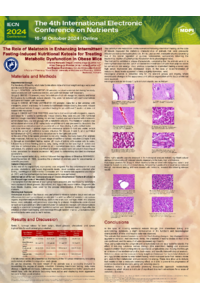
Melatonin, a potent antioxidant, improves energy metabolism and reduces inflammation. It modulates insulin secretion, lipid metabolism, and may reduce low-grade inflammation in obesity. Melatonin influences adipose tissue development, lipid accumulation, body weight, and brown adipose tissue activation, playing a crucial role in energy homeostasis. Notably, melatonin levels are lower in obese individuals.
The present study evaluated melatonin's effect on intermittent fasting-induced nutritional ketosis in obese mice. Four groups of mice were studied: control, obese, ketosis without treatment, and ketosis treated with melatonin. Melatonin improved tissue morphology in the brain, liver, and kidney, as revealed by the histological analysis, and balanced the biochemical parameters. The control group showed normal blood values, while the obese group had increased blood glucose, cholesterol, and triglycerides. Ketosis alone reduced these values, and melatonin further amplified these effects. Interestingly, a significant increase in serum lipid levels was registered, namely total cholesterol and serum triglycerides, observed in the group of mice on ketosis and treated with melatonin. This increase in lipemia can be attributed to the intermittent 20/4 fasting regimen, which likely mobilized lipid stores to meet the animals' caloric needs. Consequently, these mobilized lipids were transported to hepatocytes' mitochondria for beta-oxidation, resulting in the production of acetyl-coenzyme A, which enters the Krebs cycle, the primary energy production pathway in living organisms.
This study concludes that melatonin supplementation partially alleviates early-stage obesity pathogenesis.
Keywords
melatonin
obesity
ketosis
intermittent fasting
metabolic syndrome
Poster
sciforum-101387-Dumitrescu.pdf
Lifestyle and Behavioral Changes: A Pathway to Weight Reduction and Pain Management in Overweight and Obese Women
The impact of in vitro digestion on the bioactivity and bioaccessibility of hypoglycemic ingredients from Pistacia vera shells: a step forward for their application as potential nutritional supplements