Event submissions
Published
This submission belongs to the session S3. Diet and Chronic Disease Management of the event The 4th International Electronic Conference on Nutrients
Published date
11 Oct, 2024
Academic Editor
'%3e%3cpath%20d='M12.6657%2010.9104C12.4185%2010.325%2012.0599%209.79327%2011.6097%209.34482C11.1609%208.89508%2010.6293%208.5365%2010.0442%208.28888C10.0389%208.28626%2010.0337%208.28495%2010.0285%208.28233C10.8446%207.69279%2011.3752%206.73249%2011.3752%205.64904C11.3752%203.8542%209.92103%202.39999%208.1262%202.39999C6.33136%202.39999%204.87715%203.8542%204.87715%205.64904C4.87715%206.73249%205.40774%207.69279%206.22393%208.28364C6.21869%208.28626%206.21345%208.28757%206.20821%208.29019C5.62129%208.5378%205.09463%208.89284%204.64265%209.34613C4.1929%209.79493%203.83432%2010.3266%203.58671%2010.9117C3.34345%2011.4845%203.21226%2012.0987%203.20023%2012.7209C3.19988%2012.7349%203.20233%2012.7488%203.20744%2012.7619C3.21255%2012.7749%203.22022%2012.7867%203.22998%2012.7968C3.23975%2012.8068%203.25142%2012.8147%203.26431%2012.8202C3.2772%2012.8256%203.29105%2012.8284%203.30504%2012.8284H4.09109C4.14874%2012.8284%204.19459%2012.7825%204.1959%2012.7262C4.2221%2011.7148%204.62823%2010.7676%205.34617%2010.0497C6.08899%209.30683%207.0755%208.89808%208.1262%208.89808C9.17689%208.89808%2010.1634%209.30683%2010.9062%2010.0497C11.6242%2010.7676%2012.0303%2011.7148%2012.0565%2012.7262C12.0578%2012.7838%2012.1037%2012.8284%2012.1613%2012.8284H12.9474C12.9613%2012.8284%2012.9752%2012.8256%2012.9881%2012.8202C13.001%2012.8147%2013.0126%2012.8068%2013.0224%2012.7968C13.0322%2012.7867%2013.0398%2012.7749%2013.0449%2012.7619C13.0501%2012.7488%2013.0525%2012.7349%2013.0522%2012.7209C13.0391%2012.0947%2012.9094%2011.4855%2012.6657%2010.9104ZM8.1262%207.9024C7.52486%207.9024%206.9589%207.6679%206.53312%207.24211C6.10733%206.81633%205.87283%206.25037%205.87283%205.64904C5.87283%205.0477%206.10733%204.48174%206.53312%204.05596C6.9589%203.63018%207.52486%203.39567%208.1262%203.39567C8.72753%203.39567%209.29349%203.63018%209.71927%204.05596C10.1451%204.48174%2010.3796%205.0477%2010.3796%205.64904C10.3796%206.25037%2010.1451%206.81633%209.71927%207.24211C9.29349%207.6679%208.72753%207.9024%208.1262%207.9024Z'%20fill='%235D1EE1'/%3e%3c/g%3e%3c/svg%3e) Jaime Uribarri
Jaime UribarriCitation
Rita Natália Couto Santos, Fernando Xavier Ferreira Moreira, Agostinho Luís Silva Cruz, Systematic review of clinical trials on the potential of probiotics for the treatment of Covid-19, in Proceedings of The 4th International Electronic Conference on Nutrients, 16 October–18 October 2024, MDPI: Basel, Switzerland
Share
Email
Facebook
Twitter
LinkedIn
Systematic review of clinical trials on the potential of probiotics for the treatment of Covid-19
'%3e%3cpath%20d='M12.6647%2010.9104C12.4176%2010.325%2012.0589%209.7933%2011.6088%209.34485C11.16%208.89511%2010.6283%208.53653%2010.0432%208.28891C10.038%208.28629%2010.0327%208.28498%2010.0275%208.28236C10.8437%207.69282%2011.3743%206.73252%2011.3743%205.64907C11.3743%203.85423%209.92005%202.40002%208.12522%202.40002C6.33038%202.40002%204.87618%203.85423%204.87618%205.64907C4.87618%206.73252%205.40677%207.69282%206.22296%208.28367C6.21772%208.28629%206.21248%208.2876%206.20724%208.29022C5.62031%208.53783%205.09365%208.89287%204.64167%209.34616C4.19192%209.79496%203.83334%2010.3266%203.58573%2010.9117C3.34247%2011.4846%203.21128%2012.0987%203.19925%2012.721C3.1989%2012.735%203.20135%2012.7489%203.20646%2012.7619C3.21157%2012.7749%203.21924%2012.7868%203.22901%2012.7968C3.23877%2012.8068%203.25045%2012.8148%203.26334%2012.8202C3.27623%2012.8256%203.29007%2012.8284%203.30406%2012.8284H4.09012C4.14776%2012.8284%204.19362%2012.7825%204.19493%2012.7262C4.22113%2011.7148%204.62726%2010.7676%205.34519%2010.0497C6.08802%209.30686%207.07452%208.89811%208.12522%208.89811C9.17592%208.89811%2010.1624%209.30686%2010.9052%2010.0497C11.6232%2010.7676%2012.0293%2011.7148%2012.0555%2012.7262C12.0568%2012.7839%2012.1027%2012.8284%2012.1603%2012.8284H12.9464C12.9604%2012.8284%2012.9742%2012.8256%2012.9871%2012.8202C13%2012.8148%2013.0117%2012.8068%2013.0214%2012.7968C13.0312%2012.7868%2013.0389%2012.7749%2013.044%2012.7619C13.0491%2012.7489%2013.0515%2012.735%2013.0512%2012.721C13.0381%2012.0947%2012.9084%2011.4856%2012.6647%2010.9104ZM8.12522%207.90243C7.52388%207.90243%206.95792%207.66793%206.53214%207.24215C6.10636%206.81636%205.87185%206.2504%205.87185%205.64907C5.87185%205.04773%206.10636%204.48177%206.53214%204.05599C6.95792%203.63021%207.52388%203.3957%208.12522%203.3957C8.72655%203.3957%209.29252%203.63021%209.7183%204.05599C10.1441%204.48177%2010.3786%205.04773%2010.3786%205.64907C10.3786%206.2504%2010.1441%206.81636%209.7183%207.24215C9.29252%207.66793%208.72655%207.90243%208.12522%207.90243Z'%20fill='%235D1EE1'/%3e%3c/g%3e%3c/svg%3e)
Rita Natália Couto Santos 1
Fernando Xavier Ferreira Moreira 2
Agostinho Luís Silva Cruz 2
1. ESS, Polytechnic Institute of Porto, Rua Dr. António Bernardino de Almeida, 400, 4200-072 Porto, Portugal
2. LAQV/REQUIMTE, ESS - Polytechnic Institute of Porto, Rua Dr. António Bernardino de Almeida, 400, 4200-072
Abstract
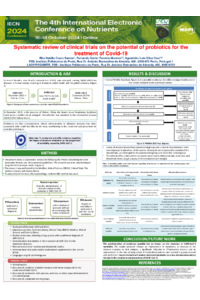
In recent decades, new deadly coronaviruses causing highly infectious diseases have emerged in human society, resulting in threats to public health and the global economy. In December 2019, in the province of Wuhan, China, the severe acute respiratory syndrome coronavirus 2 (SARS-CoV-2) emerged. This infection was classified as the coronavirus disease 2019 (COVID-19) pandemic. Probiotics are live microorganisms whose administration in adequate quantities has been associated with health benefits for the host, contributing to the treatment and prevention of multiple pathologies. The present study aims to review scientific evidence on the impact of probiotic treatment on the progression of morbidity due to SARS-CoV-2. The research was conducted in the Cochrane Library, Clinical Trials, EBSCO, Medline, Web of Science, and Science Direct databases. Inclusion criteria were as follows: study period between 2019 and 2023; language in English or Portuguese; methodology based on clinical trials; studies in humans with a confirmed diagnosis of SARS-CoV-2 and administration of probiotics in the treatment of the pathology. Five studies were included in this review, recruiting a total of patients ranging from 23 and 300 individuals. The main positive results of the probiotic intervention compared to the control group were nearly an improvement in digestive symptoms (65% vs 88%, p-value 0.06) and overall symptoms (88.6% vs 70.8%; p-value 0.03). Also, in the probiotic group, there was an increase in serum concentrations of Immunoglobulin G (IgG) in the receptor-binding domain/spike 1 (RBD/S1) (225.9 vs 105.6 binding antibody units/mL, p-value < 0.05). The major limitation is related to the fact that, in all five studies, patients were concomitantly treated with several other drugs whose action may have influenced the observed results. The conducted studies suggest that the use of probiotics enhances a decrease in morbidity in SARS-CoV-2, although more studies are needed to confirm their efficacy in the disease.
Keywords
Probiotics
SARS-CoV-2
morbidity
Poster
Submission101358_Rita Santos.pdf
Warfarin–supplement interactions: a systematic review
NUTRITION KNOWLEDGE, ATTITUDES, AND DIETARY PRACTICES AMONG FOOTBALLERS AT LEAD CITY FOOTBALL ACADEMY