Event submissions
Published
This submission belongs to the session S2. Innovation in Dietary Choices of the event The 4th International Electronic Conference on Nutrients
Published date
11 Oct, 2024
Academic Editor
'%3e%3cpath%20d='M12.6657%2010.9104C12.4185%2010.325%2012.0599%209.79327%2011.6097%209.34482C11.1609%208.89508%2010.6293%208.5365%2010.0442%208.28888C10.0389%208.28626%2010.0337%208.28495%2010.0285%208.28233C10.8446%207.69279%2011.3752%206.73249%2011.3752%205.64904C11.3752%203.8542%209.92103%202.39999%208.1262%202.39999C6.33136%202.39999%204.87715%203.8542%204.87715%205.64904C4.87715%206.73249%205.40774%207.69279%206.22393%208.28364C6.21869%208.28626%206.21345%208.28757%206.20821%208.29019C5.62129%208.5378%205.09463%208.89284%204.64265%209.34613C4.1929%209.79493%203.83432%2010.3266%203.58671%2010.9117C3.34345%2011.4845%203.21226%2012.0987%203.20023%2012.7209C3.19988%2012.7349%203.20233%2012.7488%203.20744%2012.7619C3.21255%2012.7749%203.22022%2012.7867%203.22998%2012.7968C3.23975%2012.8068%203.25142%2012.8147%203.26431%2012.8202C3.2772%2012.8256%203.29105%2012.8284%203.30504%2012.8284H4.09109C4.14874%2012.8284%204.19459%2012.7825%204.1959%2012.7262C4.2221%2011.7148%204.62823%2010.7676%205.34617%2010.0497C6.08899%209.30683%207.0755%208.89808%208.1262%208.89808C9.17689%208.89808%2010.1634%209.30683%2010.9062%2010.0497C11.6242%2010.7676%2012.0303%2011.7148%2012.0565%2012.7262C12.0578%2012.7838%2012.1037%2012.8284%2012.1613%2012.8284H12.9474C12.9613%2012.8284%2012.9752%2012.8256%2012.9881%2012.8202C13.001%2012.8147%2013.0126%2012.8068%2013.0224%2012.7968C13.0322%2012.7867%2013.0398%2012.7749%2013.0449%2012.7619C13.0501%2012.7488%2013.0525%2012.7349%2013.0522%2012.7209C13.0391%2012.0947%2012.9094%2011.4855%2012.6657%2010.9104ZM8.1262%207.9024C7.52486%207.9024%206.9589%207.6679%206.53312%207.24211C6.10733%206.81633%205.87283%206.25037%205.87283%205.64904C5.87283%205.0477%206.10733%204.48174%206.53312%204.05596C6.9589%203.63018%207.52486%203.39567%208.1262%203.39567C8.72753%203.39567%209.29349%203.63018%209.71927%204.05596C10.1451%204.48174%2010.3796%205.0477%2010.3796%205.64904C10.3796%206.25037%2010.1451%206.81633%209.71927%207.24211C9.29349%207.6679%208.72753%207.9024%208.1262%207.9024Z'%20fill='%235D1EE1'/%3e%3c/g%3e%3c/svg%3e) Mauro Lombardo
Mauro LombardoCitation
Bruna Freitas de Oliveira, Lara Netto Rocha, Leonara Martins Viana, Mária Herminia Ferrari Felisberto, Frederico Barros, EFFECT OF MIXED GREEN BANANA PULP AND PEEL FLOUR ON PHYSICOCHEMICAL AND SENSORY PROPERTIES AND RESISTANT STARCH CONTENT OF CHOCOLATE COOKIES, in Proceedings of The 4th International Electronic Conference on Nutrients, 16 October–18 October 2024, MDPI: Basel, Switzerland
Share
Email
Facebook
Twitter
LinkedIn
EFFECT OF MIXED GREEN BANANA PULP AND PEEL FLOUR ON PHYSICOCHEMICAL AND SENSORY PROPERTIES AND RESISTANT STARCH CONTENT OF CHOCOLATE COOKIES
'%3e%3cpath%20d='M12.6647%2010.9104C12.4176%2010.325%2012.0589%209.7933%2011.6088%209.34485C11.16%208.89511%2010.6283%208.53653%2010.0432%208.28891C10.038%208.28629%2010.0327%208.28498%2010.0275%208.28236C10.8437%207.69282%2011.3743%206.73252%2011.3743%205.64907C11.3743%203.85423%209.92005%202.40002%208.12522%202.40002C6.33038%202.40002%204.87618%203.85423%204.87618%205.64907C4.87618%206.73252%205.40677%207.69282%206.22296%208.28367C6.21772%208.28629%206.21248%208.2876%206.20724%208.29022C5.62031%208.53783%205.09365%208.89287%204.64167%209.34616C4.19192%209.79496%203.83334%2010.3266%203.58573%2010.9117C3.34247%2011.4846%203.21128%2012.0987%203.19925%2012.721C3.1989%2012.735%203.20135%2012.7489%203.20646%2012.7619C3.21157%2012.7749%203.21924%2012.7868%203.22901%2012.7968C3.23877%2012.8068%203.25045%2012.8148%203.26334%2012.8202C3.27623%2012.8256%203.29007%2012.8284%203.30406%2012.8284H4.09012C4.14776%2012.8284%204.19362%2012.7825%204.19493%2012.7262C4.22113%2011.7148%204.62726%2010.7676%205.34519%2010.0497C6.08802%209.30686%207.07452%208.89811%208.12522%208.89811C9.17592%208.89811%2010.1624%209.30686%2010.9052%2010.0497C11.6232%2010.7676%2012.0293%2011.7148%2012.0555%2012.7262C12.0568%2012.7839%2012.1027%2012.8284%2012.1603%2012.8284H12.9464C12.9604%2012.8284%2012.9742%2012.8256%2012.9871%2012.8202C13%2012.8148%2013.0117%2012.8068%2013.0214%2012.7968C13.0312%2012.7868%2013.0389%2012.7749%2013.044%2012.7619C13.0491%2012.7489%2013.0515%2012.735%2013.0512%2012.721C13.0381%2012.0947%2012.9084%2011.4856%2012.6647%2010.9104ZM8.12522%207.90243C7.52388%207.90243%206.95792%207.66793%206.53214%207.24215C6.10636%206.81636%205.87185%206.2504%205.87185%205.64907C5.87185%205.04773%206.10636%204.48177%206.53214%204.05599C6.95792%203.63021%207.52388%203.3957%208.12522%203.3957C8.72655%203.3957%209.29252%203.63021%209.7183%204.05599C10.1441%204.48177%2010.3786%205.04773%2010.3786%205.64907C10.3786%206.2504%2010.1441%206.81636%209.7183%207.24215C9.29252%207.66793%208.72655%207.90243%208.12522%207.90243Z'%20fill='%235D1EE1'/%3e%3c/g%3e%3c/svg%3e)
Bruna Freitas de Oliveira 1
Lara Netto Rocha 1
Leonara Martins Viana 1
Mária Herminia Ferrari Felisberto 1

Frederico Barros 1
1. Food Technology Department, Federal University of Viçosa, 36570-900 Viçosa, Brazil
Abstract
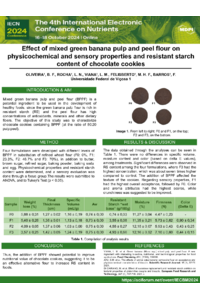
Mixed green banana pulp and peel flour (BPPF) is a potential ingredient to be used in the development of healthy foods, since green banana pulp flour is rich in resistant starch and the peel flour has high concentrations of antioxidants, minerals, and other dietary fibers. The objective of this study was to characterize chocolate cookies containing BPPF (at the ratio of 80:20 pulp–peel). Four formulations were developed with different levels of BPPF in substitution of refined wheat flour (F0: 0%, F1: 23.3%, F2: 46.7%, and F3: 70%). Physicochemical properties and resistant starch (RS) content were determined, and a sensory evaluation was performed through a focus group. The results were submitted to ANOVA, and to Tukey's Test (p < 0.05). There were no differences in specific volume (1.03-1.24 mL/g), moisture content (13.11-13.92%), and color (based on delta E values), among treatments. Significant differences were observed in RS content among the four formulations, where F3 had the highest concentration (4.93%), which was about seven times higher compared to the control (0.74%). The RS contents of F1 and F2 were 3.55% and 4.55%, respectively. The addition of BPPF affected the texture of the cookies. The control (F0) had the lowest hardness value (4.47 N), whereas F3 had the highest (7.10 N). There was no significant difference in hardness between F1 (5.73 N) and F2 (5.93 N). Regarding sensory properties, F1 had the highest overall acceptance, followed by F0. Color and aroma attributes had the highest scores, while crunchiness was suggested to be improved. Thus, the addition of BPPF showed potential to improve the nutritional value of chocolate cookies, suggesting it to be an effective alternative flour to increase RS content in foods.
Keywords
Musa spp
resistant starch
green banana flour
unconventional flour
Poster
sciforum-101156_BrunaFreitasdeOliveira.pdf
Are Common Edible Mushrooms an Answer to Healthier Diets for Global Nutrition Given their Sustainability, Nutrient Density, and Health-Promoting Bioactives?
Promoting Sustainable Plant-Based Nutrition through Microbial Priming: Impact on Almond Seed Germination and Growth