Event submissions
Published
This submission belongs to the session S2. Innovation in Dietary Choices of the event The 4th International Electronic Conference on Nutrients
Published date
11 Oct, 2024
Academic Editor
'%3e%3cpath%20d='M12.6657%2010.9104C12.4185%2010.325%2012.0599%209.79327%2011.6097%209.34482C11.1609%208.89508%2010.6293%208.5365%2010.0442%208.28888C10.0389%208.28626%2010.0337%208.28495%2010.0285%208.28233C10.8446%207.69279%2011.3752%206.73249%2011.3752%205.64904C11.3752%203.8542%209.92103%202.39999%208.1262%202.39999C6.33136%202.39999%204.87715%203.8542%204.87715%205.64904C4.87715%206.73249%205.40774%207.69279%206.22393%208.28364C6.21869%208.28626%206.21345%208.28757%206.20821%208.29019C5.62129%208.5378%205.09463%208.89284%204.64265%209.34613C4.1929%209.79493%203.83432%2010.3266%203.58671%2010.9117C3.34345%2011.4845%203.21226%2012.0987%203.20023%2012.7209C3.19988%2012.7349%203.20233%2012.7488%203.20744%2012.7619C3.21255%2012.7749%203.22022%2012.7867%203.22998%2012.7968C3.23975%2012.8068%203.25142%2012.8147%203.26431%2012.8202C3.2772%2012.8256%203.29105%2012.8284%203.30504%2012.8284H4.09109C4.14874%2012.8284%204.19459%2012.7825%204.1959%2012.7262C4.2221%2011.7148%204.62823%2010.7676%205.34617%2010.0497C6.08899%209.30683%207.0755%208.89808%208.1262%208.89808C9.17689%208.89808%2010.1634%209.30683%2010.9062%2010.0497C11.6242%2010.7676%2012.0303%2011.7148%2012.0565%2012.7262C12.0578%2012.7838%2012.1037%2012.8284%2012.1613%2012.8284H12.9474C12.9613%2012.8284%2012.9752%2012.8256%2012.9881%2012.8202C13.001%2012.8147%2013.0126%2012.8068%2013.0224%2012.7968C13.0322%2012.7867%2013.0398%2012.7749%2013.0449%2012.7619C13.0501%2012.7488%2013.0525%2012.7349%2013.0522%2012.7209C13.0391%2012.0947%2012.9094%2011.4855%2012.6657%2010.9104ZM8.1262%207.9024C7.52486%207.9024%206.9589%207.6679%206.53312%207.24211C6.10733%206.81633%205.87283%206.25037%205.87283%205.64904C5.87283%205.0477%206.10733%204.48174%206.53312%204.05596C6.9589%203.63018%207.52486%203.39567%208.1262%203.39567C8.72753%203.39567%209.29349%203.63018%209.71927%204.05596C10.1451%204.48174%2010.3796%205.0477%2010.3796%205.64904C10.3796%206.25037%2010.1451%206.81633%209.71927%207.24211C9.29349%207.6679%208.72753%207.9024%208.1262%207.9024Z'%20fill='%235D1EE1'/%3e%3c/g%3e%3c/svg%3e) Mauro Lombardo
Mauro LombardoCitation
Zineb Bouabidi, Najat Manaut, Mountasser Douma, Promoting Sustainable Plant-Based Nutrition through Microbial Priming: Impact on Almond Seed Germination and Growth, in Proceedings of The 4th International Electronic Conference on Nutrients, 16 October–18 October 2024, MDPI: Basel, Switzerland
Share
Email
Facebook
Twitter
LinkedIn
Promoting Sustainable Plant-Based Nutrition through Microbial Priming: Impact on Almond Seed Germination and Growth
'%3e%3cpath%20d='M12.6647%2010.9104C12.4176%2010.325%2012.0589%209.7933%2011.6088%209.34485C11.16%208.89511%2010.6283%208.53653%2010.0432%208.28891C10.038%208.28629%2010.0327%208.28498%2010.0275%208.28236C10.8437%207.69282%2011.3743%206.73252%2011.3743%205.64907C11.3743%203.85423%209.92005%202.40002%208.12522%202.40002C6.33038%202.40002%204.87618%203.85423%204.87618%205.64907C4.87618%206.73252%205.40677%207.69282%206.22296%208.28367C6.21772%208.28629%206.21248%208.2876%206.20724%208.29022C5.62031%208.53783%205.09365%208.89287%204.64167%209.34616C4.19192%209.79496%203.83334%2010.3266%203.58573%2010.9117C3.34247%2011.4846%203.21128%2012.0987%203.19925%2012.721C3.1989%2012.735%203.20135%2012.7489%203.20646%2012.7619C3.21157%2012.7749%203.21924%2012.7868%203.22901%2012.7968C3.23877%2012.8068%203.25045%2012.8148%203.26334%2012.8202C3.27623%2012.8256%203.29007%2012.8284%203.30406%2012.8284H4.09012C4.14776%2012.8284%204.19362%2012.7825%204.19493%2012.7262C4.22113%2011.7148%204.62726%2010.7676%205.34519%2010.0497C6.08802%209.30686%207.07452%208.89811%208.12522%208.89811C9.17592%208.89811%2010.1624%209.30686%2010.9052%2010.0497C11.6232%2010.7676%2012.0293%2011.7148%2012.0555%2012.7262C12.0568%2012.7839%2012.1027%2012.8284%2012.1603%2012.8284H12.9464C12.9604%2012.8284%2012.9742%2012.8256%2012.9871%2012.8202C13%2012.8148%2013.0117%2012.8068%2013.0214%2012.7968C13.0312%2012.7868%2013.0389%2012.7749%2013.044%2012.7619C13.0491%2012.7489%2013.0515%2012.735%2013.0512%2012.721C13.0381%2012.0947%2012.9084%2011.4856%2012.6647%2010.9104ZM8.12522%207.90243C7.52388%207.90243%206.95792%207.66793%206.53214%207.24215C6.10636%206.81636%205.87185%206.2504%205.87185%205.64907C5.87185%205.04773%206.10636%204.48177%206.53214%204.05599C6.95792%203.63021%207.52388%203.3957%208.12522%203.3957C8.72655%203.3957%209.29252%203.63021%209.7183%204.05599C10.1441%204.48177%2010.3786%205.04773%2010.3786%205.64907C10.3786%206.2504%2010.1441%206.81636%209.7183%207.24215C9.29252%207.66793%208.72655%207.90243%208.12522%207.90243Z'%20fill='%235D1EE1'/%3e%3c/g%3e%3c/svg%3e)
Zineb Bouabidi 1
Najat Manaut 2
Mountasser Douma 1
1. Natural Resources Engineering and Environmental Impacts Team, Multidisciplinary Research and Innovation Laboratory, Polydisciplinary Faculty of Khouribga (FPK), Sultan Moulay Slimane University, Khouribga, Morocco.
2. Faculty of Sciences Semlalia, Laboratory of Microbial Biotechnology, Agrosciences and Environment, Cadi Ayyad University, Labeled Research Unit-CNRST N°4, Marrakesh, Morocco.
Abstract
Abstract:
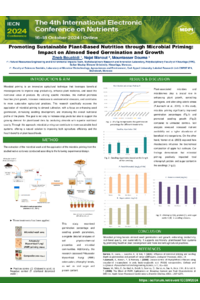
Microbial priming is an innovative agricultural technique that utilizes beneficial microorganisms to enhance both crop productivity and nutritional quality, thereby supporting sustainable and healthy plant-based nutrition. This study explores the application of microbial priming to improve almond seed germination, seedling growth, and overall nutritional content, which is crucial for plant-based diets. Methods: Almond seeds were treated with a microbial solution extracted from the rhizosphere of Pistacia lentiscus soil to enhance their growth potential. This study investigated their germination rates and seedling growth parameters and conducted comprehensive analyses of soil physico-chemical properties and microbial communities. Additionally, the colonization of Arbuscular Mycorrhizal Fungi (AMF), chlorophyll levels, and the content of total sugars and proteins were investigated. Results: Microbial priming led to significantly higher germination rates and enhanced seedling growth compared to untreated controls. Soil analysis showed increased nutrient availability and a greater abundance of beneficial microorganisms. Treated plants exhibited notably higher colonization by AMF, associated with elevated levels of chlorophyll, total sugars, and proteins in the seedlings. Conclusions: Microbial priming effectively enhances almond seed germination and seedling growth, promoting higher productivity and improved nutritional quality. This sustainable practice offers an eco-friendly alternative, supporting healthier and more sustainable plant-based food systems. These findings underscore the potential of microbial priming to enhance almond cultivation, promoting plant-based nutrition and sustainability.
Keywords
Microbial Priming
Almond Seed Germination
Seedling Growth
Plant-Based Nutrition
Sustainable Agriculture
Soil Microbiology.
Poster
sciforum-101150_Bouabidi Zineb.pdf
EFFECT OF MIXED GREEN BANANA PULP AND PEEL FLOUR ON PHYSICOCHEMICAL AND SENSORY PROPERTIES AND RESISTANT STARCH CONTENT OF CHOCOLATE COOKIES
Ecdysterone Content in Selected Vegetables and Crops - Applications in Sport