Event submissions
Published
This submission belongs to the session S3. Diet and Chronic Disease Management of the event The 4th International Electronic Conference on Nutrients
Published date
11 Oct, 2024
Academic Editor
'%3e%3cpath%20d='M12.6657%2010.9104C12.4185%2010.325%2012.0599%209.79327%2011.6097%209.34482C11.1609%208.89508%2010.6293%208.5365%2010.0442%208.28888C10.0389%208.28626%2010.0337%208.28495%2010.0285%208.28233C10.8446%207.69279%2011.3752%206.73249%2011.3752%205.64904C11.3752%203.8542%209.92103%202.39999%208.1262%202.39999C6.33136%202.39999%204.87715%203.8542%204.87715%205.64904C4.87715%206.73249%205.40774%207.69279%206.22393%208.28364C6.21869%208.28626%206.21345%208.28757%206.20821%208.29019C5.62129%208.5378%205.09463%208.89284%204.64265%209.34613C4.1929%209.79493%203.83432%2010.3266%203.58671%2010.9117C3.34345%2011.4845%203.21226%2012.0987%203.20023%2012.7209C3.19988%2012.7349%203.20233%2012.7488%203.20744%2012.7619C3.21255%2012.7749%203.22022%2012.7867%203.22998%2012.7968C3.23975%2012.8068%203.25142%2012.8147%203.26431%2012.8202C3.2772%2012.8256%203.29105%2012.8284%203.30504%2012.8284H4.09109C4.14874%2012.8284%204.19459%2012.7825%204.1959%2012.7262C4.2221%2011.7148%204.62823%2010.7676%205.34617%2010.0497C6.08899%209.30683%207.0755%208.89808%208.1262%208.89808C9.17689%208.89808%2010.1634%209.30683%2010.9062%2010.0497C11.6242%2010.7676%2012.0303%2011.7148%2012.0565%2012.7262C12.0578%2012.7838%2012.1037%2012.8284%2012.1613%2012.8284H12.9474C12.9613%2012.8284%2012.9752%2012.8256%2012.9881%2012.8202C13.001%2012.8147%2013.0126%2012.8068%2013.0224%2012.7968C13.0322%2012.7867%2013.0398%2012.7749%2013.0449%2012.7619C13.0501%2012.7488%2013.0525%2012.7349%2013.0522%2012.7209C13.0391%2012.0947%2012.9094%2011.4855%2012.6657%2010.9104ZM8.1262%207.9024C7.52486%207.9024%206.9589%207.6679%206.53312%207.24211C6.10733%206.81633%205.87283%206.25037%205.87283%205.64904C5.87283%205.0477%206.10733%204.48174%206.53312%204.05596C6.9589%203.63018%207.52486%203.39567%208.1262%203.39567C8.72753%203.39567%209.29349%203.63018%209.71927%204.05596C10.1451%204.48174%2010.3796%205.0477%2010.3796%205.64904C10.3796%206.25037%2010.1451%206.81633%209.71927%207.24211C9.29349%207.6679%208.72753%207.9024%208.1262%207.9024Z'%20fill='%235D1EE1'/%3e%3c/g%3e%3c/svg%3e) Mauro Lombardo
Mauro LombardoCitation
Manju Bargavi S, Dr. Nora Vigasini K, FORMULATION AND EVALUATION OF A PROBIOTIC DRAGON FRUIT (HYLOCERUS UNDATUS)– HONEY BEVERAGE, in Proceedings of The 4th International Electronic Conference on Nutrients, 16 October–18 October 2024, MDPI: Basel, Switzerland
Share
Email
Facebook
Twitter
LinkedIn
FORMULATION AND EVALUATION OF A PROBIOTIC DRAGON FRUIT (HYLOCERUS UNDATUS)– HONEY BEVERAGE
'%3e%3cpath%20d='M12.6647%2010.9104C12.4176%2010.325%2012.0589%209.7933%2011.6088%209.34485C11.16%208.89511%2010.6283%208.53653%2010.0432%208.28891C10.038%208.28629%2010.0327%208.28498%2010.0275%208.28236C10.8437%207.69282%2011.3743%206.73252%2011.3743%205.64907C11.3743%203.85423%209.92005%202.40002%208.12522%202.40002C6.33038%202.40002%204.87618%203.85423%204.87618%205.64907C4.87618%206.73252%205.40677%207.69282%206.22296%208.28367C6.21772%208.28629%206.21248%208.2876%206.20724%208.29022C5.62031%208.53783%205.09365%208.89287%204.64167%209.34616C4.19192%209.79496%203.83334%2010.3266%203.58573%2010.9117C3.34247%2011.4846%203.21128%2012.0987%203.19925%2012.721C3.1989%2012.735%203.20135%2012.7489%203.20646%2012.7619C3.21157%2012.7749%203.21924%2012.7868%203.22901%2012.7968C3.23877%2012.8068%203.25045%2012.8148%203.26334%2012.8202C3.27623%2012.8256%203.29007%2012.8284%203.30406%2012.8284H4.09012C4.14776%2012.8284%204.19362%2012.7825%204.19493%2012.7262C4.22113%2011.7148%204.62726%2010.7676%205.34519%2010.0497C6.08802%209.30686%207.07452%208.89811%208.12522%208.89811C9.17592%208.89811%2010.1624%209.30686%2010.9052%2010.0497C11.6232%2010.7676%2012.0293%2011.7148%2012.0555%2012.7262C12.0568%2012.7839%2012.1027%2012.8284%2012.1603%2012.8284H12.9464C12.9604%2012.8284%2012.9742%2012.8256%2012.9871%2012.8202C13%2012.8148%2013.0117%2012.8068%2013.0214%2012.7968C13.0312%2012.7868%2013.0389%2012.7749%2013.044%2012.7619C13.0491%2012.7489%2013.0515%2012.735%2013.0512%2012.721C13.0381%2012.0947%2012.9084%2011.4856%2012.6647%2010.9104ZM8.12522%207.90243C7.52388%207.90243%206.95792%207.66793%206.53214%207.24215C6.10636%206.81636%205.87185%206.2504%205.87185%205.64907C5.87185%205.04773%206.10636%204.48177%206.53214%204.05599C6.95792%203.63021%207.52388%203.3957%208.12522%203.3957C8.72655%203.3957%209.29252%203.63021%209.7183%204.05599C10.1441%204.48177%2010.3786%205.04773%2010.3786%205.64907C10.3786%206.2504%2010.1441%206.81636%209.7183%207.24215C9.29252%207.66793%208.72655%207.90243%208.12522%207.90243Z'%20fill='%235D1EE1'/%3e%3c/g%3e%3c/svg%3e)
Manju Bargavi S 1
Dr. Nora Vigasini K 2,3
1. Department of Home Science, Women's Christian College, Chennai
2. Department of Home Science
3. Women's Christian College, Chennai
Abstract
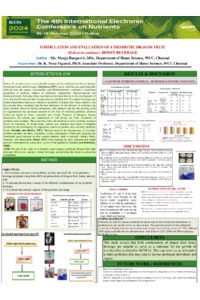
Background: Today, all consumers have a considerable amount of their nutritional needs met through fermented foods and beverages. Probiotic foods have positive effects on intestinal microbiota composition and overall health. The use of fruit juices as vehicles for probiotic microorganisms can be an alternative for those who do not or cannot consume dairy products. With an increase in lactose intolerance and vegetarianism and a high demand for vegetarian probiotic products, there is an urgent need to develop new non-dairy probiotic food products. Fruits could be a suitable alternative to serve as a medium for probiotic product development. One such fruit is Dragon fruit.
Aim: To formulate and evaluate a probiotic dragon fruit (Hylocereus undatus)–honey beverage incorporating the strain Lactobacillus acidophilus.
Methodology: A Probiotic and a non-probiotic dragon fruit–honey beverage was prepared by inoculating and fermenting it with the revived Lactobacillus acidophilus (NCDC14). An analysis of specific nutrients of the formulated beverages, such as energy, carbohydrate, protein, vitamin C, and calcium, was carried out. The chemical parameters of the beverages such as pH, titratable acidity, total soluble solids, total sugar, and reducing sugar were also assessed. The total bacterial count of the prepared probiotic and non-probiotic beverages were evaluated after 24 hours.
Results: The prepared probiotic and non-probiotic beverages were found to have adequate nutrients such as carbohydrate, protein, calcium, and vitamin C, and they were also found to have optimal pH, titratable activity, total soluble solids, and reducing sugars. However, the total bacterial count was found to be higher in the probiotic beverage than the non-probiotic beverage.
Conclusion: From the results, it is evident that the formulated probiotic dragon fruit–honey beverage may be expected to be a good substitute for milk for individuals who have lactose intolerance or a milk allergy.
Keywords
Key words: Probiotic beverage
dragon fruit
Lactobacillus acidophilus
non-probiotic beverage
honey beverage
fermented beverage.
Poster
PROBIOTIC POSTER OFFICIAL PDF.pdf
Elaboration of peanut- and nut-based yogurts
Comparative efficiency of EPO-Boost Natural Blood Builder and Blood Booster Active 17 supplementation on hematological biomarkers and athletic performance in CrossFit® athletes: A randomized placebo-controlled trial.