Event submissions
Published
This submission belongs to the session S2. Innovation in Dietary Choices of the event The 4th International Electronic Conference on Nutrients
Published date
11 Oct, 2024
Academic Editor
'%3e%3cpath%20d='M12.6657%2010.9104C12.4185%2010.325%2012.0599%209.79327%2011.6097%209.34482C11.1609%208.89508%2010.6293%208.5365%2010.0442%208.28888C10.0389%208.28626%2010.0337%208.28495%2010.0285%208.28233C10.8446%207.69279%2011.3752%206.73249%2011.3752%205.64904C11.3752%203.8542%209.92103%202.39999%208.1262%202.39999C6.33136%202.39999%204.87715%203.8542%204.87715%205.64904C4.87715%206.73249%205.40774%207.69279%206.22393%208.28364C6.21869%208.28626%206.21345%208.28757%206.20821%208.29019C5.62129%208.5378%205.09463%208.89284%204.64265%209.34613C4.1929%209.79493%203.83432%2010.3266%203.58671%2010.9117C3.34345%2011.4845%203.21226%2012.0987%203.20023%2012.7209C3.19988%2012.7349%203.20233%2012.7488%203.20744%2012.7619C3.21255%2012.7749%203.22022%2012.7867%203.22998%2012.7968C3.23975%2012.8068%203.25142%2012.8147%203.26431%2012.8202C3.2772%2012.8256%203.29105%2012.8284%203.30504%2012.8284H4.09109C4.14874%2012.8284%204.19459%2012.7825%204.1959%2012.7262C4.2221%2011.7148%204.62823%2010.7676%205.34617%2010.0497C6.08899%209.30683%207.0755%208.89808%208.1262%208.89808C9.17689%208.89808%2010.1634%209.30683%2010.9062%2010.0497C11.6242%2010.7676%2012.0303%2011.7148%2012.0565%2012.7262C12.0578%2012.7838%2012.1037%2012.8284%2012.1613%2012.8284H12.9474C12.9613%2012.8284%2012.9752%2012.8256%2012.9881%2012.8202C13.001%2012.8147%2013.0126%2012.8068%2013.0224%2012.7968C13.0322%2012.7867%2013.0398%2012.7749%2013.0449%2012.7619C13.0501%2012.7488%2013.0525%2012.7349%2013.0522%2012.7209C13.0391%2012.0947%2012.9094%2011.4855%2012.6657%2010.9104ZM8.1262%207.9024C7.52486%207.9024%206.9589%207.6679%206.53312%207.24211C6.10733%206.81633%205.87283%206.25037%205.87283%205.64904C5.87283%205.0477%206.10733%204.48174%206.53312%204.05596C6.9589%203.63018%207.52486%203.39567%208.1262%203.39567C8.72753%203.39567%209.29349%203.63018%209.71927%204.05596C10.1451%204.48174%2010.3796%205.0477%2010.3796%205.64904C10.3796%206.25037%2010.1451%206.81633%209.71927%207.24211C9.29349%207.6679%208.72753%207.9024%208.1262%207.9024Z'%20fill='%235D1EE1'/%3e%3c/g%3e%3c/svg%3e) Mauro Lombardo
Mauro LombardoCitation
Danúbia Joanes Rosa Guerra, Caroline Woelffel Silva, Amanda Lais Alves Almeida Nascimento, Paulo César Stringheta, Moysés Naves Moraes, Ceres Mattos Della Lucia, Frederico Augusto Ribeiro de Barros, ULTRASOUND-ASSISTED EXTRACTION OF CAROTENOIDS FROM MACAUBA PULP AND PULP PRESS-CAKE USING ETHYL ACETATE, in Proceedings of The 4th International Electronic Conference on Nutrients, 16 October–18 October 2024, MDPI: Basel, Switzerland
Share
Email
Facebook
Twitter
LinkedIn
ULTRASOUND-ASSISTED EXTRACTION OF CAROTENOIDS FROM MACAUBA PULP AND PULP PRESS-CAKE USING ETHYL ACETATE
'%3e%3cpath%20d='M12.6647%2010.9104C12.4176%2010.325%2012.0589%209.7933%2011.6088%209.34485C11.16%208.89511%2010.6283%208.53653%2010.0432%208.28891C10.038%208.28629%2010.0327%208.28498%2010.0275%208.28236C10.8437%207.69282%2011.3743%206.73252%2011.3743%205.64907C11.3743%203.85423%209.92005%202.40002%208.12522%202.40002C6.33038%202.40002%204.87618%203.85423%204.87618%205.64907C4.87618%206.73252%205.40677%207.69282%206.22296%208.28367C6.21772%208.28629%206.21248%208.2876%206.20724%208.29022C5.62031%208.53783%205.09365%208.89287%204.64167%209.34616C4.19192%209.79496%203.83334%2010.3266%203.58573%2010.9117C3.34247%2011.4846%203.21128%2012.0987%203.19925%2012.721C3.1989%2012.735%203.20135%2012.7489%203.20646%2012.7619C3.21157%2012.7749%203.21924%2012.7868%203.22901%2012.7968C3.23877%2012.8068%203.25045%2012.8148%203.26334%2012.8202C3.27623%2012.8256%203.29007%2012.8284%203.30406%2012.8284H4.09012C4.14776%2012.8284%204.19362%2012.7825%204.19493%2012.7262C4.22113%2011.7148%204.62726%2010.7676%205.34519%2010.0497C6.08802%209.30686%207.07452%208.89811%208.12522%208.89811C9.17592%208.89811%2010.1624%209.30686%2010.9052%2010.0497C11.6232%2010.7676%2012.0293%2011.7148%2012.0555%2012.7262C12.0568%2012.7839%2012.1027%2012.8284%2012.1603%2012.8284H12.9464C12.9604%2012.8284%2012.9742%2012.8256%2012.9871%2012.8202C13%2012.8148%2013.0117%2012.8068%2013.0214%2012.7968C13.0312%2012.7868%2013.0389%2012.7749%2013.044%2012.7619C13.0491%2012.7489%2013.0515%2012.735%2013.0512%2012.721C13.0381%2012.0947%2012.9084%2011.4856%2012.6647%2010.9104ZM8.12522%207.90243C7.52388%207.90243%206.95792%207.66793%206.53214%207.24215C6.10636%206.81636%205.87185%206.2504%205.87185%205.64907C5.87185%205.04773%206.10636%204.48177%206.53214%204.05599C6.95792%203.63021%207.52388%203.3957%208.12522%203.3957C8.72655%203.3957%209.29252%203.63021%209.7183%204.05599C10.1441%204.48177%2010.3786%205.04773%2010.3786%205.64907C10.3786%206.2504%2010.1441%206.81636%209.7183%207.24215C9.29252%207.66793%208.72655%207.90243%208.12522%207.90243Z'%20fill='%235D1EE1'/%3e%3c/g%3e%3c/svg%3e)
Danúbia Joanes Rosa Guerra 1
Caroline Woelffel Silva 2
Amanda Lais Alves Almeida Nascimento 2
Paulo César Stringheta 2
Moysés Naves Moraes 2
Ceres Mattos Della Lucia 3

Frederico Augusto Ribeiro de Barros 2
1. Universidade Federal de Viçosa
2. Federal University of Viçosa, Department of Food Technology
3. Federal University of Viçosa, Department of Nutrition and Health
Abstract
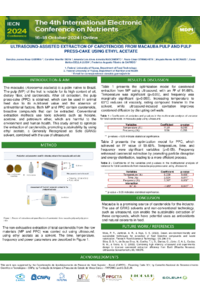
Introduction: The macauba (Acrocomia aculeata) is a palm native to Brazil. The pulp (MP) of the fruit is notable for its high content of oil, dietary fiber, and carotenoids. After oil extraction, the pulp press-cake (PPC) is obtained, which can be used in animal feed due to its nutritional value and absence of anti-nutritional factors. Both the MP and PPC contain carotenoids, which are bioactive compounds that can be extracted. Conventional extraction methods use toxic solvents such as hexane, acetone, and petroleum ether, which are harmful to the environment and human health. This study aimed to optimize the extraction of carotenoids, promoting sustainability by using ethyl acetate, a Generally Recognized as Safe (GRAS) solvent, combined with the use of ultrasound. Methods: The extraction of total carotenoids from the MP and PPC was carried out with ethyl acetate and an ultrasonic bath, varying parameters of temperature (25°C, 42.5°C, and 60°C), time (5, 17.5, and 30 minutes), and frequency (25 and 45 kHz), maintaining a power of 400 W. Total carotenoid content was determined using a spectrophotometer (450 nm). Results: The optimization models generated equations and response surfaces. For the MP, the total carotenoid content ranged from 200.69 to 247.22 µg/g, while for the PPC, the values ranged from 92.48 to 123.84 µg/g. Temperature was significant (p < 0.05) for carotenoid extraction. The temperature/frequency interaction was significant only for the PPC, resulting in higher extraction levels with increased temperatures and frequencies. In the MP, there was a difference in extraction content when employing different frequencies; however, the variation was marginally significant. Temperature was a significant variable in the model. Conclusion: Macauba is a promising source of carotenoids for the industry. The use of GRAS solvents and non-conventional technology, such as ultrasound, can enable the sustainable extraction of these compounds, which have potential uses as antioxidants and natural colorants in food.
Keywords
Acrocomia Aculeata
carotenoids
extraction
ethyl acetate
GRAS
Poster
sciforum-097642-Guerra.pdf
Plant Proteins for a Healthier Heart: A Meta-Analysis Approach
Protective action of in vitro orogastric digests of Nannochloropsis gaditana against Helicobacter pylori infection