Event submissions
Published
This submission belongs to the session S4. Global Nutrition Trends: Shaping Health and Athletic Performance of the event The 4th International Electronic Conference on Nutrients
Published date
11 Oct, 2024
Academic Editor
'%3e%3cpath%20d='M12.6657%2010.9104C12.4185%2010.325%2012.0599%209.79327%2011.6097%209.34482C11.1609%208.89508%2010.6293%208.5365%2010.0442%208.28888C10.0389%208.28626%2010.0337%208.28495%2010.0285%208.28233C10.8446%207.69279%2011.3752%206.73249%2011.3752%205.64904C11.3752%203.8542%209.92103%202.39999%208.1262%202.39999C6.33136%202.39999%204.87715%203.8542%204.87715%205.64904C4.87715%206.73249%205.40774%207.69279%206.22393%208.28364C6.21869%208.28626%206.21345%208.28757%206.20821%208.29019C5.62129%208.5378%205.09463%208.89284%204.64265%209.34613C4.1929%209.79493%203.83432%2010.3266%203.58671%2010.9117C3.34345%2011.4845%203.21226%2012.0987%203.20023%2012.7209C3.19988%2012.7349%203.20233%2012.7488%203.20744%2012.7619C3.21255%2012.7749%203.22022%2012.7867%203.22998%2012.7968C3.23975%2012.8068%203.25142%2012.8147%203.26431%2012.8202C3.2772%2012.8256%203.29105%2012.8284%203.30504%2012.8284H4.09109C4.14874%2012.8284%204.19459%2012.7825%204.1959%2012.7262C4.2221%2011.7148%204.62823%2010.7676%205.34617%2010.0497C6.08899%209.30683%207.0755%208.89808%208.1262%208.89808C9.17689%208.89808%2010.1634%209.30683%2010.9062%2010.0497C11.6242%2010.7676%2012.0303%2011.7148%2012.0565%2012.7262C12.0578%2012.7838%2012.1037%2012.8284%2012.1613%2012.8284H12.9474C12.9613%2012.8284%2012.9752%2012.8256%2012.9881%2012.8202C13.001%2012.8147%2013.0126%2012.8068%2013.0224%2012.7968C13.0322%2012.7867%2013.0398%2012.7749%2013.0449%2012.7619C13.0501%2012.7488%2013.0525%2012.7349%2013.0522%2012.7209C13.0391%2012.0947%2012.9094%2011.4855%2012.6657%2010.9104ZM8.1262%207.9024C7.52486%207.9024%206.9589%207.6679%206.53312%207.24211C6.10733%206.81633%205.87283%206.25037%205.87283%205.64904C5.87283%205.0477%206.10733%204.48174%206.53312%204.05596C6.9589%203.63018%207.52486%203.39567%208.1262%203.39567C8.72753%203.39567%209.29349%203.63018%209.71927%204.05596C10.1451%204.48174%2010.3796%205.0477%2010.3796%205.64904C10.3796%206.25037%2010.1451%206.81633%209.71927%207.24211C9.29349%207.6679%208.72753%207.9024%208.1262%207.9024Z'%20fill='%235D1EE1'/%3e%3c/g%3e%3c/svg%3e) Mauro Lombardo
Mauro LombardoCitation
Antonio Peña-Fernández, Edna Segura, María de los Ángeles Peña, Manuel Higueras, Sodium intake in young university students from Leicester (England), in Proceedings of The 4th International Electronic Conference on Nutrients, 16 October–18 October 2024, MDPI: Basel, Switzerland
Share
Email
Facebook
Twitter
LinkedIn
Sodium intake in young university students from Leicester (England)

Antonio Peña-Fernández 1
'%3e%3cpath%20d='M12.6647%2010.9104C12.4176%2010.325%2012.0589%209.7933%2011.6088%209.34485C11.16%208.89511%2010.6283%208.53653%2010.0432%208.28891C10.038%208.28629%2010.0327%208.28498%2010.0275%208.28236C10.8437%207.69282%2011.3743%206.73252%2011.3743%205.64907C11.3743%203.85423%209.92005%202.40002%208.12522%202.40002C6.33038%202.40002%204.87618%203.85423%204.87618%205.64907C4.87618%206.73252%205.40677%207.69282%206.22296%208.28367C6.21772%208.28629%206.21248%208.2876%206.20724%208.29022C5.62031%208.53783%205.09365%208.89287%204.64167%209.34616C4.19192%209.79496%203.83334%2010.3266%203.58573%2010.9117C3.34247%2011.4846%203.21128%2012.0987%203.19925%2012.721C3.1989%2012.735%203.20135%2012.7489%203.20646%2012.7619C3.21157%2012.7749%203.21924%2012.7868%203.22901%2012.7968C3.23877%2012.8068%203.25045%2012.8148%203.26334%2012.8202C3.27623%2012.8256%203.29007%2012.8284%203.30406%2012.8284H4.09012C4.14776%2012.8284%204.19362%2012.7825%204.19493%2012.7262C4.22113%2011.7148%204.62726%2010.7676%205.34519%2010.0497C6.08802%209.30686%207.07452%208.89811%208.12522%208.89811C9.17592%208.89811%2010.1624%209.30686%2010.9052%2010.0497C11.6232%2010.7676%2012.0293%2011.7148%2012.0555%2012.7262C12.0568%2012.7839%2012.1027%2012.8284%2012.1603%2012.8284H12.9464C12.9604%2012.8284%2012.9742%2012.8256%2012.9871%2012.8202C13%2012.8148%2013.0117%2012.8068%2013.0214%2012.7968C13.0312%2012.7868%2013.0389%2012.7749%2013.044%2012.7619C13.0491%2012.7489%2013.0515%2012.735%2013.0512%2012.721C13.0381%2012.0947%2012.9084%2011.4856%2012.6647%2010.9104ZM8.12522%207.90243C7.52388%207.90243%206.95792%207.66793%206.53214%207.24215C6.10636%206.81636%205.87185%206.2504%205.87185%205.64907C5.87185%205.04773%206.10636%204.48177%206.53214%204.05599C6.95792%203.63021%207.52388%203.3957%208.12522%203.3957C8.72655%203.3957%209.29252%203.63021%209.7183%204.05599C10.1441%204.48177%2010.3786%205.04773%2010.3786%205.64907C10.3786%206.2504%2010.1441%206.81636%209.7183%207.24215C9.29252%207.66793%208.72655%207.90243%208.12522%207.90243Z'%20fill='%235D1EE1'/%3e%3c/g%3e%3c/svg%3e)
Edna Segura 2

María de los Ángeles Peña 3
Manuel Higueras 2
1. Department of Surgery, Medical and Social Sciences, Faculty of Medicine and Health Sciences, University of Alcalá, Ctra. Madrid-Barcelona, Km. 33.600, 28871 Alcalá de Henares, Madrid, Spain.
2. Scientific Computation & Technological Innovation Center (SCoTIC), Universidad de La Rioja, Logroño, Spain.
3. Departamento de Ciencias Biomédicas, Universidad de Alcalá, Crta. Madrid-Barcelona Km, 33.6, 28871 Alcalá de Henares, Madrid, Spain
Abstract
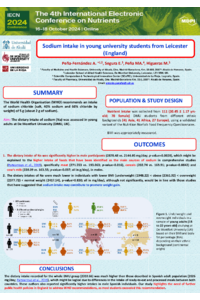
The World Health Organisation (WHO) recommends an intake of sodium chloride (salt: 40% sodium and 60% chloride by weight) of 5 g (about 2 g of sodium). The dietary intake of sodium (Na) was assessed in young adults at De Montfort University (DMU, UK). Comprehensive nutrient intake information was collected from 111 (20.45 yrs old; 78 female) DMU students between 2015 and 2016 from three major ethnic backgrounds (41 from Asia, 41 from Africa, 27 from Europe) using a validated variant of the Nutrition Norfolk Food Frequency Questionnaire. According to their BMI values, 25.7% and 8.3% of this population were overweight and obese, while 9.2% were underweight. The number that were overweight is three times that of the national average in this age group, 10.6%. The dietary intake of Na was significantly higher in male participants (2878.48 vs. 2144.05 mg/day; p-value=0.0028), which might be explained by their higher intake of foods that have been identified as primary sources of sodium in a number of comprehensive studies, specifically meat (271.553 vs. 193.063; p-value=0.016), cereals (202.74 vs. 169.91; p-value=0.0842) and cow’s milk (228.09 vs. 163.55; p-value=0.037; all in g/day). The dietary intake of Na was much lower in individuals with a lower BMI [underweight (1948.22) < obese (2361.92) < overweight (2377.72) < normal weight (2417.54), p-value=0.830; all in mg/day], although not significantly. This is in line with studies that have suggested that a high sodium intake may contribute to promoting weight gain. The dietary intake recorded for the whole DMU group (2359.66) was much higher than that described in a Spanish adult population (2026 mg/day), which might be logically due to differences in the intake of ready-to-eat and processed meals between both countries. The authors of that study also reported significantly higher sodium intakes in Spanish men. Our study highlights the need for further public health policies in England to address the WHO recommendations, as most students exceeded the recommended intake of sodium.
Keywords
Sodium intake
University students
WHO recommendation
salt intake
dietary intake.
Poster
IECN 2024 Nutrients Na DMU students Leicester_APF.pdf
Relationship between serum Vitamin D levels and otic affection in preschool children
Impact of varied whey substrates on the lactose oxidation efficiency of Pseudomonas taetrolens