Event submissions
Published
This submission belongs to the session S1. Plant-Based Diets: Health and Well-Being of the event The 4th International Electronic Conference on Nutrients
Published date
11 Oct, 2024
Academic Editor
'%3e%3cpath%20d='M12.6657%2010.9104C12.4185%2010.325%2012.0599%209.79327%2011.6097%209.34482C11.1609%208.89508%2010.6293%208.5365%2010.0442%208.28888C10.0389%208.28626%2010.0337%208.28495%2010.0285%208.28233C10.8446%207.69279%2011.3752%206.73249%2011.3752%205.64904C11.3752%203.8542%209.92103%202.39999%208.1262%202.39999C6.33136%202.39999%204.87715%203.8542%204.87715%205.64904C4.87715%206.73249%205.40774%207.69279%206.22393%208.28364C6.21869%208.28626%206.21345%208.28757%206.20821%208.29019C5.62129%208.5378%205.09463%208.89284%204.64265%209.34613C4.1929%209.79493%203.83432%2010.3266%203.58671%2010.9117C3.34345%2011.4845%203.21226%2012.0987%203.20023%2012.7209C3.19988%2012.7349%203.20233%2012.7488%203.20744%2012.7619C3.21255%2012.7749%203.22022%2012.7867%203.22998%2012.7968C3.23975%2012.8068%203.25142%2012.8147%203.26431%2012.8202C3.2772%2012.8256%203.29105%2012.8284%203.30504%2012.8284H4.09109C4.14874%2012.8284%204.19459%2012.7825%204.1959%2012.7262C4.2221%2011.7148%204.62823%2010.7676%205.34617%2010.0497C6.08899%209.30683%207.0755%208.89808%208.1262%208.89808C9.17689%208.89808%2010.1634%209.30683%2010.9062%2010.0497C11.6242%2010.7676%2012.0303%2011.7148%2012.0565%2012.7262C12.0578%2012.7838%2012.1037%2012.8284%2012.1613%2012.8284H12.9474C12.9613%2012.8284%2012.9752%2012.8256%2012.9881%2012.8202C13.001%2012.8147%2013.0126%2012.8068%2013.0224%2012.7968C13.0322%2012.7867%2013.0398%2012.7749%2013.0449%2012.7619C13.0501%2012.7488%2013.0525%2012.7349%2013.0522%2012.7209C13.0391%2012.0947%2012.9094%2011.4855%2012.6657%2010.9104ZM8.1262%207.9024C7.52486%207.9024%206.9589%207.6679%206.53312%207.24211C6.10733%206.81633%205.87283%206.25037%205.87283%205.64904C5.87283%205.0477%206.10733%204.48174%206.53312%204.05596C6.9589%203.63018%207.52486%203.39567%208.1262%203.39567C8.72753%203.39567%209.29349%203.63018%209.71927%204.05596C10.1451%204.48174%2010.3796%205.0477%2010.3796%205.64904C10.3796%206.25037%2010.1451%206.81633%209.71927%207.24211C9.29349%207.6679%208.72753%207.9024%208.1262%207.9024Z'%20fill='%235D1EE1'/%3e%3c/g%3e%3c/svg%3e) Mauro Lombardo
Mauro LombardoCitation
Marta Majchrzak, Laura Alonso-Pintre, Samuel Paterson, Pilar Gómez-Cortés, Miguel A de la Fuente, Blanca Hernández-Ledesma, Proteomic approaches to identify antioxidant peptides from the microalga Tetraselmis chuii after its simulated orogastric digestion, in Proceedings of The 4th International Electronic Conference on Nutrients, 16 October–18 October 2024, MDPI: Basel, Switzerland
Share
Email
Facebook
Twitter
LinkedIn
Proteomic approaches to identify antioxidant peptides from the microalga Tetraselmis chuii after its simulated orogastric digestion
'%3e%3cpath%20d='M12.6647%2010.9104C12.4176%2010.325%2012.0589%209.7933%2011.6088%209.34485C11.16%208.89511%2010.6283%208.53653%2010.0432%208.28891C10.038%208.28629%2010.0327%208.28498%2010.0275%208.28236C10.8437%207.69282%2011.3743%206.73252%2011.3743%205.64907C11.3743%203.85423%209.92005%202.40002%208.12522%202.40002C6.33038%202.40002%204.87618%203.85423%204.87618%205.64907C4.87618%206.73252%205.40677%207.69282%206.22296%208.28367C6.21772%208.28629%206.21248%208.2876%206.20724%208.29022C5.62031%208.53783%205.09365%208.89287%204.64167%209.34616C4.19192%209.79496%203.83334%2010.3266%203.58573%2010.9117C3.34247%2011.4846%203.21128%2012.0987%203.19925%2012.721C3.1989%2012.735%203.20135%2012.7489%203.20646%2012.7619C3.21157%2012.7749%203.21924%2012.7868%203.22901%2012.7968C3.23877%2012.8068%203.25045%2012.8148%203.26334%2012.8202C3.27623%2012.8256%203.29007%2012.8284%203.30406%2012.8284H4.09012C4.14776%2012.8284%204.19362%2012.7825%204.19493%2012.7262C4.22113%2011.7148%204.62726%2010.7676%205.34519%2010.0497C6.08802%209.30686%207.07452%208.89811%208.12522%208.89811C9.17592%208.89811%2010.1624%209.30686%2010.9052%2010.0497C11.6232%2010.7676%2012.0293%2011.7148%2012.0555%2012.7262C12.0568%2012.7839%2012.1027%2012.8284%2012.1603%2012.8284H12.9464C12.9604%2012.8284%2012.9742%2012.8256%2012.9871%2012.8202C13%2012.8148%2013.0117%2012.8068%2013.0214%2012.7968C13.0312%2012.7868%2013.0389%2012.7749%2013.044%2012.7619C13.0491%2012.7489%2013.0515%2012.735%2013.0512%2012.721C13.0381%2012.0947%2012.9084%2011.4856%2012.6647%2010.9104ZM8.12522%207.90243C7.52388%207.90243%206.95792%207.66793%206.53214%207.24215C6.10636%206.81636%205.87185%206.2504%205.87185%205.64907C5.87185%205.04773%206.10636%204.48177%206.53214%204.05599C6.95792%203.63021%207.52388%203.3957%208.12522%203.3957C8.72655%203.3957%209.29252%203.63021%209.7183%204.05599C10.1441%204.48177%2010.3786%205.04773%2010.3786%205.64907C10.3786%206.2504%2010.1441%206.81636%209.7183%207.24215C9.29252%207.66793%208.72655%207.90243%208.12522%207.90243Z'%20fill='%235D1EE1'/%3e%3c/g%3e%3c/svg%3e)
Marta Majchrzak 1
Laura Alonso-Pintre 1
Samuel Paterson 1
Pilar Gómez-Cortés 1
Miguel A de la Fuente 1

Blanca Hernández-Ledesma 1
1. Institute of Food Science Research (CIAL, CSIC-UAM, CEI UAM+CSIC), Nicolás Cabrera 9, 28049 Madrid, Spain
Abstract
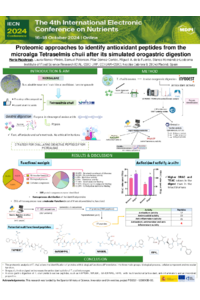
Over the last few years, the interest in bioactive peptides derived from microalgae has grown significantly due to their potential health benefits. Within the different microalgae species, the green microalga Tetraselmis chuii stands out for its protein profile composition and essential amino acids1. The proteomic analyses of simulated gastric or gastrointestinal digestion phases, both in vitro and in silico, have become one of the most widely investigated strategies to evaluate bioactive peptides from microalgae proteins.
T. chuii biomass was pretreated with a combination of freeze–thaw cycles and ultrasounds. Proteomic analysis was carried out by HPLC coupled with tandem mass spectrometry. The functional analysis of the proteome was carried out with OmicsBox software. The annotated proteins were classified into three functional groups—cellular component, molecular function, and biological processes—using BLAST 2GO Methodology. n silico gastric digestion was performed by the Rapid Peptides Generator (RPG); pepsin was selected as the digestive enzyme. In parallel to this, in vitro orogastric digestion was carried out following the INFOGEST protocol2. The antioxidant capacity of the digests was evaluated by ORAC and ABTS assays.
The proteomic and functional analysis allowed for the identification of 287 annotated proteins, which were classified into three different groups: 254 sequences (33.5% of total) were associated with a biological process; 222 sequences (35.5%) were classified as proteins involved in molecular function; and 240 sequences (31.0%) were identified as proteins constituent of a cellular component. In silico gastric digestion of the identified proteins revealed the release of 14,774 peptides, most of them (79%) containing between two and ten amino acids. Among the low-molecular-weight peptides produced during the in silico analysis, 24% contained aromatic amino acids, which could be responsible for the radical scavenging capacity determined in the in vitro orogastric digests of T. chuii.
Keywords
microalgae
proteomics
in silico and in vitro orogastric digestion
bioactive peptides
antioxidant capacity
Poster
sciforum-097570_Marta Majchrzak.pdf
Correlation of Reduced Serum Iron Levels with Acute Adenoiditis in Preschool-Aged Children
Brown rice bran powder, when added to the standard diet, could alleviate cardiometabolic risk factors and antioxidant status in patients with metabolic syndrome