Event submissions
Published
This submission belongs to the session S2. Innovation in Dietary Choices of the event The 4th International Electronic Conference on Nutrients
Published date
11 Oct, 2024
Academic Editor
'%3e%3cpath%20d='M12.6657%2010.9104C12.4185%2010.325%2012.0599%209.79327%2011.6097%209.34482C11.1609%208.89508%2010.6293%208.5365%2010.0442%208.28888C10.0389%208.28626%2010.0337%208.28495%2010.0285%208.28233C10.8446%207.69279%2011.3752%206.73249%2011.3752%205.64904C11.3752%203.8542%209.92103%202.39999%208.1262%202.39999C6.33136%202.39999%204.87715%203.8542%204.87715%205.64904C4.87715%206.73249%205.40774%207.69279%206.22393%208.28364C6.21869%208.28626%206.21345%208.28757%206.20821%208.29019C5.62129%208.5378%205.09463%208.89284%204.64265%209.34613C4.1929%209.79493%203.83432%2010.3266%203.58671%2010.9117C3.34345%2011.4845%203.21226%2012.0987%203.20023%2012.7209C3.19988%2012.7349%203.20233%2012.7488%203.20744%2012.7619C3.21255%2012.7749%203.22022%2012.7867%203.22998%2012.7968C3.23975%2012.8068%203.25142%2012.8147%203.26431%2012.8202C3.2772%2012.8256%203.29105%2012.8284%203.30504%2012.8284H4.09109C4.14874%2012.8284%204.19459%2012.7825%204.1959%2012.7262C4.2221%2011.7148%204.62823%2010.7676%205.34617%2010.0497C6.08899%209.30683%207.0755%208.89808%208.1262%208.89808C9.17689%208.89808%2010.1634%209.30683%2010.9062%2010.0497C11.6242%2010.7676%2012.0303%2011.7148%2012.0565%2012.7262C12.0578%2012.7838%2012.1037%2012.8284%2012.1613%2012.8284H12.9474C12.9613%2012.8284%2012.9752%2012.8256%2012.9881%2012.8202C13.001%2012.8147%2013.0126%2012.8068%2013.0224%2012.7968C13.0322%2012.7867%2013.0398%2012.7749%2013.0449%2012.7619C13.0501%2012.7488%2013.0525%2012.7349%2013.0522%2012.7209C13.0391%2012.0947%2012.9094%2011.4855%2012.6657%2010.9104ZM8.1262%207.9024C7.52486%207.9024%206.9589%207.6679%206.53312%207.24211C6.10733%206.81633%205.87283%206.25037%205.87283%205.64904C5.87283%205.0477%206.10733%204.48174%206.53312%204.05596C6.9589%203.63018%207.52486%203.39567%208.1262%203.39567C8.72753%203.39567%209.29349%203.63018%209.71927%204.05596C10.1451%204.48174%2010.3796%205.0477%2010.3796%205.64904C10.3796%206.25037%2010.1451%206.81633%209.71927%207.24211C9.29349%207.6679%208.72753%207.9024%208.1262%207.9024Z'%20fill='%235D1EE1'/%3e%3c/g%3e%3c/svg%3e) Elad Tako
Elad TakoCitation
Abegail Oghayon, Nesteve John Agosto, Development of Herbal Tea Formulations from Citrus microcarpa (Calamansi), Mangifera indica (Mango), and Zingiber officinale (Ginger) Peels and the Evaluation of the Antioxidant and Sensory Profiles of their Infusions, in Proceedings of The 4th International Electronic Conference on Nutrients, 16 October–18 October 2024, MDPI: Basel, Switzerland
Share
Email
Facebook
Twitter
LinkedIn
Development of Herbal Tea Formulations from Citrus microcarpa (Calamansi), Mangifera indica (Mango), and Zingiber officinale (Ginger) Peels and the Evaluation of the Antioxidant and Sensory Profiles of their Infusions

Abegail Oghayon 1

Nesteve John Agosto 1
1. Department of Chemistry, University of Science and Technology of Southern Philippines, Cagayan de Oro City, 9000, Philippines
Abstract
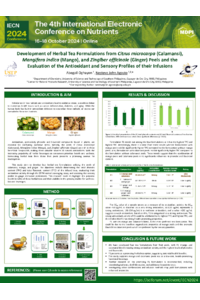
The increasing demand for sustainable, locally sourced ingredients in the food industry necessitates exploring the applications of food by-products. This study investigated the use of local food by-products to produce herbal tea, evaluating their potential health benefits and sensory properties. Four new tea formulations (F1, F2, F3, and F4) were developed using Citrus microcarpa (calamansi), Mangifera indica (mango), and Zingiber officinale (ginger) peels in different ratios. The tea formulations were infused at 100°C for 7 minutes. Their total phenolic content (TPC), total flavonoid content (TFC), antioxidant activity, and sensory profile were investigated. Of the formulations, F1, consisting of a 1:1 ratio of mango and calamansi peels, emerged as the preferred choice among the panelists. It exhibited the highest TPC (77.30 μg GAE/mL) and TFC (83.53 μg QE/mL), along with a strong antioxidant capacity (EC50 98.66 μg/mL), as determined by the DPPH radical scavenging assay. Notably, both F3, which consisted of a 1:1 ratio of ginger and mango peels, and F4, with a 1:1:1 ratio of mango, ginger, and calamansi peels, although less preferred by the panelists compared to F1, also demonstrated strong antioxidant activities (EC50 71.76 μg/mL and 94.08 μg/mL, respectively). These findings highlight the potential of utilizing these fruit peels in herbal tea production, considering their appealing sensory profiles and significant health benefits. Further research on the promising F1 formulation is recommended, including microbiological tests, shelf-life studies, and additional bioactivity tests. Investigating other combinations and infusion methods may yield formulations with enhanced properties.
Keywords
herbal tea
food by-products
antioxidant activity
sensory profile
total flavonoid content
total phenolic content
Poster
sciforum-097443-Agosto.pdf
Rice Bran Oil May Improve Glycemic Control, Alleviate Lipid Peroxidation and Improve Antioxidant Defense in Overweight/Obese Adults with Metabolic Syndrome
The sensory attributes of banana leaf-wrapped smoke meat: a comprehensive sensory test