Event submissions
Published
This submission belongs to the session S3. Diet and Chronic Disease Management of the event The 4th International Electronic Conference on Nutrients
Published date
11 Oct, 2024
Academic Editor
'%3e%3cpath%20d='M12.6657%2010.9104C12.4185%2010.325%2012.0599%209.79327%2011.6097%209.34482C11.1609%208.89508%2010.6293%208.5365%2010.0442%208.28888C10.0389%208.28626%2010.0337%208.28495%2010.0285%208.28233C10.8446%207.69279%2011.3752%206.73249%2011.3752%205.64904C11.3752%203.8542%209.92103%202.39999%208.1262%202.39999C6.33136%202.39999%204.87715%203.8542%204.87715%205.64904C4.87715%206.73249%205.40774%207.69279%206.22393%208.28364C6.21869%208.28626%206.21345%208.28757%206.20821%208.29019C5.62129%208.5378%205.09463%208.89284%204.64265%209.34613C4.1929%209.79493%203.83432%2010.3266%203.58671%2010.9117C3.34345%2011.4845%203.21226%2012.0987%203.20023%2012.7209C3.19988%2012.7349%203.20233%2012.7488%203.20744%2012.7619C3.21255%2012.7749%203.22022%2012.7867%203.22998%2012.7968C3.23975%2012.8068%203.25142%2012.8147%203.26431%2012.8202C3.2772%2012.8256%203.29105%2012.8284%203.30504%2012.8284H4.09109C4.14874%2012.8284%204.19459%2012.7825%204.1959%2012.7262C4.2221%2011.7148%204.62823%2010.7676%205.34617%2010.0497C6.08899%209.30683%207.0755%208.89808%208.1262%208.89808C9.17689%208.89808%2010.1634%209.30683%2010.9062%2010.0497C11.6242%2010.7676%2012.0303%2011.7148%2012.0565%2012.7262C12.0578%2012.7838%2012.1037%2012.8284%2012.1613%2012.8284H12.9474C12.9613%2012.8284%2012.9752%2012.8256%2012.9881%2012.8202C13.001%2012.8147%2013.0126%2012.8068%2013.0224%2012.7968C13.0322%2012.7867%2013.0398%2012.7749%2013.0449%2012.7619C13.0501%2012.7488%2013.0525%2012.7349%2013.0522%2012.7209C13.0391%2012.0947%2012.9094%2011.4855%2012.6657%2010.9104ZM8.1262%207.9024C7.52486%207.9024%206.9589%207.6679%206.53312%207.24211C6.10733%206.81633%205.87283%206.25037%205.87283%205.64904C5.87283%205.0477%206.10733%204.48174%206.53312%204.05596C6.9589%203.63018%207.52486%203.39567%208.1262%203.39567C8.72753%203.39567%209.29349%203.63018%209.71927%204.05596C10.1451%204.48174%2010.3796%205.0477%2010.3796%205.64904C10.3796%206.25037%2010.1451%206.81633%209.71927%207.24211C9.29349%207.6679%208.72753%207.9024%208.1262%207.9024Z'%20fill='%235D1EE1'/%3e%3c/g%3e%3c/svg%3e) Jaime Uribarri
Jaime UribarriCitation
Sonakshi Puri, Sumit Kumar Mandal, Pankaj Kumar Sharma, PR Deepa, Anti-obesity and anti-steatotic effects of Bixin (apocarotenoid from Bixa orellana l. seeds): Dose-dependent correlations with bioactivity, in Proceedings of The 4th International Electronic Conference on Nutrients, 16 October–18 October 2024, MDPI: Basel, Switzerland
Share
Email
Facebook
Twitter
LinkedIn
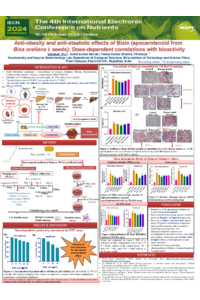
Anti-obesity and anti-steatotic effects of Bixin (apocarotenoid from Bixa orellana l. seeds): Dose-dependent correlations with bioactivity
'%3e%3cpath%20d='M12.6647%2010.9104C12.4176%2010.325%2012.0589%209.7933%2011.6088%209.34485C11.16%208.89511%2010.6283%208.53653%2010.0432%208.28891C10.038%208.28629%2010.0327%208.28498%2010.0275%208.28236C10.8437%207.69282%2011.3743%206.73252%2011.3743%205.64907C11.3743%203.85423%209.92005%202.40002%208.12522%202.40002C6.33038%202.40002%204.87618%203.85423%204.87618%205.64907C4.87618%206.73252%205.40677%207.69282%206.22296%208.28367C6.21772%208.28629%206.21248%208.2876%206.20724%208.29022C5.62031%208.53783%205.09365%208.89287%204.64167%209.34616C4.19192%209.79496%203.83334%2010.3266%203.58573%2010.9117C3.34247%2011.4846%203.21128%2012.0987%203.19925%2012.721C3.1989%2012.735%203.20135%2012.7489%203.20646%2012.7619C3.21157%2012.7749%203.21924%2012.7868%203.22901%2012.7968C3.23877%2012.8068%203.25045%2012.8148%203.26334%2012.8202C3.27623%2012.8256%203.29007%2012.8284%203.30406%2012.8284H4.09012C4.14776%2012.8284%204.19362%2012.7825%204.19493%2012.7262C4.22113%2011.7148%204.62726%2010.7676%205.34519%2010.0497C6.08802%209.30686%207.07452%208.89811%208.12522%208.89811C9.17592%208.89811%2010.1624%209.30686%2010.9052%2010.0497C11.6232%2010.7676%2012.0293%2011.7148%2012.0555%2012.7262C12.0568%2012.7839%2012.1027%2012.8284%2012.1603%2012.8284H12.9464C12.9604%2012.8284%2012.9742%2012.8256%2012.9871%2012.8202C13%2012.8148%2013.0117%2012.8068%2013.0214%2012.7968C13.0312%2012.7868%2013.0389%2012.7749%2013.044%2012.7619C13.0491%2012.7489%2013.0515%2012.735%2013.0512%2012.721C13.0381%2012.0947%2012.9084%2011.4856%2012.6647%2010.9104ZM8.12522%207.90243C7.52388%207.90243%206.95792%207.66793%206.53214%207.24215C6.10636%206.81636%205.87185%206.2504%205.87185%205.64907C5.87185%205.04773%206.10636%204.48177%206.53214%204.05599C6.95792%203.63021%207.52388%203.3957%208.12522%203.3957C8.72655%203.3957%209.29252%203.63021%209.7183%204.05599C10.1441%204.48177%2010.3786%205.04773%2010.3786%205.64907C10.3786%206.2504%2010.1441%206.81636%209.7183%207.24215C9.29252%207.66793%208.72655%207.90243%208.12522%207.90243Z'%20fill='%235D1EE1'/%3e%3c/g%3e%3c/svg%3e)
Sonakshi Puri 1
Sumit Kumar Mandal 1
Pankaj Kumar Sharma 1
PR Deepa 2
1. Biochemistry and Enzyme Biotechnology Lab, Department of Biological Sciences, Birla Institute of Technology and Science Pilani, Pilani Campus, Pilani-333031, Rajasthan, India.
2. Biochemistry and Enzyme Biotechnology Lab, Department of Biological Sciences, Birla Institute of Technology and Science Pilani, Pilani Campus, Pilani-333 031, Rajasthan, India.
Abstract
Introduction: Annatto, a tropical shrub from Central and South America and parts of India, contains bixin, an apocarotenoid pigment. Bixin is conventionally used as a natural food colorant and is now gaining attention for its health-promoting nutraceutical properties, particularly in chronic diseases (Metabolic Syndrome—MetS—and cancers). This study investigates the dose-dependent anti-obesity and anti-steatotic effects of bixin in in vitro cell culture models.
Methods: The anti-adipogenic and anti-steatotic effects of bixin were examined in well-established in vitro models of obesity and non-alcoholic fatty liver disease (NAFLD/steatosis), using 3T3-L1 preadipocytes (according to a differentiation protocol) and HepG2 cells (steatosis-induced with oleic acid), respectively. Bixin was administered in the concentration range of 1ug/ml ─20ug/ml (obesity model) and 2.5ug/ml ─ 10ug/ml (NAFLD/steatosis model). The neutral lipid content was estimated using Oil Red O staining; ROS/RNS were quantified using 2',7'-dichlorofluorescein diacetate (DCFDA), nitrite assays, and malondialdehyde (MDA); and the biochemical marker of lipid peroxidation was assessed using the TBARS assay.
Results: At lower concentrations, 5 µg/ml in steatotic cells and 10 µg/ml in matured adipocytes, bixin significantly reduced lipid accumulation in both hepatocytes and adipocytes (P<0.05), demonstrating its potential as an anti-steatotic and anti-obesity agent. This beneficial effect was correlated with a reduction in oxidative stress levels (decreased MDA and ROS/RNS levels). Strikingly, bixin at higher concentrations (>10ug/ml) showed increased lipid accumulation and oxidative stress.
Conclusions: Bixin exhibits anti-obesity and anti-steatotic effects at lower doses, which correlates with its antioxidant properties. However, its bioactivity is dose-dependent, wherein at higher concentrations, it ceases to inhibit adipogenesis. This opposing response is accompanied by elevated oxidative stress levels, indicating a pro-oxidant effect at higher doses, which implicates its anti-cancer potential. The present study highlights the significance of dosage optimization of nutraceuticals and dietary ingredients with respect to their intended biological applications, such as MetS and cancer treatment.
Keywords
Bixin
Annatto
obesity
NAFLD
oxidative stress
metabolic syndrome
Poster
sciforum-097088-Puri.pdf
FABRICATION OF CARBOCISTEINE-LOADED SOLID LIPID NANOPARTICLES FOR THE TREATMENT OF PULMONARY DISEASE AND IN VITRO EVALUATION
The Efficacy of Millet-Infused Diets in the Regulation of Metabolic Conditions like Diabetes, Obesity, and Hypertension