Event submissions
Published
This submission belongs to the session S6. Nutrition Across the Lifespan of the event The 4th International Electronic Conference on Nutrients
Published date
11 Oct, 2024
Academic Editor
'%3e%3cpath%20d='M12.6657%2010.9104C12.4185%2010.325%2012.0599%209.79327%2011.6097%209.34482C11.1609%208.89508%2010.6293%208.5365%2010.0442%208.28888C10.0389%208.28626%2010.0337%208.28495%2010.0285%208.28233C10.8446%207.69279%2011.3752%206.73249%2011.3752%205.64904C11.3752%203.8542%209.92103%202.39999%208.1262%202.39999C6.33136%202.39999%204.87715%203.8542%204.87715%205.64904C4.87715%206.73249%205.40774%207.69279%206.22393%208.28364C6.21869%208.28626%206.21345%208.28757%206.20821%208.29019C5.62129%208.5378%205.09463%208.89284%204.64265%209.34613C4.1929%209.79493%203.83432%2010.3266%203.58671%2010.9117C3.34345%2011.4845%203.21226%2012.0987%203.20023%2012.7209C3.19988%2012.7349%203.20233%2012.7488%203.20744%2012.7619C3.21255%2012.7749%203.22022%2012.7867%203.22998%2012.7968C3.23975%2012.8068%203.25142%2012.8147%203.26431%2012.8202C3.2772%2012.8256%203.29105%2012.8284%203.30504%2012.8284H4.09109C4.14874%2012.8284%204.19459%2012.7825%204.1959%2012.7262C4.2221%2011.7148%204.62823%2010.7676%205.34617%2010.0497C6.08899%209.30683%207.0755%208.89808%208.1262%208.89808C9.17689%208.89808%2010.1634%209.30683%2010.9062%2010.0497C11.6242%2010.7676%2012.0303%2011.7148%2012.0565%2012.7262C12.0578%2012.7838%2012.1037%2012.8284%2012.1613%2012.8284H12.9474C12.9613%2012.8284%2012.9752%2012.8256%2012.9881%2012.8202C13.001%2012.8147%2013.0126%2012.8068%2013.0224%2012.7968C13.0322%2012.7867%2013.0398%2012.7749%2013.0449%2012.7619C13.0501%2012.7488%2013.0525%2012.7349%2013.0522%2012.7209C13.0391%2012.0947%2012.9094%2011.4855%2012.6657%2010.9104ZM8.1262%207.9024C7.52486%207.9024%206.9589%207.6679%206.53312%207.24211C6.10733%206.81633%205.87283%206.25037%205.87283%205.64904C5.87283%205.0477%206.10733%204.48174%206.53312%204.05596C6.9589%203.63018%207.52486%203.39567%208.1262%203.39567C8.72753%203.39567%209.29349%203.63018%209.71927%204.05596C10.1451%204.48174%2010.3796%205.0477%2010.3796%205.64904C10.3796%206.25037%2010.1451%206.81633%209.71927%207.24211C9.29349%207.6679%208.72753%207.9024%208.1262%207.9024Z'%20fill='%235D1EE1'/%3e%3c/g%3e%3c/svg%3e) Mauro Lombardo
Mauro LombardoCitation
Oluwadamilola Bukola Adekolujo, Kayode Paul Owolabi, Yusuff Gbenga Omole Adebusuyi, NUTRITIONAL ANALYSIS AND SENSORY EVALUATION OF FORMULATED INFANT CEREAL FROM GUINEA CORN, CRAYFISH AND CAROT, in Proceedings of The 4th International Electronic Conference on Nutrients, 16 October–18 October 2024, MDPI: Basel, Switzerland
Share
Email
Facebook
Twitter
LinkedIn
NUTRITIONAL ANALYSIS AND SENSORY EVALUATION OF FORMULATED INFANT CEREAL FROM GUINEA CORN, CRAYFISH AND CAROT
'%3e%3cpath%20d='M12.6647%2010.9104C12.4176%2010.325%2012.0589%209.7933%2011.6088%209.34485C11.16%208.89511%2010.6283%208.53653%2010.0432%208.28891C10.038%208.28629%2010.0327%208.28498%2010.0275%208.28236C10.8437%207.69282%2011.3743%206.73252%2011.3743%205.64907C11.3743%203.85423%209.92005%202.40002%208.12522%202.40002C6.33038%202.40002%204.87618%203.85423%204.87618%205.64907C4.87618%206.73252%205.40677%207.69282%206.22296%208.28367C6.21772%208.28629%206.21248%208.2876%206.20724%208.29022C5.62031%208.53783%205.09365%208.89287%204.64167%209.34616C4.19192%209.79496%203.83334%2010.3266%203.58573%2010.9117C3.34247%2011.4846%203.21128%2012.0987%203.19925%2012.721C3.1989%2012.735%203.20135%2012.7489%203.20646%2012.7619C3.21157%2012.7749%203.21924%2012.7868%203.22901%2012.7968C3.23877%2012.8068%203.25045%2012.8148%203.26334%2012.8202C3.27623%2012.8256%203.29007%2012.8284%203.30406%2012.8284H4.09012C4.14776%2012.8284%204.19362%2012.7825%204.19493%2012.7262C4.22113%2011.7148%204.62726%2010.7676%205.34519%2010.0497C6.08802%209.30686%207.07452%208.89811%208.12522%208.89811C9.17592%208.89811%2010.1624%209.30686%2010.9052%2010.0497C11.6232%2010.7676%2012.0293%2011.7148%2012.0555%2012.7262C12.0568%2012.7839%2012.1027%2012.8284%2012.1603%2012.8284H12.9464C12.9604%2012.8284%2012.9742%2012.8256%2012.9871%2012.8202C13%2012.8148%2013.0117%2012.8068%2013.0214%2012.7968C13.0312%2012.7868%2013.0389%2012.7749%2013.044%2012.7619C13.0491%2012.7489%2013.0515%2012.735%2013.0512%2012.721C13.0381%2012.0947%2012.9084%2011.4856%2012.6647%2010.9104ZM8.12522%207.90243C7.52388%207.90243%206.95792%207.66793%206.53214%207.24215C6.10636%206.81636%205.87185%206.2504%205.87185%205.64907C5.87185%205.04773%206.10636%204.48177%206.53214%204.05599C6.95792%203.63021%207.52388%203.3957%208.12522%203.3957C8.72655%203.3957%209.29252%203.63021%209.7183%204.05599C10.1441%204.48177%2010.3786%205.04773%2010.3786%205.64907C10.3786%206.2504%2010.1441%206.81636%209.7183%207.24215C9.29252%207.66793%208.72655%207.90243%208.12522%207.90243Z'%20fill='%235D1EE1'/%3e%3c/g%3e%3c/svg%3e)
Oluwadamilola Bukola Adekolujo 1
Kayode Paul Owolabi 1
Yusuff Gbenga Omole Adebusuyi 2
1. Department of Human Nutrition and Dietetics, Lead City University Ibadan, Oyo State Nigeria.
2. Department of Human Nutrition and Dietetics, Lead City University Ibadan, Oyo State Nigeria
Abstract
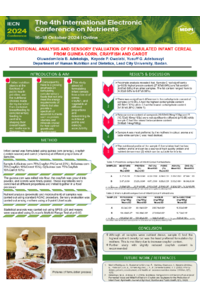
INTRODUCTION: Infant nutrition stands at the forefront of public health priorities, and nutritional choices made during transition from exclusive breastfeeding to complementary feeding are central to shaping infants' overall health and resilience to diseases. Consequently, there is a growing emphasis on formulating complementary foods that not only meet the energy requirements of infants but also provide a spectrum of essential nutrients such as protein, vitamins and minerals crucial for their optimal growth and development.
METHODS: Infant cereal was formulated using guinea corn (energy), crayfish (protein source) and carrot (vitamins) at different proportions, denoted as samples A (Guinea corn 75%, Crayfish 5%, Carrot 20%), B (Guinea corn 75%, Crayfish 10%, Carrot 15%), and C (Guinea corn 75%, Crayfish 15%, Carrot 10%). Sensory evaluation was carried out among mothers using a 9-point Likert scale. Data analysis was carried out using SPSS V26.
RESULTS: Proximate analysis revealed that there was no significant difference in the moisture content of the three samples, ranging from 3.17±0.29% to 3.83±0.29%. Sample C had significantly (p<0.05) higher protein content (27.67±0.04%) and fat content (6.67±0.58%) than the other samples. The fat content ranged from to 4.33±0.58% to 6.67±0.58%. There was a significant difference in the carbohydrate content of the samples (p<0.05). Sample A had the highest carbohydrate content (67.64±1.10%) while C had the lowest carbohydrate content (57.87±0.28%). The ash content of the samples was not significantly different, ranging between 3.03±0.50% and 3.67±0.29%. The beta-carotene contents of samples A (10.55±0.06mg/100g) and B (10.72±0.16mg/100g) were not significantly different (p>0.05) while sample C had the lowest beta-carotene content (9.06±0.14mg/100g). Sample A was most preferred by the mothers in terms of colour, aroma and taste while sample C was the most disliked.
CONCLUSION: The formulated infant cereal was nutrient-dense and highly acceptable by mothers. However, sample C, with a higher percentage of crayfish, was the most disliked by mothers.
Keywords
Nutrition
Infant
Cereal
Complementary Feeding
Poster
NutritionAcrosstheLifespan_18577_NUTRITIONAL_ANALYSIS_AND_SENSO_slides.pdf
Effects of Soy Food and Soy Isoflavone Consumption on Cardiovascular Disease Risk Factors—A Systematic Review and Meta-analysis of Randomized Controlled Trials in Asian Countries
Foods for the sexes: Differential digestibility of milk and plant-based drinks and proteins in healthy men or women