Event submissions
Published
This submission belongs to the session S1. Plant-Based Diets: Health and Well-Being of the event The 4th International Electronic Conference on Nutrients
Published date
11 Oct, 2024
Academic Editor
'%3e%3cpath%20d='M12.6657%2010.9104C12.4185%2010.325%2012.0599%209.79327%2011.6097%209.34482C11.1609%208.89508%2010.6293%208.5365%2010.0442%208.28888C10.0389%208.28626%2010.0337%208.28495%2010.0285%208.28233C10.8446%207.69279%2011.3752%206.73249%2011.3752%205.64904C11.3752%203.8542%209.92103%202.39999%208.1262%202.39999C6.33136%202.39999%204.87715%203.8542%204.87715%205.64904C4.87715%206.73249%205.40774%207.69279%206.22393%208.28364C6.21869%208.28626%206.21345%208.28757%206.20821%208.29019C5.62129%208.5378%205.09463%208.89284%204.64265%209.34613C4.1929%209.79493%203.83432%2010.3266%203.58671%2010.9117C3.34345%2011.4845%203.21226%2012.0987%203.20023%2012.7209C3.19988%2012.7349%203.20233%2012.7488%203.20744%2012.7619C3.21255%2012.7749%203.22022%2012.7867%203.22998%2012.7968C3.23975%2012.8068%203.25142%2012.8147%203.26431%2012.8202C3.2772%2012.8256%203.29105%2012.8284%203.30504%2012.8284H4.09109C4.14874%2012.8284%204.19459%2012.7825%204.1959%2012.7262C4.2221%2011.7148%204.62823%2010.7676%205.34617%2010.0497C6.08899%209.30683%207.0755%208.89808%208.1262%208.89808C9.17689%208.89808%2010.1634%209.30683%2010.9062%2010.0497C11.6242%2010.7676%2012.0303%2011.7148%2012.0565%2012.7262C12.0578%2012.7838%2012.1037%2012.8284%2012.1613%2012.8284H12.9474C12.9613%2012.8284%2012.9752%2012.8256%2012.9881%2012.8202C13.001%2012.8147%2013.0126%2012.8068%2013.0224%2012.7968C13.0322%2012.7867%2013.0398%2012.7749%2013.0449%2012.7619C13.0501%2012.7488%2013.0525%2012.7349%2013.0522%2012.7209C13.0391%2012.0947%2012.9094%2011.4855%2012.6657%2010.9104ZM8.1262%207.9024C7.52486%207.9024%206.9589%207.6679%206.53312%207.24211C6.10733%206.81633%205.87283%206.25037%205.87283%205.64904C5.87283%205.0477%206.10733%204.48174%206.53312%204.05596C6.9589%203.63018%207.52486%203.39567%208.1262%203.39567C8.72753%203.39567%209.29349%203.63018%209.71927%204.05596C10.1451%204.48174%2010.3796%205.0477%2010.3796%205.64904C10.3796%206.25037%2010.1451%206.81633%209.71927%207.24211C9.29349%207.6679%208.72753%207.9024%208.1262%207.9024Z'%20fill='%235D1EE1'/%3e%3c/g%3e%3c/svg%3e) Mauro Lombardo
Mauro LombardoCitation
Bellik Yuva, Phenolic profile and antioxidant capacity of some Algerian olive oil cultivars, in Proceedings of The 4th International Electronic Conference on Nutrients, 16 October–18 October 2024, MDPI: Basel, Switzerland
Share
Email
Facebook
Twitter
LinkedIn
Phenolic profile and antioxidant capacity of some Algerian olive oil cultivars

Bellik Yuva 1
1. University of Bordj Bou Arreridj, Algeria
Abstract
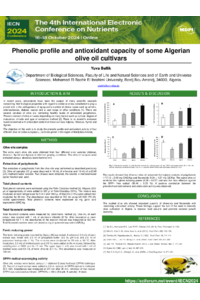
Olive trees have been able to adapt to different pedoclimatic conditions over the centuries. Olive plantations represent a strategic sector and contribute to environmental and biodiversity conservation. Olive and olive oil production is of great socio-economic importance. The aim of the present work is to assess the phenolic profile and the antioxidant potential of different varieties of Algerian olive oils (Aharoun, Agnaw, Adjeraz, Aymel). Their total phenolic content (TPC) and the total flavonoid content (TFC) were determined spectrophotometrically. Antioxidant activity was tested using reducing power and 2,2-diphenyl-1-picrylhydrazyl (DPPH) assays. Aharoun olive oil showed the highest contents of polyphenols (177. 21 ± 2.59 mg GAE/Kg) and flavonoids (9.34 ± 1.27 mg QE/Kg), whereas Aymel showed the lowest contents of polyphenols (40.11 ± 3.89 mg GAE/Kg) and flavonoids (4.38 ± 0.71 mg QE/Kg). The former olive oil (Aharoun) exhibited the highest reducing power (0.38 ± 0.037) and was the most effective against DPPH free radicals (95.46 ± 0.39 %). However, Adjeraz presented the weakest reducing power (0.09 ± 0.004) and free radical scavenging activity (43.60 ± 2.52 %). A positive correlation between the oils' phenolic/flavonoid contents and antioxidant activity was observed. The results showed that the olive oils contain significant quantities of phenolics and flavonoids with interesting antioxidant activity. These findings support the need to intensify olive cultivation in Algeria to improve food security and promote the growth of the national economy.
Keywords
Olive oils
cultivars
polyphenols
flavonoids
antioxidant activity
Poster
sciforum-095754-Bellik-Yuva- 4th-IECN.pdf
Reducing Agricultural Land Use through Plant-Based Diets: A Case Study of Romania
Dynamic Changes in Gut Microbiota-Derived Metabolite Trimethylamine-N-oxide and Risk of Type 2 Diabetes Mellitus: Potential for Dietary Changes in Diabetes Prevention